
Learn how to build a simple 3-Bucket Portfolio in India with clear explanations, real-life examples, limited mistakes, and a disciplined investing framework. 3-bucket portfolio in India, bucket investment strategy India, investment buckets India, portfolio allocation by age India, long-term portfolio planning India, asset allocation strategy India, investment planning for Indian investors.
Introduction: Why Indian Investors Need Structure More Than Smart Products
Indian investors are more informed today than ever before. They track markets daily, compare fund returns, read expert opinions, and actively look for better investment opportunities. Yet, despite this awareness, many portfolios fail to grow steadily over time. The issue is rarely about choosing the “wrong” product. It is about lack of structure.
Money meant for long-term goals is often used to deal with short-term emergencies. Equity investments are redeemed during market corrections to meet sudden expenses. This happens when investors ignore the broader idea of financial planning beyond assets and focus only on returns instead of purpose and time horizon.
This is where the 3-bucket portfolio in India framework becomes extremely relevant. It introduces clarity by organising money based on when it will be needed, not on how markets are performing. By separating today’s needs from tomorrow’s goals, investors can stay disciplined even during volatile periods.
What Is a 3-Bucket Portfolio?
A 3-bucket portfolio is a simple investment framework that divides your money into three clearly defined buckets, each linked to a specific time horizon. Instead of starting with products, the approach starts with intent. It forces investors to answer one crucial question before investing: When will I need this money?
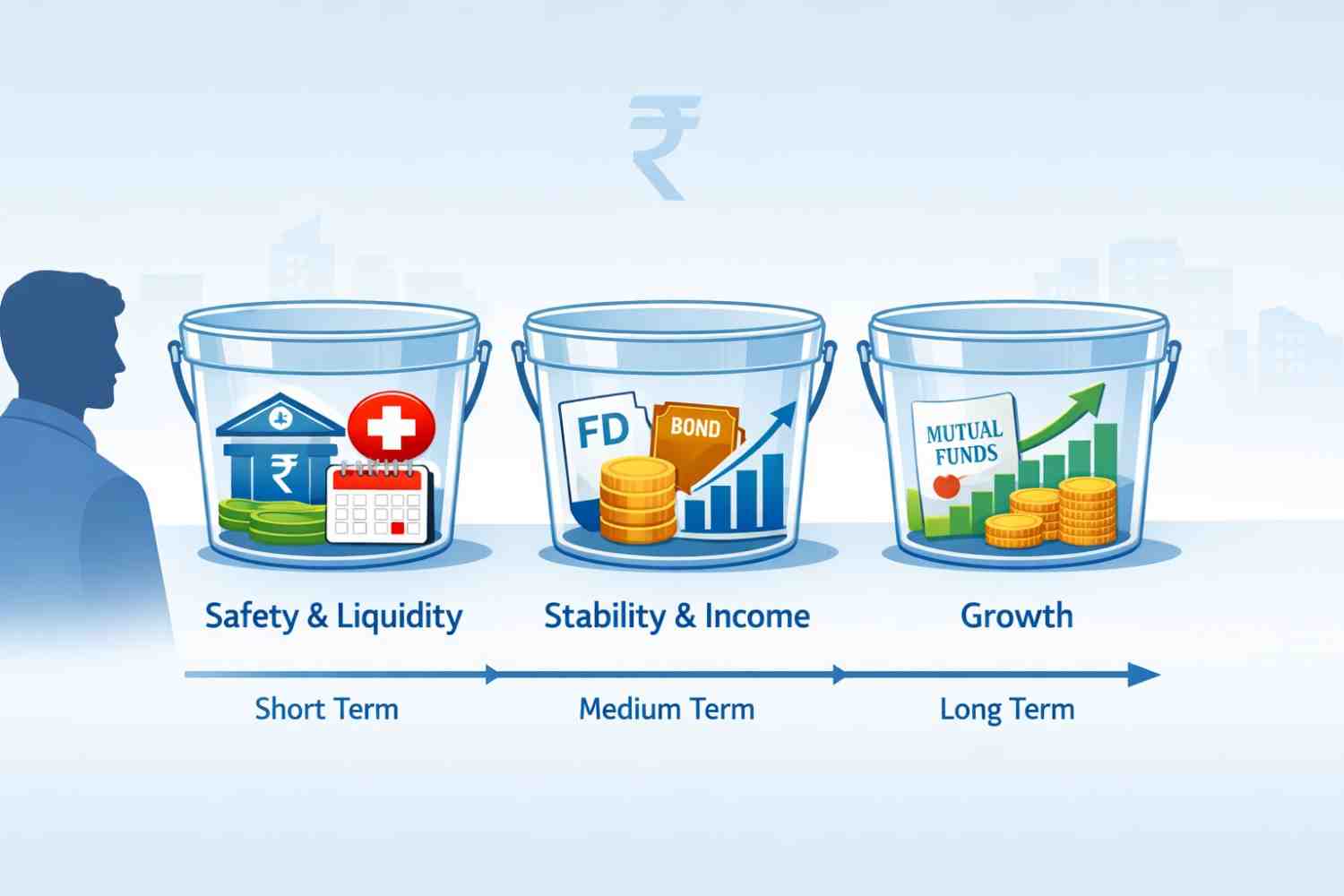
In the 3-bucket portfolio in India approach, each bucket serves a distinct role. One bucket ensures safety and liquidity, the second provides stability for medium-term goals, and the third focuses on long-term growth. This separation makes asset allocation practical rather than theoretical.
By following the 3-bucket portfolio in India structure, investors avoid one of the most common financial mistakes—using long-term investments to solve short-term problems.
Why the 3-Bucket Portfolio Works So Well in the Indian Context
India’s financial landscape is unique. Most households manage multiple goals simultaneously—children’s education, healthcare for parents, housing EMIs, lifestyle costs, and retirement. Income patterns may also be uncertain due to job changes, business cycles, or self-employment.
Research on investor behaviour in India shows that emotional decisions during market volatility hurt long-term returns more than poor product selection.
The success of the 3-bucket portfolio in India lies in its ability to reduce emotional decision-making. When short-term needs are already funded, investors are far less likely to panic during market downturns. This psychological comfort allows long-term investments to remain untouched, which is critical for wealth creation.
Understanding the Three Buckets Clearly
Bucket 1: Safety and Liquidity (0–2 Years)
In the 3-bucket portfolio in India, the first bucket exists purely to provide certainty and peace of mind. It covers regular expenses, emergencies, and any financial requirement that may arise within the next one to two years.
This bucket typically includes savings accounts, sweep-in fixed deposits, and liquid mutual funds. The objective here is not growth but immediate accessibility and capital safety.
Many investors struggle with deciding how much to allocate to this bucket. Factors such as income stability, number of dependents, and fixed obligations play an important role. Understanding the ideal savings account balance helps investors size this bucket correctly.
Since this bucket deals directly with cash and deposits, it is important to remain aligned with RBI’s official FAQs on deposits and banking safeguards, which explain depositor protection and banking rules.
Key takeaway:
- Within the 3-bucket portfolio in India, returns do not matter in this bucket. Liquidity matters.
Bucket 2: Stability and Predictable Income (2–7 Years)
The second bucket is the stabilising force of the 3-bucket portfolio in India. It is designed for goals that are a few years away, where capital protection is important but some growth is still necessary to beat inflation.
This bucket often includes short-duration debt funds, high-quality fixed deposits, RBI bonds, or conservative hybrid options. Many investors use debt-oriented instruments here, as discussed in our guide on how to use debt funds for savings.
The stability bucket plays a crucial role during market downturns. Instead of selling equity investments at unfavourable prices, investors can rely on this bucket for planned expenses.
Key takeaway:
- The stability bucket protects the growth bucket from short-term shocks.
Bucket 3: Long-Term Growth (7+ Years)
The third bucket is the engine of wealth creation. In the 3-bucket portfolio in India, this bucket is meant for goals that are at least seven years away, such as retirement or long-term financial independence.
Equity-oriented investments dominate this bucket because they benefit from compounding and long-term economic growth. Short-term volatility is expected and should not trigger emotional reactions. Understanding the power of compounding helps investors stay patient and committed to this bucket.
From a regulatory perspective, long-term investing aligns with SEBI’s official investor education and awareness guidance, which encourages investors to choose products based on risk capacity, suitability, and time horizon rather than short-term return chasing.
Step-by-Step: How to Build Your 3-Bucket Portfolio in India
Start by calculating your essential monthly expenses, including EMIs, insurance premiums, household costs, and minimum lifestyle spending. This figure determines the size of your safety bucket.
Next, ensure that Bucket 1 is fully funded before allocating aggressively to other buckets. When building a 3-bucket portfolio in India, this order is non-negotiable.
List all your financial goals and assign them to buckets based on when the money will be required. A house down payment in five years belongs in Bucket 2, while retirement naturally fits into Bucket 3.
Automation is critical. Salary-day allocations ensure consistency and prevent lifestyle inflation from eroding long-term goals. Reviews should ideally be annual, or triggered only by major life events such as marriage, job changes, or childbirth.
Real-Life Indian Scenarios
A young salaried professional in their late twenties usually has fewer responsibilities and a longer investment horizon. In such cases, the 3-bucket portfolio in India allows higher exposure to growth assets while maintaining basic liquidity.
Mid-career investors in their forties often balance EMIs, education expenses, and insurance commitments. A stronger stability bucket helps reduce stress during volatile market phases.
Pre-retirees typically prioritise capital protection. While growth exposure is reduced, keeping a measured allocation to long-term assets helps protect purchasing power against inflation.
Across all life stages, the logic of the 3-bucket portfolio in India remains consistent: invest based on time horizon, not market sentiment.
Rebalancing: The Most Ignored but Critical Step
Over time, market movements can distort bucket proportions. A prolonged equity rally may inflate the growth bucket, increasing overall risk. Rebalancing involves shifting excess gains from Bucket 3 into Bucket 2 or replenishing Bucket 1 when required.
Regular rebalancing keeps the 3-bucket portfolio in India aligned with both market conditions and personal life changes. It also enforces disciplined profit booking without emotional decision-making.
Common Mistakes Investors Make
One common mistake is treating fixed deposits as long-term wealth creators while ignoring inflation. Another is overloading the growth bucket without fully funding liquidity needs. Some investors never rebalance, allowing risk to creep up silently over time.
The 3-bucket portfolio in India works only when each bucket is respected for its intended role.
Conclusion
The 3-bucket portfolio in India framework is not about complexity or prediction. It is about clarity and discipline. By separating money based on time horizon, investors gain control, confidence, and consistency. In a country where financial responsibilities are many and volatility is inevitable, this simple structure can make long-term investing far less stressful and far more effective.
FAQs
Q1: Is the 3-bucket portfolio in India suitable for beginners?
Yes. The 3-bucket portfolio India is ideal for beginners because it separates short-term needs from long-term investments, reducing confusion and emotional decision-making during market volatility.
Q2: How often should a 3-bucket portfolio India be reviewed?
A 3-bucket portfolio India should typically be reviewed once a year. Reviews are also necessary after major life events such as a job change, marriage, or a significant increase in expenses.
Q3: Can the 3-bucket portfolio in India be used for retirement planning?
Yes. The 3-bucket portfolio India works very well for retirement planning because it allows regular expenses to be met from safer buckets without disturbing long-term growth investments.
Q4: Does the 3-bucket portfolio limit returns?
No. The 3-bucket portfolio does not limit returns; instead, it improves discipline. By protecting long-term investments from short-term needs, it helps compounding work effectively.
Q5: Is this strategy better than traditional asset allocation?
The 3-bucket portfolio does not replace asset allocation but complements it. It makes asset allocation easier to implement by organising investments according to time horizon and purpose.
Disclaimer
This article is for educational and informational purposes only and does not constitute financial advice. Investment decisions depend on individual goals, risk tolerance, and financial circumstances. Readers should consult a qualified financial advisor before making any investment decisions.