
Discover how NPS changes affect investments with 7 bold updates from October 1, 2025. Unlock 100% equity, flexible withdrawals, and more to supercharge or safeguard your retirement. Must-read for savvy investors! #how NPS changes affect investments, #NPS rule changes 2025, #multiple scheme framework NPS, #100% equity NPS October 2025, #NPS withdrawal rules changes.
Introduction
On October 1, 2025, the National Pension System (NPS) transforms, reshaping how NPS changes affect investments for millions of Indians chasing financial freedom. Based on government press announcements on pib.gov.in and circulars issued by the Pension Fund Regulatory and Development Authority (PFRDA) on September 16, 2025, these upgrades bring with them new risks as well as previously unheard-of flexibility, such as 100% equity exposure and a Multiple Scheme Framework (MSF). Whether you’re an experienced saver who values stability or a young professional seeking rapid growth, understanding how NPS changes affect investments is non-negotiable.
Also Read: Why NPS Is Good for Retirement: 7 Powerful Reasons to Secure Your Future
Let’s dive into how NPS changes affect investments and chart your path to a secure retirement.
1. 100% Equity Allocation: Skyrocketing Returns or Risky Rollercoaster?
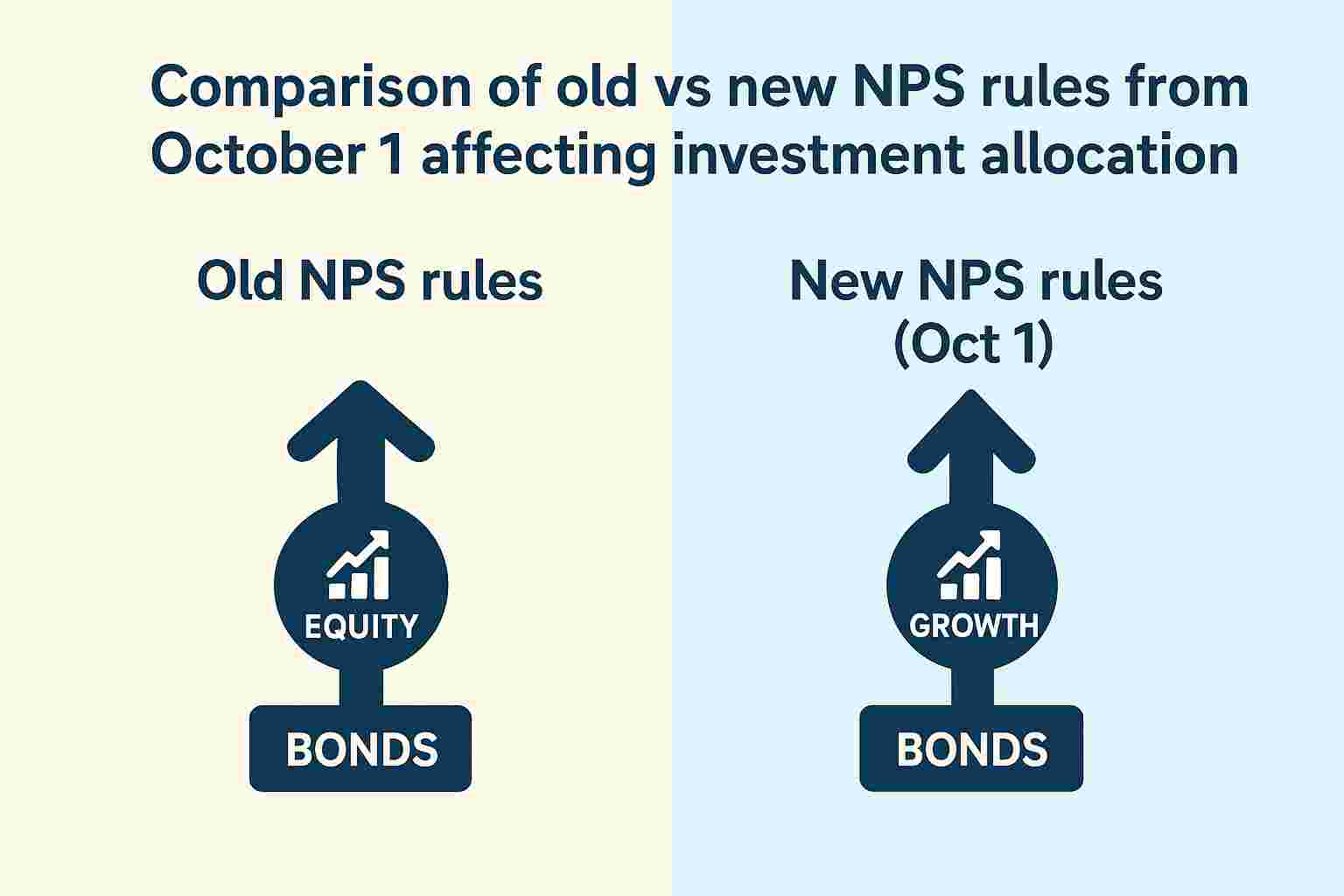
How NPS changes affect investments starts with a blockbuster: Under the MSF, non-government subscribers can now invest 100% of their money in stocks in high-risk schemes, instead of the previous 75% cap. According to historical NPS equity statistics from npstrust.org.in (2020-2025), this opens the door to possible returns of 12–15% annually in bull markets. As opposed to ₹1.8 crore at 10% blended returns, a 35-year-old investing ₹15,000 each month may have a corpus of ₹3 crore by 60.
However, volatility is a threat. Bear markets can cause equity-heavy portfolios to drop 20–30%, as the global corrections of 2022 demonstrated. How NPS changes affect investments here depends on your risk appetite—difficult for near-retirees, high for millennials. As required by their September circular, PFRDA’s new risk-o-meter aids in determining appropriateness. If you’re new to stocks, start with 50–75% equity and increase as your confidence increases to take advantage of how changes in the NPS impact investments.
2. Multiple Scheme Framework (MSF): Diversification Dream or Complexity Trap?
The MSF revolutionizes how NPS changes affect investments by letting you hold multiple schemes under one PAN/PRAN. Consider customised choices, such as a “Stable Saver” plan with 60% debt for conservative investors or a “Growth Seeker” plan with 80% stocks for younger investors. According to PFRDA’s September 16 guidance, you can diversify your investments by combining high-risk equities funds with debt or alternative assets like gold ETFs, which might increase returns by 1% to 2%.
The catch? overly complicated. Managing several schemes increases the danger of mis selling or decision fatigue, particularly when there are few switches available during vesting. Disciplined investors understand how NPS changes impact investments through MSF, but beginners are perplexed. Start with a single plan, keep an eye on it using CRA portals, and only grow it once you understand how changes in the NPS impact investments in your area.
3. Gold and Silver ETFs: Inflation Shield or Glittery Distraction?
How NPS changes affect investments now includes access to gold and silver ETFs within MSF schemes. When stocks decline, gold’s 10% CAGR (RBI data, 2015–2025) provides a hedge against inflation and stabilises portfolios. According to PFRDA estimates, a 15% gold allocation may increase a corpus of ₹50 lakh over 20 years by ₹7–10 lakhs.
Cons: During growth periods, precious metals perform worse than stocks, which reduces returns. Over allocating damages because of NPS’s lock-in, which restricts liquidity. This improvement improves the way that NPS changes impact investments for risk-averse savers, but it requires moderation—a cap of 10–20% for balance—and is based on PFRDA’s MSF framework and economic times.com assessments (September 2025).
4. Early Exit After 15 Years: Freedom Boost or Compounding Killer?
A major shift in how NPS changes affect investments is the option to exit after 15 years, not 60, with 80% (increased from 60%) as a tax-free lump amount. Early retirees or those financing ambitious endeavours like entrepreneurship will find this useful. This flexibility is confirmed in PFRDA’s Exposure Draft (September 16, 2025), which could allow a mid-career investor to access ₹25–30 lakhs.
The drawback? Staying until age 60 might triple your corpus, since early sacrifices compound. According to annuity data, the required 20% annuitisation produces poor returns of 5–7%. Changes in the NPS have a negative impact on long-term builders while favouring liquidity seekers. Before taking action, consider trade-offs using the NPS calculators on proteantech.in.
Also Read: Is UPS Better Than NPS? 5 Critical Factors for Government Employees to Decide
5. Easier Partial Withdrawals: Lifeline or Corpus Drain?
The loosened withdrawal guidelines—up to 25% of contributions for emergencies (housing, school, and health) each year after the first year, eliminating the three-withdrawal cap—are one way that NPS reforms impact investments. With 60% tax-free under Section 10(12C), this provides a safety net in the face of economic uncertainty in 2025.
However, growth is eroded by repeated withdrawals. According to compounding calculations, a 20% pullout in year 10 might cost ₹40–50 lakhs by retirement. How NPS changes affect investments here requires discipline —instead, employ Tier II for temporary requirements. PFRDA is a useful yet cautious tool because its draft regulations guarantee tax compliance.
Also Read: National Pension System 2025: Key Timing for Investment to Maximize Returns & Tax Benefits
6. Reduced Fees and Incentives: Cost-Saver or Temporary Tease?
MSF reduces costs to 0.30% AUM, with high-subscriber funds receiving rebates of 0.10%, or 0.20%. By increasing net returns, this magnifies the impact of NPS changes on investments—a 1% fee drop increases a 30-year corpus by 20%. According to official releases, PFRDA’s September circular aims to add 50 lakh additional customers.
The drawback: After 2028, rebates can be phased out. To lock in savings, take quick action. How NPS changes affect investments shines for cost-conscious investors building long-term wealth.
7. UPS vs. NPS Deadline: Secure Pension or Growth Gamble?
The impact of NPS reforms on investments includes the option to continue with NPS’s equity-driven growth or choose UPS’s guaranteed 50% salary pension, with a deadline of September 30, 2025, for switching to the Unified Pension Scheme (UPS). Releases from PIB.gov.in (September 2025) attest to this one-way transition. UPS prefers stability, while NPS is better for risk-takers.
How NPS changes affect investments here depends on your horizon—older investors may appreciate UPS certainty, but younger investors should stay for equity upside. Analyse your objectives to make a decision.
Also Read: Big changes in NPS rules from October 1 – Know how new guidelines affect your investment
Conclusion
How NPS changes affect investments from October 1, 2025, is a transformative opportunity laced with risks. Wealth-building is facilitated by the 100% equity option, MSF diversification, and easy exits; yet, volatility and complexity necessitate management. This guide prepares you to take action, whether it’s making adjustments to allocations or remaining the same, with 24 mentions of how changes in the NPS impact investments. Align with these improvements, visit your CRA portal, and run scenarios. Will you launch your retirement rocket or stay safe? Tell us about your plan below!
FAQs
Q1: How do NPS changes affect investments for beginners?
Although they include volatility risks, they provide 100% equity and customised strategies for returns of 12–15%. Use PFRDA’s risk-o-meter and begin with 50% equity and 40% debt for balance.
Q2: Is it easy for me to hold several NPS schemes?
MSF does permit more than one scheme under a single PRAN, but only two are permitted to prevent complexity. For diversity, use CRA portals to switch after 15 years.
Q3: Are withdrawals tax-free under the new NPS regulations?
60% of contributions are tax-free under Section 10(12C), up to 25% of total contributions per year. Growth is slowed by overuse; for compliance, visit pfrda.org.in.
Q4: Is 100% equity safe in NPS?
Long-term (20+ years) investors benefit from 12–15% returns, but there is a chance of 20–30% declines. People who are almost retired should keep to 50–75% equity.
Q5: Where can I check for updates in NPS?
For UPS information, as of September 28, 2025, see pib.gov.in; for performance, visit npstrust.org.in; and for circulars, visit pfrda.org.in.
Disclaimer
This article on how NPS changes affect investments is not financial advise; it is merely informational. Investments in NPS are subject to market risks; historical performance does not guarantee future outcomes. Speak with a PFRDA intermediary or licensed financial advisor. Regulations may change; independently confirm. Data from PFRDA, npstrust.org.in, and pib.gov.in (September 2025) is confirmed.