
Discover how to use debt funds for savings with 10 expert strategies. Boost returns, ensure liquidity, and achieve goals safely—perfect for beginners avoiding traditional pitfalls in 2025. #how to use debt funds for savings, #benefits of debt funds for goals, #tips for investing in debt funds, #low risk debt funds for beginners, #debt funds vs fixed deposits, #debt funds for short term goals, #best way to start debt funds.
Introduction: Why Mastering How to Use Debt Funds for Savings Could Be Your Best Financial Move Yet
Imagine this: You’re barely making ends meet, let alone creating the future you want, and your savings account is collecting dust. It’s a common mistake to cling to what is known while letting chances for development pass. Here’s the thrilling surprise, though: There’s a safe approach to improve your saving skills without taking any chances. Debt funds are the preferred option for anyone who is serious about making financial development since they provide the ideal balance of safety and opportunity.
In this comprehensive book, we’ll look at doable strategies for integrating loan finances into your daily routine and transforming them into a dependable growth tool. These mutual funds seek for higher returns than standard bank options while primarily investing in stable debt instruments such as government securities and bonds, which provide as a buffer against market volatility. For short- to medium-term demands, where predictability and liquidity are crucial, they are particularly alluring. Recent trends indicate that regular investors looking for balanced growth are becoming more and more popular, according to reliable regulatory information.
Debt funds can turn routine activities into effective wealth-builders, whether you’re putting money aside for emergencies, organising a family vacation, or enhancing your retirement savings. We’ll outline the fundamentals, highlight the main benefits, and offer ten doable tactics along with advice on where to begin. We’ll discuss possible obstacles along the road to keep you informed and assured. You’ll have a well-defined plan for incorporating them into your life by the time you’re done. Together, let’s go out on this adventure to make your money work harder, as we dive into how to use debt funds for savings effectively.
Also Read: Benefits of Investing in Gilt Funds in India: A Safe Haven for Debt Investors in 2025
What Are Debt Funds? Laying the Groundwork for Effective Savings Tactics
Fundamentally, debt funds are group investment plans that allocate your cash among a variety of fixed-income securities. Consider corporate bonds, treasury bills, and safe government documents—all expertly managed to maximise revenue and stability. Debt funds prioritise flexibility, enabling you to use your savings when life calls for it, in contrast to the strictures of fixed deposits, which tie your money up with penalties for early access.
To get the most out of them, begin by understanding that they serve as a clever compromise between gradual growth and complete safety. They prioritise capital preservation while producing steady income through interest accruals rather than seeking extremely large equity gains. Their liquidity is one of their best qualities; many varieties allow you to take money out fast without incurring significant fees, which is perfect for the unpredictability of the real world. The fact that earnings are normally only taxed at the time of redemption gives your money more time to compound, which adds another element of attraction.
This foundation is vital because it alters your perspective from mere preservation to deliberate progress. Expert studies from mid-2025 underline how these funds fit neatly into broader financial plans, particularly for individuals afraid of market ups and downs. They aren’t completely hands-off, of course; the important thing is to choose the appropriate type according to your schedule. Now that you know the fundamentals, you can see why debt funds frequently outperform traditional savings options. Next, we’ll unpack their standout perks to fuel your enthusiasm for how to use debt funds for savings in everyday contexts.
Also Read: 7 Powerful Reasons Why Invest in Bonds Now in India – Don’t Miss This Golden Opportunity!
The Compelling Advantages: Elevating Your How to Use Debt Funds for Savings Beyond the Basics
Why change gears when your existing configuration “works”? Debt funds provide access to efficiencies that are just not possible with conventional approaches. Let’s examine the features that make them popular with progressive people, particularly when thinking about how to use loan money for savings.
First of all, they provide competitive returns that assist fight the insidious erosion of inflation and maintain your spending power over time. For conservative profiles, this advantage offers peace of mind without the suspenseful swings of equities.
Second, liquidity is crucial. Being able to access assets quickly—often within a day—means you’re never caught off guard in a world full of unforeseen bills. You can stop worrying about the exit fees and lock-in periods that afflict fixed deposits.
Third, there is inherent variety. A more robust savings buffer is produced by distributing investments among different loan instruments, which naturally dilutes risks.
Fourth, long-term growth can be improved by the tax treatment. One small but significant benefit of deferring taxes until redemption is that it permits continuous compounding.
Fifth, they are accessible to all skill levels; novices can start small and increase in size as their confidence grows. Professional management also gives you acce are more than just theoretical. Conversely, failing to consider alignment with your objectives may weaken these victories—a topic we’ll discuss later. Accepting these advantages positions you for long-term success, especially when you apply how to use debt funds for savings principles thoughtfully.
Also Read: Alternative Investment Funds Explained
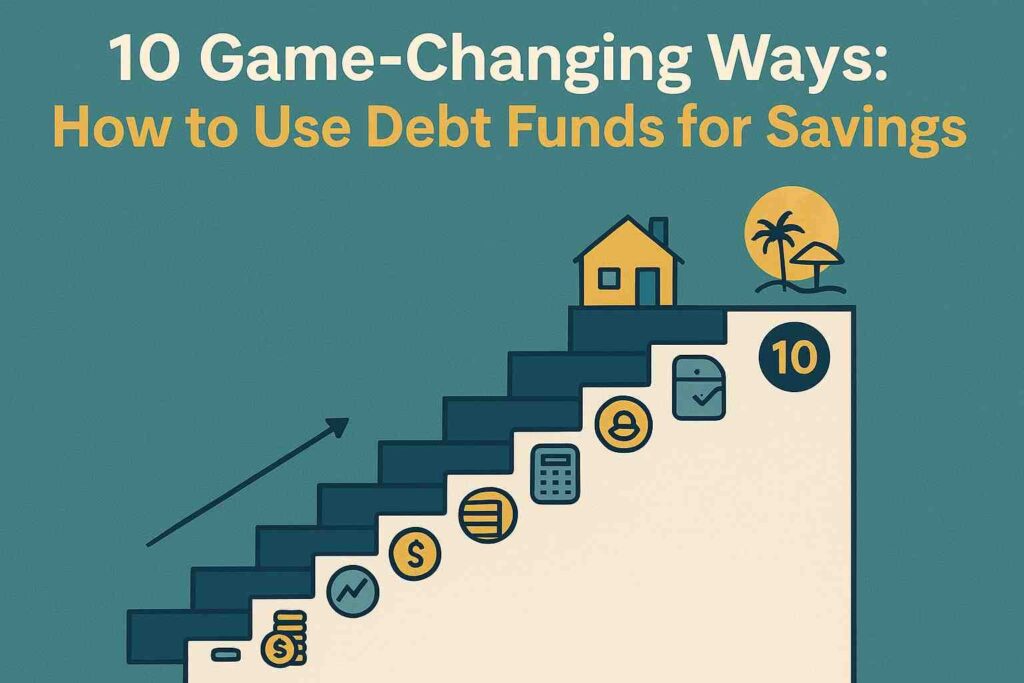
10 Game-Changing Ways to Use Debt Funds for Savings: Your Step-by-Step How to Use Debt Funds for Savings Playbook
The exciting part comes next: applying what has been learnt. Ten flexible debt fund leverage options, each suited to typical situations, are shown below. These utilise established correlations between fund durations and life stages to assist you in navigating with ease as part of how to use debt funds for savings. Build from the things that really resonate with you.
- Fortify Your Emergency Kit with Overnight Funds: Put three to six months’ worth of necessities here because life can be unpredictable. For next-day access and incredibly stable performance, choose funds that specialise in ultra-short securities. To easily manage the buffer and make sure you’re always ready without taking out long-term pots, set up automatic monthly top-ups. This is the first step in how to use debt funds for savings for immediate security.
- Fuel Short-Term Dreams with Liquid Funds: Do you have a weekend getaway or gadget in mind for the upcoming year? When it comes to money market tools, liquid funds excel due to their rapid turnover. Put any windfalls or bonuses here for quick access, and take use of the flexibility that allows you to take advantage of opportunities as they present themselves as your money steadily grows in value. Quick wins are the main focus in how to use debt funds for savings without complications.
- Bridge Medium-Term Milestones Using Short-Duration Funds: Looking to improve your house or your schooling in the next one to three years? These funds strike a compromise between modest maturities and yield potential. Without being overly exposed to changes in interest rates, start making regular withdrawals from your pay account and watch as consistent interest accumulates towards your goal. This strategy is an example of how to use debt funds for savings for balanced progress.
- Accelerate Long-Term Visions via Corporate Bond Funds: Are you planning a big purchase or retirement? The returns on premium corporate bonds are slightly greater. Give these a share of yearly raises, taking advantage of their strong credit to generate compound growth that fits in with longer time horizons. Here, patience yields significant benefits through how to use debt funds for savings.
- Create a Laddered Safety Net Across Durations: Spread your investments across several fund types to avoid placing all your eggs in one basket. To create a staggered maturity ladder that offers continuous liquidity and protects against rate fluctuations, divide allocations, for example, into equal portions in overnight, short, and medium. This kind of layering improves how to use debt funds for savings overall.
- Harness Tax Deferral for Amplified Compounding: Take advantage of postponed taxes to allow profits to accumulate. Reinvest any distributions to extend the amount of time your money works unhindered and avoid early redemptions unless absolutely required. It’s an ingenious strategy in how to use debt funds for savings for tax-savvy individuals.
- Establish Routine Discipline Through SIPs in Debt Funds: Treating savings like a habit will yield results. In order to level out entry points and gradually promote a “pay yourself first” mentality, automate fixed monthly investments into a blended debt portfolio. This simplifies how to use debt funds for savings in daily life.
- Align with Goal-Based Platforms for Precision Tracking: These days, personalisation is easy with apps. Choose funds using easy-to-use systems that link investments to predetermined goals and offer progress reports to maintain motivation. Technology integration transforms how to use debt funds for savings.
- Blend with Equity for Balanced Portfolio Harmony: Pure debt is secure, but it is elevated by a little growth. Together with stocks, use them as the steady core (60–70%), rebalancing occasionally to keep your risk tolerance while aiming for larger total returns. Hybrid methods improve how to use debt funds for savings.
- Incorporate as a Shield in Holistic Financial Planning: For complete coverage, think beyond isolation and pair with insurance. Create layers of protection to defend your overall wealth strategy by building a corpus that also serves as a backstop for premiums or deductibles. This broad perspective connects to how to use debt funds for savings perfectly.
Since each of these methods enables you to tailor your plan to your own rhythm, using borrowed money for saves becomes an easy part of your financial toolbox. With careful experimentation, you’ll quickly observe the transition from static to dynamic wealth accumulation.
Navigating the Shadows: Potential Pitfalls in How to Use Debt Funds for Savings (And Smart Counters)
Every instrument has drawbacks, and debt funds are no different. Despite their promise of stability, interest rate increases have the potential to momentarily strain net asset values, especially in longer-duration investments, resulting in brief declines that try patience. Even though they are rare in carefully examined portfolios, credit crises serve as a reminder that no asset is infallible.
The mismatch trap is another issue: putting long-term money in ultra-short funds may limit your potential gains, while doing the opposite encourages needless volatility. In rare instances, market stress may also cause redemptions to lag, highlighting the importance of having reasonable expectations.
Prioritise horizon matching—short requirements with short funds, always—to avoid stumbling. Diversify assets, prioritise high-rated options (AA and above), and rely on qualified advisors for specialised advice. Recent oversight from regulators like SEBI emphasizes these precautions, with norms promoting openness and low default rates in compliance schemes. By remaining alert, you turn these difficulties into teaching opportunities, enhancing your general strategy to how to use debt funds for savings. Awareness of these issues ensures safer practices in how to use debt funds for savings moving forward.
Inspiring Stories: Everyday Triumphs in How to Use Debt Funds for Savings
It is in the trenches that real change occurs. Consider Sarah, who balances sporadic income as a freelance designer. Due to her unstable financial flow, she started converting freelancing work into liquid money for her six-month emergency fund as part of how to use debt funds for savings. She not only survived a dry stretch without incident within a year, but the modest improvement also helped pay for a much-needed course upgrade, which improved her chances of landing a good job.
Amit, a mid-level manager, is also interested in family trips. Using a laddered debt technique instead of fragmented FDs, he combined durations to fit trip schedules by figuring out how to employ borrowed funds for saves. The result? Seamless funding for two dream getaways, plus extra liquidity that covered surprise school fees— all without stress.
These stories reflect more general trends in investor behaviour, where the adoption of strategic debt funds encourages resilience and happiness in financial planning. Your story is waiting for you; begin writing it now, focussing on how to use debt money for saves.
Also Read: Why debt funds can power your financial goals (and how to use them right)
Conclusion: Empower Yourself—Embrace How to Use Debt Funds for Savings for Lasting Impact
The landscape has been discussed: Debt funds are a flexible ally in your pursuit of financial balance, offering everything from basic information to ten innovative tactics. They avoid the boredom of low-yield traps, encourage expansion with prudent risks, and adjust to your changing requirements. The main lesson? Potential is transformed into progress by action infused with awareness, particularly when directed by the best way to employ borrowed finances for savings.
Keeping up with trends from reliable sources helps you stay ahead of the curve. As of late 2025, regulatory support will confirm their place in balanced portfolios, thus the timing couldn’t be more ideal. Try just one strategy this week—maybe that emergency fund refresh—and see how it spreads. Your empowered savings journey is not only feasible, but also attainable. Go forth, invest thoughtfully, and celebrate the wealth you create through how to use debt funds for savings.
FAQs: Essential Insights on How to Use Debt Funds for Savings
Q1: Why are debt funds a suitable option for novices?
Starting with little investments of ₹500, they are accessible due to their low volatility. To gain confidence, concentrate on liquid varieties; to prevent overwhelm, utilise applications that make tracking simple, aligning with how to use debt funds for savings basics.
Q2. How do fixed deposits and debt funds compare in terms of savings plans?
Even though their prices fluctuate slightly, debt funds provide greater flexibility and the possibility of bigger post-tax growth. If you prefer liquidity to guaranteed rates, they’re perfect, especially for goals beyond six months in how to use debt funds for savings.
Q3: How can I start using debt funds the simplest?
Create an account on a trustworthy platform and begin a systematic investment plan (SIP) in an overnight fund. This creates habits gradually, with no lock-ins to dissuade you from experimenting safely while you learn how to use borrowed funds for saves.
Q4: Is it possible for me to lose money with borrowed funds?
Although rate changes may cause brief declines, quality funds typically preserve capital. To reduce this, limit short-term requirements, and diversify for further security in how to use debt funds for savings.
Q5: How frequently should I check on my debt fund savings plan?
Most people only need to look once a month, with yearly adjustments to account for changes in their lives. This is made easier with tools like fund trackers, which guarantee that your approach remains effective without frequent tweaking via how to use debt funds for savings.
Q6: Are debt funds appropriate for all types of financial objectives?
They work well for stability-focused goals like emergencies or medium-term purchases, but they work best when combined with stocks for rapid growth. Use loan funds for savings in a way that is tailored by length to each goal’s schedule.
Disclaimer
This is not individualised financial advice; rather, it is instructional information. Market risks are associated with debt funds, and historical patterns do not necessarily portend future results. Always check the scheme specifics and speak with an advisor who is registered with SEBI.