
Discover 11 important tax sops for women in India that most taxpayers overlook. Learn how ownership, deductions and planning improve tax efficiency legally. tax sops for women, financial planning for women India, tax benefits for women in India, income tax benefits for women, women home loan tax benefit, stamp duty concession for women, capital gains tax planning India, tax planning for working women.
Introduction
India’s income tax system does not explicitly grant blanket concessions to women purely on the basis of gender. This has led to a widespread belief that women taxpayers receive no meaningful tax advantages at all. In reality, this understanding is incomplete. While the law treats men and women equally on paper, several tax sops operate indirectly through ownership rules, deductions, exemptions, state-level policies, and behavioural patterns, all of which disproportionately benefit women when used correctly.
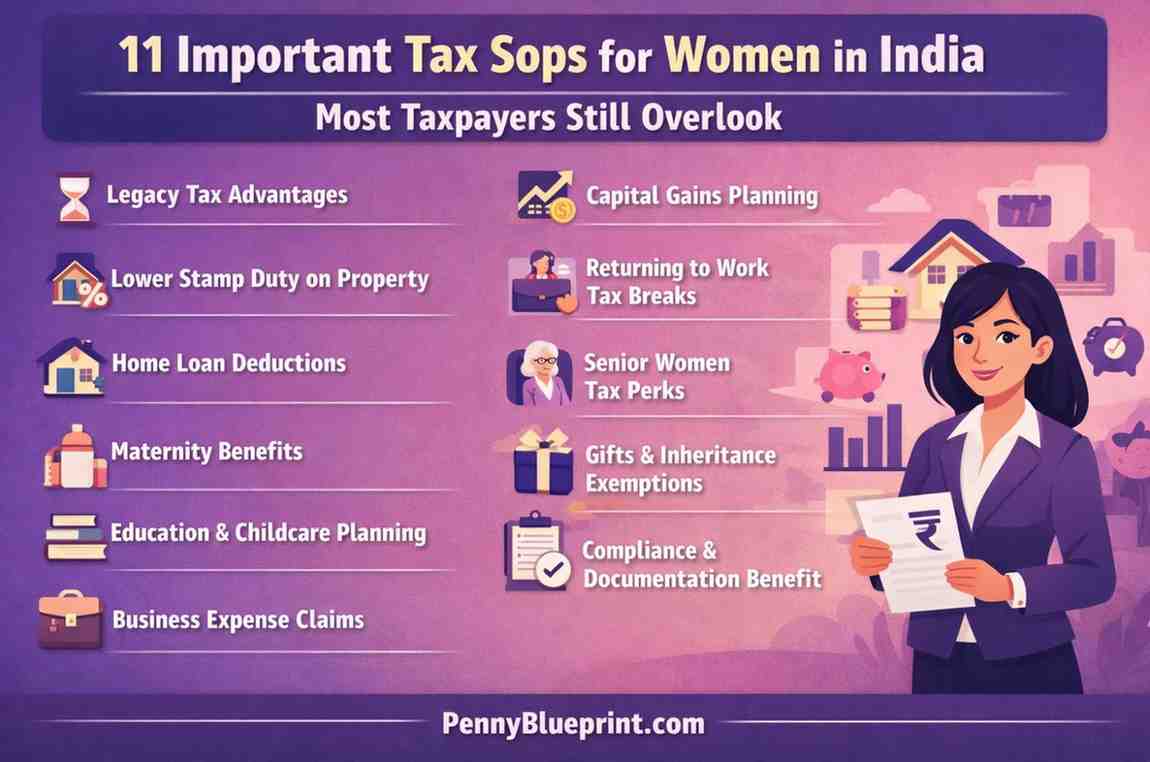
These advantages are rarely explained in one place, and many women either underutilise them or structure finances in a way that neutralises their benefits. This article explains 11 important but often overlooked tax sops for women in India, how they work in practice, what advantages they offer, and the common misconceptions that prevent taxpayers from using them effectively.
Update (Feb 2026): Reviewed to reflect current income tax provisions and slab structure.
1. Legacy tax advantages continue to benefit many women taxpayers
Although the current income tax regime no longer differentiates exemption limits by gender, women who began their financial journeys earlier often structured savings, investments, and assets under older rules where women enjoyed slightly higher basic exemption thresholds. These historical structures still influence present-day taxation, particularly in long-term investments, capital assets, and inherited portfolios.
The advantage here lies in continuity. Investments made years ago continue to generate income, capital gains, or maturity proceeds today, and their tax treatment depends on the original ownership and structure. Women who re-enter the workforce after a break often fall into lower slabs temporarily, allowing them to realise gains at a reduced tax cost. The common misconception is that once rules change, older benefits disappear. In reality, tax outcomes depend on when and how assets were created, not just current law.
2. Lower stamp duty for women homebuyers creates long-term tax efficiency
Several Indian states offer reduced stamp duty when residential property is registered in a woman’s name, either solely or jointly. While stamp duty itself is not an income tax benefit, it directly lowers the acquisition cost of the property, which has important downstream tax implications. A lower purchase cost reduces the capital gains tax burden at the time of sale and improves overall return on investment. In addition, properties owned by women are often used more efficiently in family tax planning, such as distributing rental income or structuring future transfers. Many taxpayers mistakenly view stamp duty concessions as a “one-time saving” and ignore their long-term tax impact. In reality, this sop improves both entry and exit taxation, making it one of the most structurally powerful benefits available to women.
3. Housing loan deductions work more effectively when women are co-owners
When a woman is both a co-owner and co-borrower of a home loan, she can independently claim tax deductions on principal repayment under Section 80C and interest under Section 24(b). This allows families to distribute deductions more efficiently instead of concentrating them under a single taxpayer.
An added advantage is that many banks offer slightly lower interest rates to women borrowers, which reduces interest outgo over the loan tenure and indirectly enhances tax-adjusted returns. The most common misconception is that adding a woman’s name is merely symbolic. In reality, ownership and repayment responsibility must be genuine, but when structured correctly, this sop creates sustained tax efficiency over 15–20 years of loan life.
4. Employer-provided maternity and health benefits reduce taxable income
Employer-provided maternity benefits, when paid in accordance with labour laws and company policy, are not treated as taxable perquisites. This includes paid maternity leave and certain employer-supported medical benefits during pregnancy and childbirth.
This sop is particularly important because it applies during a period when household income may temporarily decline. Properly structured benefits reduce the effective tax burden without requiring additional deductions or exemptions. A common misunderstanding is that all employer payments are taxable salary. In reality, the nature and purpose of the payment determine taxability, and maternity-related benefits enjoy favourable treatment when correctly classified.
5. Education and childcare planning improves deduction utilisation
Deductions for children’s school fees under Section 80C are gender-neutral, but in practice, women often bear or manage these expenses. When deductions are claimed by the actual payer instead of being left unused or duplicated incorrectly, the family’s total tax efficiency improves.
Women who manage household finances are better positioned to align deductions with real cash outflows, ensuring that statutory limits are fully utilised each year. The misconception here is that “any parent can claim, so it doesn’t matter who does.” In reality, misaligned claims lead to wasted deductions, especially in dual-income households where one spouse may already be exhausting their 80C limit.
6. Self-employed women can legitimately reduce taxable income through expenses
Women who work as freelancers, consultants, professionals, or small business owners are entitled to deduct legitimate business expenses from taxable income. These include home office costs, internet and phone bills, professional travel, depreciation on work-related assets, and software subscriptions.
The advantage is not just tax reduction but also improved cash flow stability. However, many women under-claim expenses due to fear of scrutiny or lack of documentation. The misconception that claiming expenses is “aggressive tax planning” leads to overpayment of tax. When records are maintained properly, expense deductions are a lawful and essential component of income computation, not a loophole. For self-employed women, managing business expenses alongside quarterly tax payments becomes easier once you understand how to calculate advance tax in India, especially when income is irregular.
7. Asset ownership in a woman’s name enables better capital gains planning
Assets held in a woman’s name, such as equities, mutual funds, property, or gold, can be used to optimise capital gains taxation across the family. This is especially useful when gains can be realised during years when the woman’s taxable income is lower.
This sop allows staggered redemptions, lower slab utilisation, and better exemption planning. However, the clubbing provisions under the Income Tax Act must be respected. The most common misconception is that simply transferring assets avoids tax. In reality, ownership must be genuine and funded appropriately; otherwise, income may still be taxed in the original owner’s hands.
8. Women returning to work have a unique tax planning window
Career breaks are common among women due to caregiving responsibilities. When women return to work, they often do so at moderate income levels initially, placing them in lower tax slabs. This period offers a unique opportunity for tax-efficient portfolio rebalancing.
Long-term investments can be redeemed, profits booked, and assets restructured with minimal tax impact. Many women miss this window due to lack of guidance, assuming tax planning should wait until income stabilises. In reality, early re-entry years are among the most tax-efficient phases in a woman’s financial life.
9. Senior women enjoy compounded age-based tax advantages
Senior citizens benefit from higher basic exemption limits, simplified compliance, and favourable treatment of certain income streams. For women, these age-based benefits often combine with conservative investment choices to create stable, low-tax income in retirement.
Proper planning ensures that interest income, pension receipts, and capital gains are spread efficiently across years. A misconception is that retirement automatically means low tax. Without planning, accumulated interest and lump-sum withdrawals can still push income into higher slabs. Senior women benefit most when tax planning begins well before retirement, not after. Many senior women prefer predictable instruments such as tax-saving fixed deposits under Section 80C, which help balance stable income with tax efficiency during retirement.
10. Gifts and inheritance received by women are often tax-free
Money or assets received by women from specified relatives, including parents and spouses, are generally exempt from tax. Inheritance is also not taxable in the recipient’s hands. This creates a strong tax shelter for long-term financial security. The advantage lies in capital preservation rather than income generation. However, confusion arises when income generated from gifted assets becomes taxable. The key distinction is between receipt of the asset (often tax-free) and income earned from it (usually taxable). Misunderstanding this difference leads to incorrect reporting or missed planning opportunities.
11. Compliance-oriented financial behaviour itself reduces tax risk
Studies consistently show that women tend to prefer compliant, documented, and conservative financial choices. While this may not appear to be a tax sop, it has real financial consequences. Clean compliance reduces the risk of penalties, interest, litigation, and prolonged disputes with tax authorities.
Over time, this behavioural advantage translates into smoother assessments, lower stress, and better long-term wealth preservation. The misconception is that aggressive tax saving always leads to higher returns. In reality, risk-adjusted outcomes often favour disciplined, compliant taxpayers, especially over multi-decade horizons. Maintaining clean tax and financial records also reduces the risk of operational disruptions such as bank account is frozen in India, which can affect access to funds.
Common Misconceptions Explained Clearly
A major misconception is that women receive special tax rates or automatic exemptions. This is false. The real advantage lies in how existing rules interact with ownership, timing, and life stages. Another misunderstanding is that these sops apply without action. In truth, most benefits require deliberate planning, documentation, and correct claims. Finally, many believe tax planning is only for high-income earners, whereas women across income levels can benefit from structural efficiency.
Conclusion
Tax sops for women in India are not loud, headline-grabbing concessions. They are quiet structural advantages embedded in the tax system, available to those who understand ownership rules, life-stage transitions, and timing. Women who recognise and use these provisions can legally reduce tax outgo, improve compliance, and strengthen long-term financial independence. Ignoring these sops does not simplify taxation — it simply results in paying more tax than necessary. Thoughtful planning, not aggressive tactics, is the real advantage.
FAQs
Q1: Do women get special income tax exemption in India?
No separate exemption exists purely based on gender. However, women benefit indirectly through property ownership rules, deductions, and planning opportunities that arise from income patterns and life stages.
Q2: Are tax sops for women automatic?
No. Most benefits require correct structuring, such as genuine ownership, proper documentation, and timely claims while filing returns.
Q3: Can tax planning for women attract scrutiny from tax authorities?
Legitimate planning within the framework of the law is permitted. Scrutiny generally arises only when arrangements are artificial or lack economic substance.
Q4: Does adding a woman’s name to assets always reduce tax?
Not always. Benefits arise only when ownership and funding are genuine. Otherwise, clubbing provisions may apply and negate the advantage.
Q5: Is tax planning more important for working women or homemakers?
Both. Working women benefit through income and deductions, while homemakers benefit through asset ownership, gifts, and long-term capital planning.
Disclaimer
This article is for informational purposes only and does not constitute tax or financial advice. Tax laws are subject to change, and their application depends on individual circumstances. Readers should consult a qualified tax professional before making financial decisions.