
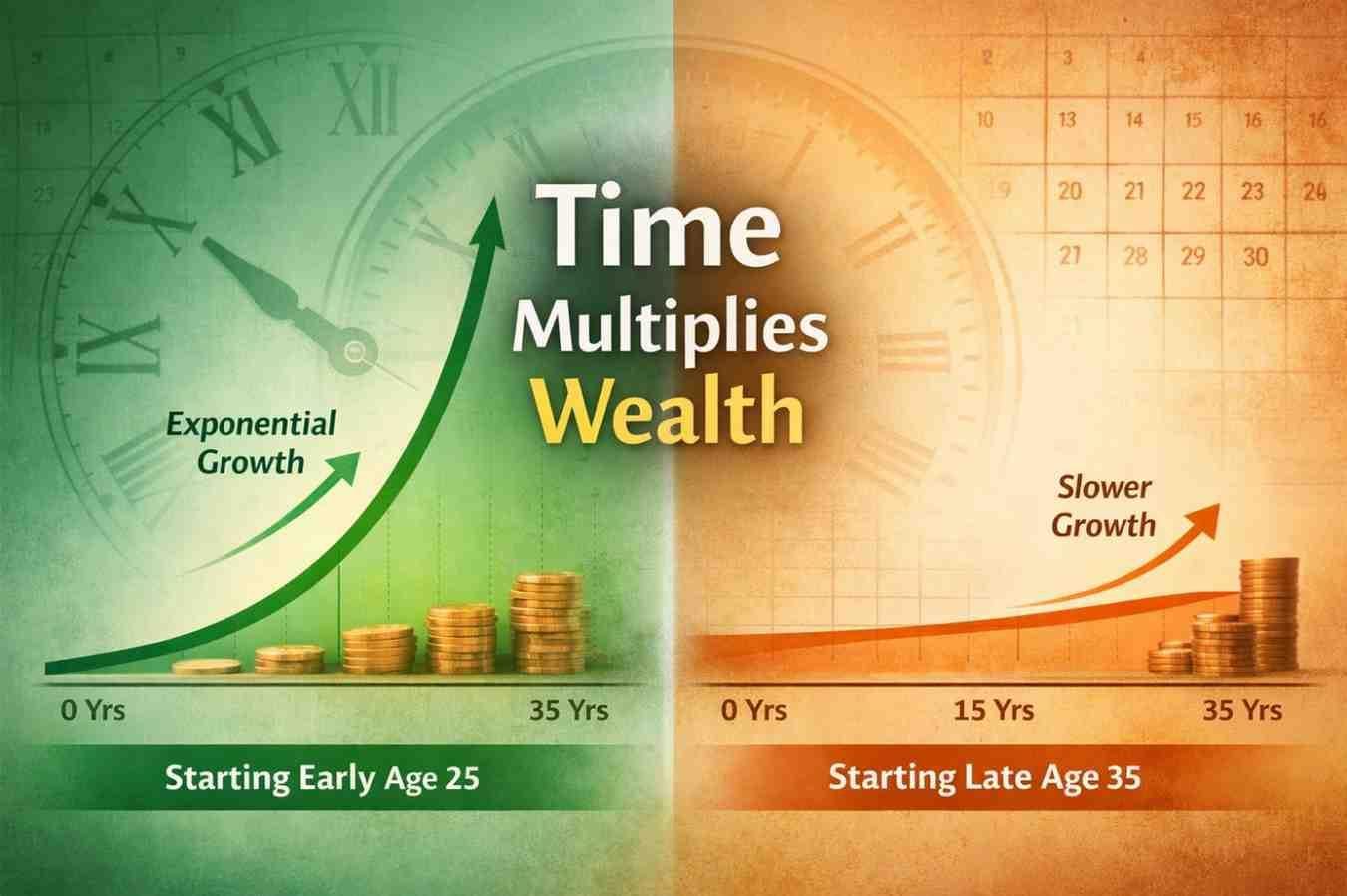
The Power of Compounding explained through 10 shocking truths about time, inflation, investor behaviour, SIP growth, debt risks, and retirement sustainability for long-term wealth creation in India. The Power of Compounding, compound interest investing India, long term investing India, SIP growth over 30 years, inflation adjusted returns India, retirement corpus planning India, exponential wealth creation, power of compounding example, start investing early India.
Update (March 2026): Now that more people are joining SIPs, facing steeper living costs shown in RBI data, and spending more years retired, growing money through compounding matters more than ever. By 2026, smart investing means adjusting for price rises, understanding emotional decision traps, planning steady deposits, plus seeing how long savings can last in later life.
Introduction
The Power of Compounding is often described as the backbone of long-term wealth creation, yet it remains one of the most misunderstood forces in personal finance. Most people know how it works on paper: earnings grow more earnings as years pass. Yet few fully grasp the sheer force of time turning small, steady gains into something far larger through unbroken effort. Excitement gets nowhere here. Short bursts of cleverness? Worth little. What wins is showing up without fail, again and again. With India’s changing money landscape – more folks buying stocks, mutual fund plans spreading fast, lives stretching longer, prices never stopping their climb – the power of compounding stopped being just smart. It now sits at the core, quiet but essential. According to World Bank life expectancy data, India’s average lifespan has steadily increased over the past decades, which directly extends retirement duration and increases long-term financial responsibility.
Retirement might stretch three and a half decades now, simply because people live longer. When gains can’t grow steadily year after year, keeping up with rising costs feels nearly impossible over that kind of time. Early on, the Power of Compounding is not very noticeable, but it grows exponentially over decades. Compounding affects financial results more than most investors realize, which can be explained by the following ten facts.
Truth 1: Compounding Appears Weak Before It Becomes Powerful
Early on, putting money into investments doesn’t seem to do much. Five or six years pass before regular deposits start showing any real change. Much of what builds up at first is just new cash going in, not earnings piling up. Progress can feel slow, particularly next to wild wins people hear about in risky markets. It becomes clearer when you look at how compounding works in numbers. With a tiny starting amount, big percent gains still add only a little in real value. Once the sum grows bigger, identical rates bring much higher actual increases. Over time, yearly earnings outpace fresh deposits, shifting steady progress into rapid expansion. Those who stop early miss the sharp climb that follows. Early mornings often feel empty. Still, those quiet moments build what comes next. When you wait, gains grow bigger because each new gain adds to what was already there. Patience turns small results into larger ones over time.
Truth 2: Time Matters More Than Higher Returns
Chasing big yearly profits keeps plenty of investors busy, arguing about whether 12% or 15% growth each year actually happens. Yet when it comes to building wealth, timing often outweighs percentages. Jumping into investing a full decade sooner means ten extra years for money to grow on its own. That early progress fuels future expansion, layer after layer piling up quietly. Someone beginning much later might pour in far more cash every month, but without those first crucial cycles of growth, the foundation stays weak – hard to fix, even with effort. The Power of Compounding disproportionately rewards early participation. Most people never get back moments they waited too long to begin. Instead of chasing quick wins after delays, better choices come earlier. Missing a few years early means missing growth on top of growth. Markets do not reward urgency that shows up late. A decade spent building quietly beats ten years rushed at the end. Growth feeds on itself when given space. Starting shapes outcomes more than speed ever will.
Truth 3: Inflation Reduces Real Compounding Strength
A number going up on paper might seem like progress. When gains hit 12% each year but prices rise by 6%, actual value only moves about half as far. Stretch that gap across three decades, then watch how small shifts pile into large gaps. RBI inflation statistics consistently highlight ongoing price pressures in the Indian economy.
Costs for housing, food, transportation, healthcare, and education are all continuously rising. Three decades from now, a ₹1 crore corpus won’t afford the same lifestyle. The Power of Compounding must always be evaluated in real terms, not nominal figures. Investors who ignore inflation risk may reach impressive numeric milestones yet struggle to maintain purchasing power in retirement. Creating returns that continuously surpass inflation is necessary for sustainable wealth accumulation. Compounding loses some of its revolutionary impact in the absence of inflation-adjusted planning.
Truth 4: Behaviour Disrupts Compounding More Than Market Volatility
When markets dip, feelings often drive choices that backfire later. Some halt monthly investments just when prices drop, others dump holdings amid swings, while a few jump into hot areas near peaks. Pausing buys means fewer shares collected over time. Momentum falters when timing overrides consistency. Retail investors often underestimate how emotional decision-making affects long-term outcomes, which is why patterns seen in investor behaviour during bull and bear markets repeatedly weaken compounding momentum.
Stuck in motion, growth keeps building only when nothing interrupts it. When feelings drive a move out, money steps off the ride just as speed should rise. Holding on while things feel shaky? That can beat chasing the top choice every time. What holds everything together isn’t clever picks – it’s staying put, again and again.
Truth 5: Withdrawals Create Invisible Opportunity Loss
That ₹5 lakh pulled out at forty? It takes more than just cash – it steals what that money could become. Picture it staying put instead – growing quietly year after year under steady gains. Two decades later, the number on screen might shock you. What feels like a small move now shapes far-off outcomes in ways few notice until much later. Every time you pull money out, your long-term gains start shrinking like ice in warm water. That steady climb? It stumbles. A stash set aside for surprises keeps the core untouched. Growth stays intact when life throws sharp turns. The Power of Compounding thrives on uninterrupted capital. Each interruption weakens the multiplication effect and reduces final outcomes significantly.
Truth 6: Market Corrections Strengthen Long-Term Investors
When markets fall, steady savers might actually gain an edge. Lower prices mean each contribution buys more shares over time. Once values climb again, having extra units lifts overall gains. Sticking to a routine through swings usually beats jumping in and out. Those who stay put tend to come out ahead when things settle. Growth builds quietly when buying happens at lower prices. Missing the right moment often means fewer units owned, slowing down layered gains. Wild price swings don’t hurt compound growth – stopping does. Staying put when markets dip sets up better results years later.
Truth 7: Compounding Determines Retirement Sustainability
The real power of compounding becomes visible when you calculate retirement sustainability, especially in a country where longevity risk is extending post-retirement years beyond three decades. Thirty-five years might pass after work ends. Money saved needs to keep earning, keeping up with rising prices. Missing out on steady growth over time adds pressure later. Small amounts put aside early gain strength through repeated gains. Security comes not from risky bets near the finish line but consistent saving over many years. Living longer means savings face heavier demands. Growth that speeds up over time shifts from luxury to necessity.
Truth 8: Incremental SIP Increases Multiply Long-Term Outcomes
Luckily, sticking to the same SIP amount while earning more slows down money growth. A small yearly bump – just 5 to 10 percent – can reshape what you build over time. Grow your investments when pay checks rise; let earnings fuel savings. Tiny extra amounts grow much bigger when left undisturbed for years, quietly outpacing flat deposits. Thirty years of slowly growing investments often lead to far bigger results compared to steady fixed amounts. Because compounding thrives on consistency, even tiny yearly boosts add up in surprising ways. Time magnifies those small changes into gaps that one big deposit rarely closes. Those who steadily raise their inputs build more value over decades – without chasing danger. Growth comes not from bold moves but repeated effort.
Truth 9: Compounding Applies Equally to Debt
Compounding increases both assets and liabilities, making it neutral. Every month, interest is accrued on credit card balances. Unpaid personal loan sums increase quickly. Over time, tax penalties mount up. Ignoring structural safeguards can cause years’ worth of earned earnings to vanish in an instant, especially when de mat account fraud targets investors who are idle or overconfident.
Just as positive compounding increases wealth, negative compounding increases financial stress. To safeguard long-term growth, high-interest debt management is crucial. The effectiveness of asset compounding decreases in the absence of liability discipline.
Truth 10: Patience Outperforms Brilliance
Some folks think you need genius brains or magic talent to grow money. Truth is, waiting quietly beats flashy smarts more often than not. Sticking with a mix of assets for years tends to win over frantic moves that chase quick wins. Jumping in and out too much breaks the quiet build-up that time allows. Picking apart every detail sometimes causes too many trades and mental drain. The Power of Compounding rewards sustained participation rather than tactical perfection. Those who remain invested across cycles typically outperform those chasing trends. Patience preserves continuity; brilliance without discipline rarely sustains exponential growth.
Why Most Investors Fail to Harness The Power of Compounding
It’s habits that trip people up more than numbers ever do. Start later, lose compound growth – every time. When markets shake, stopping payments chips away at gains. Big dreams lead to early exits before plans play out. Money tends to flow into spending when pay rises, instead of building wealth. As earnings go up, plenty skip boosting their savings. Mistakes like too much debt or falling for scams wipe out gains fast. Gains grow slower without clear goals, guardrails against loss, control over habits, and attention to rising prices. Harnessing The Power of Compounding requires sustained participation, incremental growth, and risk management across decades.
Practical Framework to Maximise Compounding
Start putting money aside now, even if it seems too small. As your pay check grows, raise what you save each year. Spread investments across different types to stay calm when markets jump. When prices drop, keep going instead of stopping. Money set aside for emergencies stays clear of long-term investment plans. High-interest debt grows fast, so steer away from it. Once a year check how your investments are doing – skip the daily panic. Inflation changes value over time, adjust numbers to match. Shield assets by reducing exposure to everyday business troubles. A decision rooted in tomorrow’s needs often ignores today’s market shouts. Through years of steady choices, small gains grow tall – like trees fed by time instead of haste.
Real-Life Examples
Example 1: Early Starter
Starting at 24, Rohit puts ₹7,000 every month into varied stock funds. Each year, as pay goes up, so does his investment – climbing by eight percent. Even when markets dip, which happens more than once, he keeps going without pause. Time works quietly beside him while small amounts add up slowly. When he nears 60, what began modest now stands large – not because of luck, but consistency.
Example 2: Late Realisation
Starting at 38, Anita dives into serious investing once her spending habits settle. She puts in more money each month compared to Rohit. Yet time works slower for her gains because she began later. Growth doesn’t stretch as far without that extra decade up front. Her steady effort helps, still it can’t erase the years missed.
Example 3: Withdrawal Impact
By 42, Kunal has saved ₹30 lakh, yet pulls out ₹8 lakh for personal spending. That pulled amount? It could’ve grown much larger across 18 years. Time slips away before he sees how deeply it cuts into later ease. Comfort in retirement takes a hit – worse than expected.
Example 4: Panic Pause
Meera stops her SIP for 15 months during a market downturn. When markets recover, she resumes investing. However, she misses accumulating units at lower prices, weakening long-term compounding benefits.
Conclusion
The Power of Compounding begins quietly and ends dramatically. Starting strong sets a quiet rhythm that pays off much later. Small increases over time stack up when actions stay steady. Sticking close to plan helps avoid costly turns. Skipping ahead often leads to stumbling back. Waiting too long cuts deep into results. Acting without thinking brings penalties more than progress. Long lives mean money must stretch further now. Prices creeping up reshape what safety looks like. Growth fed slowly becomes powerful only if left undisturbed. Big wins rarely come from single leaps forward. Gains build best through unbroken stretches of consistency. Decades matter more than moments.
FAQs
Q1: Is compounding guaranteed in mutual funds?
No, market fluctuations cause annual fluctuations in mutual fund returns. Compounding does not guarantee annual returns; rather, it represents long-term average growth.
Q2: How long does compounding take to show visible impact?
Usually, momentum builds over the first eight to ten years. After 15 to 20 years of steady investing, the biggest acceleration frequently happens.
Q3: Does compounding work in fixed deposits?
Indeed, but at reduced interest rates. When it comes to long-term compounding, equity investments have typically outperformed fixed-income assets.
Q4: What is the Rule of 72?
The Rule of 72 estimates doubling time. Divide 72 by expected annual return rate to approximate how many years it takes for money to double.
Q5: Is 15% CAGR sustainable for 30 years?
Sustaining very high returns over decades is difficult. Conservative projections between 10–12% for equities are more realistic for long-term planning.
Q6: Can increasing SIP slightly really make a difference?
Indeed. Because of compounding on incremental capital, even modest annual additions greatly improve the final corpus.
Q7: What is the biggest threat to compounding?
The biggest danger to long-term exponential growth is behavioral inconsistency, which includes frequent withdrawals, panic selling, and halting SIPs.
Disclaimer
This article is for educational and informational purposes only and does not constitute financial advice. Investment returns are subject to market risks and economic conditions. Inflation, taxation, and policy changes may affect outcomes. Readers should consult a qualified financial advisor before making financial decisions.