
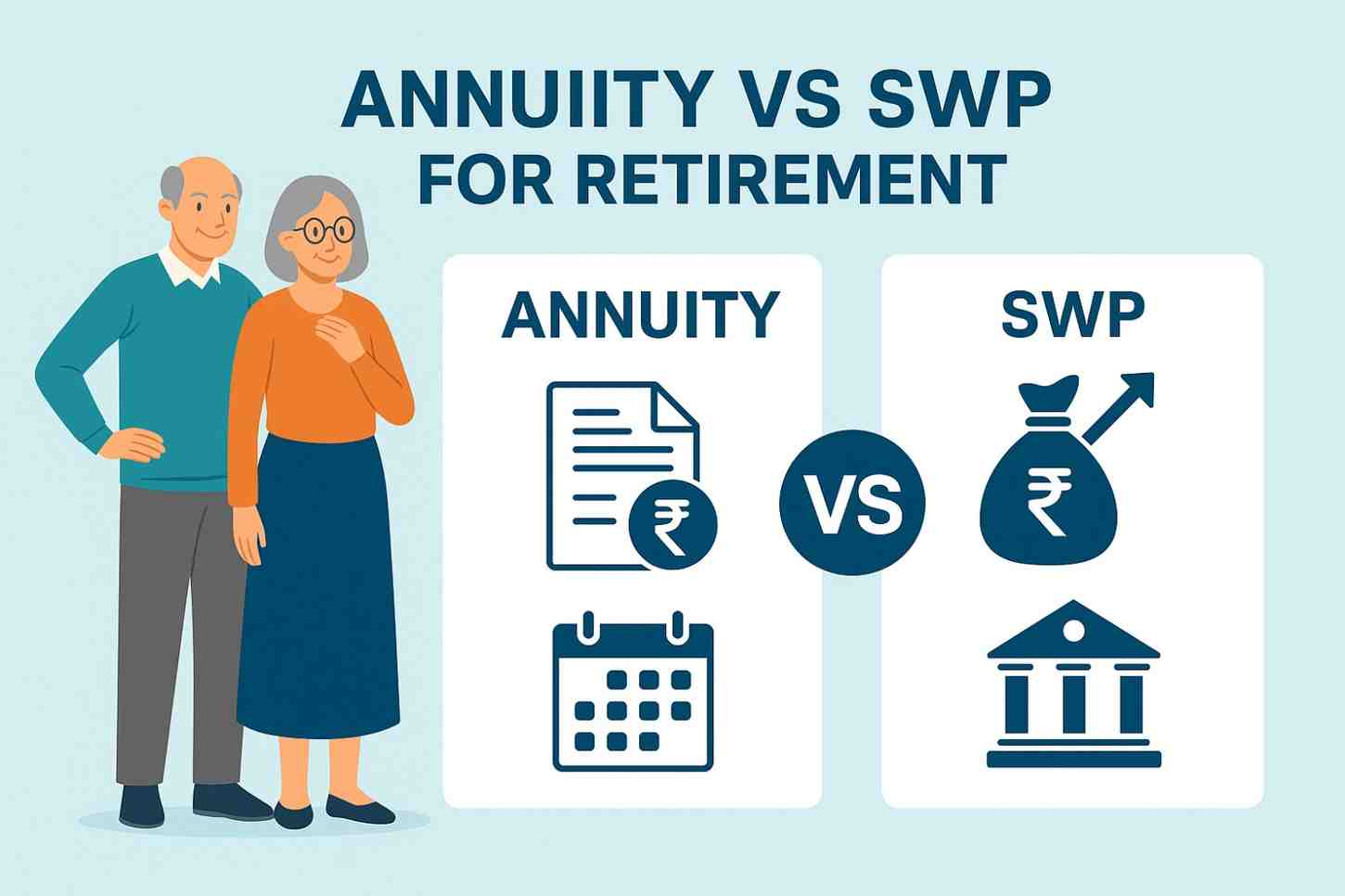
Learn Annuity vs SWP for retirement in India. Compare monthly income, tax, inflation protection, real examples, pros and cons, and hybrid strategy for secure life. #annuity vs SWP for retirement, #best retirement income plan India, #SWP in mutual funds for senior citizens, #annuity pension plan benefits India, #monthly income after retirement in India, #secure retirement planning India, #systematic withdrawal plan pros and cons.
Introduction
Figuring out how to pay for life after work in India isn’t easy anymore. Because healthcare keeps getting pricier, people are living longer, also old-style pensions aren’t common now – so those who’ve stopped working need to plan well so cash doesn’t dry up. The biggest question most people face is Annuity vs SWP for retirement — whether to go with variable market-linked withdrawals or a guaranteed monthly pension. In order to help you ensure a secure and secure retirement, this article thoroughly examines both choices.
Annuity vs SWP for Retirement: How to Choose the Right Income Plan in India
Setting up steady cash flow once you quit your job ranks among life’s key money moves. Most folks in India nearing retirement pick either an insurance pay out scheme or pull funds regularly from mutual investments. The debate around Annuity vs SWP for retirement is growing in focus since old-style pensions fade while lifespans stretch – costs pile up after work ends.
This piece shows how each choice works – along with their differences – and helps you pick what suits your needs. You’ll also find out why mixing both might offer more safety plus freedom for plenty of folks.
Also Read: Powerful Signs: How to Know If My Retirement Savings Are Enough — Stop Worrying or Risk Regret
Why the Annuity vs SWP for Retirement Question Matters
While you’re employed, paychecks keep money coming in steadily. When work ends, this income vanishes – yet costs stick around. Food, power bills, doctor visits, special events, trips, or helping loved ones – all still need funding. Without caution, savings meant to last may shrink quicker than imagined.
That is why the choice between Annuity vs SWP for retirement is not a theoretical topic. How much cash you’ve got at 75, 80, or even 90 hinges on this choice. With an annuity, there’s steady pay each month – yet it might lose value when prices rise. On the flip side, SWP lets you adapt and possibly grow your funds; however, returns rely on how markets move plus sticking to a smart drawdown plan.
In short, it’s a question of what scares you worse – giving up security or watching your money buy less. Knowing the pros and cons of annuity vs SWP for retirement enables you to make a composed, knowledgeable choice rather than reacting out of fear.
What Is an Annuity in the Indian Context?
An annuity’s an insurance deal: pay a big chunk upfront, get steady payouts over time – or forever. In India, these usually follow pension schemes, come after NPS finishes, or show up through life insurance retirement options.
When you choose an annuity in the Annuity vs SWP for retirement decision, you are essentially saying: “In exchange for a guaranteed income that I cannot outlive, I am willing to give up control over my retirement corpus.” As long as the contract stipulates, the insurance company will subsequently be responsible for paying you.
Typical features of annuity plans include:
- A set schedule for payments – like every month, three months, six months, or once a year
- Different choices – such as living solo, sharing coverage, getting money back if you die early, or picking a set time period
- Money you get back changes based on how old you are, what interest rates are doing, or which kind of annuity you pick
If you invest ₹50 lakh in an instant pension plan after retiring, you could get steady monthly payouts forever – using it as your main income source. Instead of lump sums, this setup gives consistent support each month without needing extra management. The essential issue is that once you commit to the annuity option in the Annuity vs SWP retirement decision, you typically cannot take back your capital or drastically alter the payment structure. The precise amount will vary according on the product and age.
What Is SWP and How Does It Work for Retirees?
A Systematic Withdrawal Plan (SWP) lets you take out set amounts regularly from your mutual fund investment. While you pull money out, the rest keeps growing in the fund – could be stocks, mixed assets, or bonds, based on how much risk you’re okay with.
When you choose SWP in the Annuity vs SWP for retirement debate, you are saying: I’d like my cash to stay put, building over time – yet still pull out some each month. You drop a chunk into solid funds, then arrange a steady withdrawal plan that sends cash to your account every 30 days, kind of how retirement pay works.
As time goes by, how much your money earns plus what you take out decides if it lasts, gets bigger or smaller. When earnings beat withdrawals, the pot might still expand, even with steady draws. But when gains stay low year after year – especially at first – the stash can drop quicker.
For many retirees, the appeal of SWP in the Annuity vs SWP for retirement choice is flexibility. In an emergency, you can redeem a higher amount, shift funds if necessary, or pause or alter the SWP. You still own your money, as contrast to an annuity.
Also Read: How to Use SWP for Retirement Planning and Protect Your Savings
Core Differences: Annuity vs SWP for Retirement
Although both seek to generate income after retirement, the fundamental reasoning of Annuity vs SWP for retirement is very different. An annuity means a guarantee from an insurer – SWP works more like pulling money out while investing along the way.
Some main contrasts become obvious when looking at four basic things: who’s on the hook if things go south? what occurs if markets tank? what’s left for loved ones once you’re gone? also, how does rising prices change your cash flow?
At a high level, think of it like this:
- Annuity shifts long-term survival risks to the provider while keeping your savings stuck.
- SWP holds your money close, yet gives you control over timing plus market moves.
- Annuity payouts stay the same, whereas SWP amounts can change.
- Annuity gives steady income; meanwhile, SWP offers more freedom plus room to grow.
When you evaluate Annuity vs SWP for retirement, You are balancing the opportunity to maintain and increase your wealth against the certainty of your income.
A Simple Comparison Snapshot
Here is a quick descriptive summary to support your decision on Annuity vs SWP for retirement:
- Income Pattern: Annuity gives steady payouts each month. On the flip side, SWP pulls cash by selling off bits of your fund investment – how long it lasts hinges on market moves plus how much you take out.
- Control Over Corpus: With an annuity, you lose most say after buying it. But using SWP means staying in charge – swap funds anytime, adjust how much comes out, or pause payouts whenever.
- Inflation Impact: Inflation eats away at fixed annuities – payouts don’t stretch as far when prices go up. Meanwhile, an SWP might grow faster than rising costs, especially if the money’s spread across different types of investments.
- Tax Treatment: Annuity payments get hit with regular income taxes. With SWP from mutual funds, part counts as getting your own money back, another part might be profit – taxes generally cover just the profit bit, depending on current laws.
This high-level comparison demonstrates why there isn’t a universal solution in Annuity vs SWP for retirement decisions.
Illustrative Numerical Examples
Numbers make the Annuity vs SWP for retirement trade-off easier to see. Imagine someone who has ₹1 crore and retires at age 60.
Example 1: Pure Annuity Approach
If someone dumps all ₹1 crore into a lifetime annuity, let’s say they get around 6% yearly. That’d be close to ₹6 lakh each year – so about ₹50,000 every month – paid without stop till they’re alive.
The benefits? Steady cash flow plus no headaches. Still, when prices rise by 6% yearly, that ₹50,000 won’t stretch nearly as far down the line. In two decades, what seems plenty now might barely cover basics.
Here, the Annuity vs SWP for retirement question becomes a trade-off between worrying about money later in life and getting a good night’s sleep now.
Example 2: Pure SWP Approach
Imagine putting that same ₹1 crore into a balanced hybrid fund instead. Think about earning roughly 7.5% yearly over time – though real results can swing up or down. While past performance isn’t guaranteed, this mix usually balances risk better. Still, markets change, so returns might differ each year.
If a retiree picks an SWP of ₹60,000 monthly – so that’s ₹7.2 lakh yearly – the drawdown rate dips just under the projected earnings we used earlier. Supposing market gains stay close to those figures over time, the main fund could hold steady or inch up a bit, despite regular payouts.
Still, if investments do poorly over many years while spending stays high, the savings might begin to drop. In this version of Annuity vs SWP for retirement,tThe retiree must acknowledge that income is not assured in the same manner as an annuity.
Example 3: A Balanced Combination
A common middle path in Annuity vs SWP for retirement planning is to use both products. Imagine a retired person puts ₹50 lakh in an annuity while shifting ₹50 lakh into mutual funds using SWP.
The annuity could give around ₹25,000 to ₹30,000 monthly – enough for food, power bills, or doctor visits. Meanwhile, the SWP may add another ₹25k–₹30k each month, while possibly letting your main fund increase slowly.
In this plan, must-have costs are covered by steady pay outs, whereas extra expenses plus rising prices rely on an adaptable withdrawal approach focused on gains. The retiree is not required to fully decide between either side of Annuity vs SWP for retirement, but can combine them intelligently.
Also Read: 11 Powerful Reasons You Must Learn How to Invest in VPF in India Today (Before It’s Too Late!)
Pros and Cons of Annuity
Because the Annuity vs SWP for retirement choice is so important, clearly summarizing the key advantages and disadvantages of annuities is beneficial.
Pros of Annuity
- Gives steady money either forever or just awhile
- No need for investing know-how or constant checking
- Lowers stress when markets drop or things feel shaky
- Good for handling must-pay bills – say, rent or essential doctor visits – while keeping things steady when money’s tight
Cons of Annuity
- Frozen payments could lag behind rising costs over time
- Limited or no ability to tap into a large payout once bought
- Returns might seem small when stacked up against alternatives after 15 to 20 years
- Not ideal for folks aiming to pass on big money after they’re gone
Looking at an annuity by itself might seem secure – or maybe limiting. What you value most about annuity vs SWP for retirement planning will determine how it is seen.
Pros and Cons of SWP
Likewise, SWP has a unique combination of advantages and disadvantages that are important to consider while assessing Annuity vs SWP for retirement.
Pros of SWP
- Brings steady income even as funds keep growing behind the scenes – without pulling anything out
- Opens more room to outpace rising prices when looking far ahead
- You can adjust how much you take out when your situation shifts
- Holds open the chance to pass money to kids or someone else
Cons of SWP
- Funds might vanish if conditions turn rough – so shaky trends could wreck stability
- Staying on track means keeping your hands off excess gains when times are flush
- Familiarity with mutual funds helps – or seek advice from a pro
- Feelings might get more intense when markets dip
SWP works well when you use it carefully – though mess it up by seeing it as endless cash, things go south. While smart choices help, blowing it on wants kills results. The success of SWP in Annuity vs SWP for retirement rely largely on selecting the appropriate funds and establishing reasonable withdrawal rates.
How to Decide: Which Option Fits You?
There is no universal answer to Annuity vs SWP for retirement. The correct balance relies on who you are, your money status, or what duties you have at home. Though just a full budget layout gives exact answers, general tips might still work.
You might prefer an annuity if you hate risk, don’t care about tracking stocks, or barely have enough savings for essentials. That way, steady payments act like a cushion – helping you get by with peace of mind, no matter what happens in the financial world.
You might prefer SWP if you’ve got a solid chunk of savings, already earn steady money from rent or a pension, yet don’t mind taking on a bit of market risk to protect and boost your funds. In this case, the SWP part of Annuity vs SWP for retirement planning lets your money work harder while still providing monthly cash flow.
For many, particularly in India, the most sensible response to Annuity vs SWP for retirement is to split the corpus. You can utilize SWP to manage lifestyle spending, vacation, gifts, and growing healthcare bills while securing a base monthly income through an annuity.
Also Read: Annuity or SWP in retirement: How to choose the right income plan for a financially secure life
Practical Steps to Implement Your Choice
Once you have understood the logic behind Annuity vs SWP for retirement, the next stage is to put theory into practice. An easy, useful place to start is:
- Start by writing down what you must pay every month – like groceries, power bills, doctor visits, getting around town, helping family when needed.
- Next, write down what’s giving you steady cash right now – like a pension, rent from property, money in locked-in savings, or help from family that actually shows up when needed.
- Next, check how much your basic costs are above what you earn for sure. Then think about covering some – or all – of that difference with an annuity payout instead.
- Next, take what’s left of the money and start an SWP using a low-risk mix of mutual funds – go with something steady, pulling out cash at a pace your advisor finds reasonable.
The above steps convert the abstract question of Annuity vs SWP for retirement into a personalised cash-flow plan that matches your real life. You concentrate on the amount of money you require at various phases of retirement rather than discussing goods separately.
Conclusion
There is no universal winner in Annuity vs SWP for retirement. Both meet separate goals. Annuity gives steady cash flow along with security, whereas SWP allows adaptability plus better returns over time. Many retirees in India do well using them together – annuity covers must-have costs, SWP handles comforts and long-term gains. What works best relies on how much money you’ve saved, how much risk feels okay, and what duties you have at home. Think through your situation step by step, then build a strategy letting you move forward without worry in later years.
FAQs
Q1: Is annuity safe for retirement income?
Indeed. When it comes to retirement planning, annuities are a safe option for people who don’t want market-related volatility because they guarantee lifetime income.
Q2: Can SWP give lifetime income?
Yes, provided you keep your withdrawal rate reasonable and your returns stay within reasonable bounds. However, unlike annuities, income is not certain.
Q3: Which is more tax-efficient?
Unlike annuity income, which is taxed according to slab, SWP frequently benefits from better tax treatment because only gains are subject to taxation. Long-term planning may benefit from this in Annuity vs SWP for retirement.
Q4: Which is preferable, SWP or annuity?
Depending on your needs, both may be appropriate. While SWP offers flexibility and inflation protection, annuities provide security. Risk and comfort can be balanced by combining both.
Q5: With SWP, may I lose money?
Your corpus may decrease if markets perform poorly for an extended period of time or if withdrawals are excessive. Planning ahead is crucial in Annuity vs SWP for retirement.
Q6: Can I change or stop SWP at any time?
Indeed. You have complete control with SWP; if your needs change, you can delay, decrease, or raise withdrawals. This adaptability is a significant benefit.
Q7: Are spouses or heirs supported by both options?
If you don’t select return-of-purchase choices, annuities have fewer legacy benefits. Wealth transfer is facilitated by SWP’s retention of corpus.
Disclaimer
This piece aims to inform and raise basic awareness. Yet, market shifts or new tax laws could impact annuities or SWPs differently. Past returns, rate trends, or inflation guesses aren’t promises – just examples. Always talk to a certified money advisor before choosing where to invest regarding Annuity vs SWP for retirement. It should not be regarded as tax or financial advice.