
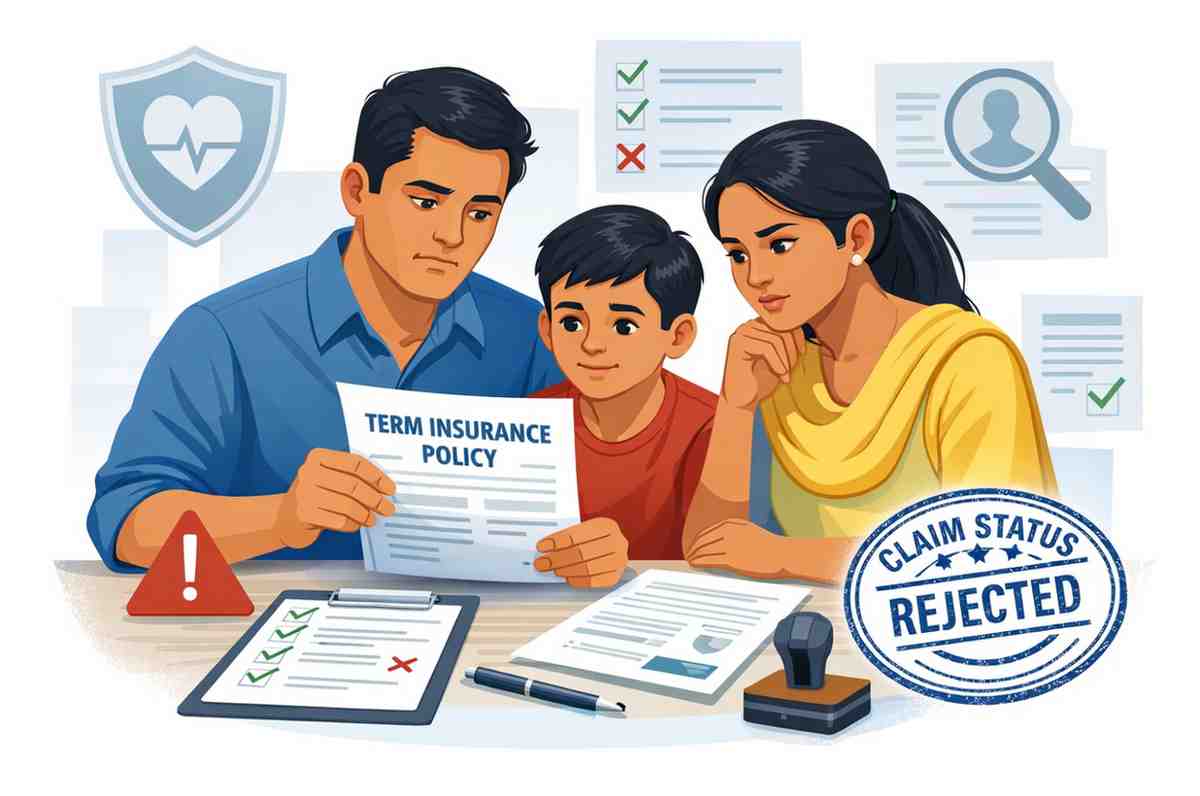
Discover the most common term insurance claim rejection reasons in India and learn how families can avoid costly mistakes during policy purchase and claim filing. term insurance claim rejection reasons, term insurance claim rejection India, life insurance claim rejection reasons, why term insurance claims are rejected, term insurance claim rules India, insurance claim rejection causes, how to avoid term insurance claim rejection, IRDAI term insurance claim guideline.
Introduction — Why Term Insurance Claims Still Get Rejected in India
Term insurance is often described as the simplest and most affordable form of life insurance. For Indian families, it represents a financial safety net meant to protect dependents if the earning member passes away. Yet, every year, thousands of families face an unexpected and devastating outcome — a rejected term insurance claim.
Contrary to popular belief, term insurance claim rejection is rarely random. In most cases, rejection happens because of errors made years earlier at the time of buying the policy or due to mistakes during claim filing. These errors often go unnoticed until the claim stage, when insurers scrutinise every detail under legal and regulatory frameworks.
Understanding why term insurance claim rejection happens — and how to prevent it — is essential for anyone relying on life insurance as a long-term protection tool. This article explains the most common reasons behind claim rejection in India, based on policy structure, regulatory rules, and real-world practices.
What Does Term Insurance Claim Rejection Actually Mean?
A term insurance claim rejection occurs when the insurer legally refuses to pay the sum assured to the nominee after evaluating the claim. This decision is based on policy terms, disclosure accuracy, exclusions, and supporting documents.
It is important to distinguish claim rejection from claim delay. A delay usually occurs when insurers request additional documents or verification. Rejection, on the other hand, means the insurer believes the claim violates policy conditions.
If you want to understand how delays differ from outright rejection, you may also read our detailed guide on life insurance claim delay reasons in India, which focuses on procedural bottlenecks rather than denial.
1. Non-Disclosure of Pre-Existing Medical Conditions
Non-disclosure of medical history remains the single biggest cause of term insurance claim rejection in India.
Many applicants omit conditions such as diabetes, hypertension, thyroid disorders, asthma, past surgeries, or long-term medication. Some believe these issues are “minor” or irrelevant if the cause of death is unrelated.
From an insurer’s perspective, this information is considered a material fact. Medical disclosures directly influence risk assessment and premium calculation. At the claim stage, insurers verify hospital records, doctor consultations, prescription histories, and diagnostic reports.
If non-disclosure is detected, insurers are legally permitted to reject the claim — particularly if death occurs within the early years of the policy.
2. Incorrect Declaration of Smoking or Alcohol Habits
Lifestyle habits play a crucial role in underwriting. Smoking and regular alcohol consumption increase mortality risk, which is why insurers charge higher premiums for such profiles.
Many policyholders declare themselves as non-smokers or non-drinkers to reduce premium costs, assuming occasional habits will not matter. This assumption often backfires.
During claim investigations, insurers review hospital records, post-mortem reports, and physician statements. If lifestyle disclosures contradict medical evidence, the insurer may treat it as misrepresentation, leading to claim rejection or reduced pay out.
3. Death During the Contestability Period
Most term insurance policies in India include a contestability period of two to three years from policy inception. During this period, insurers have the right to investigate disclosures thoroughly if a claim arises.
If death occurs early, insurers reassess the proposal form line by line. Even discrepancies that might be overlooked later can become decisive during this window.
After the contestability period, insurers must prove intentional fraud to reject a claim. However, within this period, even unintentional errors can result in denial.
4. Policy Lapse Due to Missed Premium Payments
A term insurance policy must be active at the time of death for the claim to be valid. If premiums are missed beyond the grace period, the policy lapses, and coverage ceases.
Many families assume automatic bank debits guarantee continuity. In reality, failed mandates, account changes, insufficient balance, or technical errors can silently lapse a policy.
When a policy is inactive, insurers are not legally obligated to honour claims, regardless of past premium payments.
5. Errors or Mismatch in Claim Documents
Documentation errors are a surprisingly common reason for term insurance claim rejection.
Issues often arise due to:
- Spelling mismatches in names
- Incorrect date of birth
- Relationship discrepancies
- Address or identity inconsistencies
Such errors raise red flags during verification. If discrepancies cannot be resolved with supporting proof, insurers may reject the claim or prolong investigation indefinitely.
This risk is higher when nominees are elderly parents or dependents unfamiliar with documentation processes.
6. Death Due to Policy Exclusions
Term insurance policies contain specific exclusions, particularly during the initial policy years. Common exclusions include:
- Suicide within the initial policy period
- Death resulting from illegal activities
- Death under intoxication
Insurers rely on post-mortem reports, police records, and legal findings to determine whether death falls under excluded circumstances.
Understanding exclusions clearly at the time of purchase is critical. Similar fine-print risks exist across insurance products, which is why reviewing exclusions carefully — as explained in our health insurance fine print checklist — is equally important.
7. Fraudulent or Agent-Filled Proposal Forms
In many cases, proposal forms are filled by agents to speed up sales. Applicants may sign forms without verifying entries or fully understanding what has been recorded.
At the claim stage, insurers treat the proposal form as a legally binding declaration. Any incorrect information — even if entered by the agent — becomes the policyholder’s responsibility.
This is one of the most painful reasons for term insurance claim rejection, as families often realise the mistake only after the policyholder’s death.
How to Reduce the Risk of Term Insurance Claim Rejection
Preventing claim rejection is largely about discipline and awareness, not complexity.
Key steps include:
- Full disclosure of medical and lifestyle details
- Personally reviewing the proposal form before submission
- Ensuring premiums are paid on time
- Informing nominees about policy details and documents
- Updating nominee and personal information after major life events
The Insurance Regulatory and Development Authority of India (IRDAI) mandates fair claim settlement practices, but it also places responsibility on policyholders to disclose material facts honestly.
Pros and Cons of Term Insurance (From a Claim Perspective)
Pros
- Clear contractual structure: Term insurance policies have defined conditions, making claim eligibility transparent when disclosures are accurate.
- Strong regulatory oversight: Claims are governed under IRDAI regulations, providing legal safeguards to nominees.
Cons
- Strict disclosure requirements: Even unintentional omissions can result in claim rejection, especially in early policy years.
- High documentation dependency: Nominees may struggle with paperwork during emotional distress, increasing procedural risk.
Conclusion — Transparency Is the Real Insurance
Term insurance works exactly as intended when policyholders treat it as a legal contract rather than a low-cost product. Most term insurance claim rejections in India are avoidable and stem from oversights made years earlier. Honest disclosures, careful documentation, and informed nominees ensure that financial protection reaches families when it is needed the most.
FAQs
Q1: Is term insurance claim rejection common in India?
Rejection rates are relatively low for policies with accurate disclosures. Most rejections occur due to non-disclosure or documentation issues rather than insurer malpractice.
Q2: Can insurers reject claims after many years?
Yes, but only if material fraud or misrepresentation is proven. After the contestability period, insurers must provide strong legal justification.
Q3: What should nominees do if a claim is rejected?
They should request a written explanation, escalate through the insurer’s grievance cell, and approach IRDAI’s grievance redressal system if necessary.
Q4: Does buying term insurance online reduce rejection risk?
Online purchases reduce mis-selling risk since applicants fill details themselves, but honesty and accuracy remain critical.
Disclaimer
This article is for educational and informational purposes only and does not constitute insurance, legal, or financial advice. Policy terms, exclusions, and claim procedures vary across insurers and may change over time. Readers should review official policy documents and consult licensed professionals before making decisions. Penny Blue Print does not guarantee claim outcomes.