
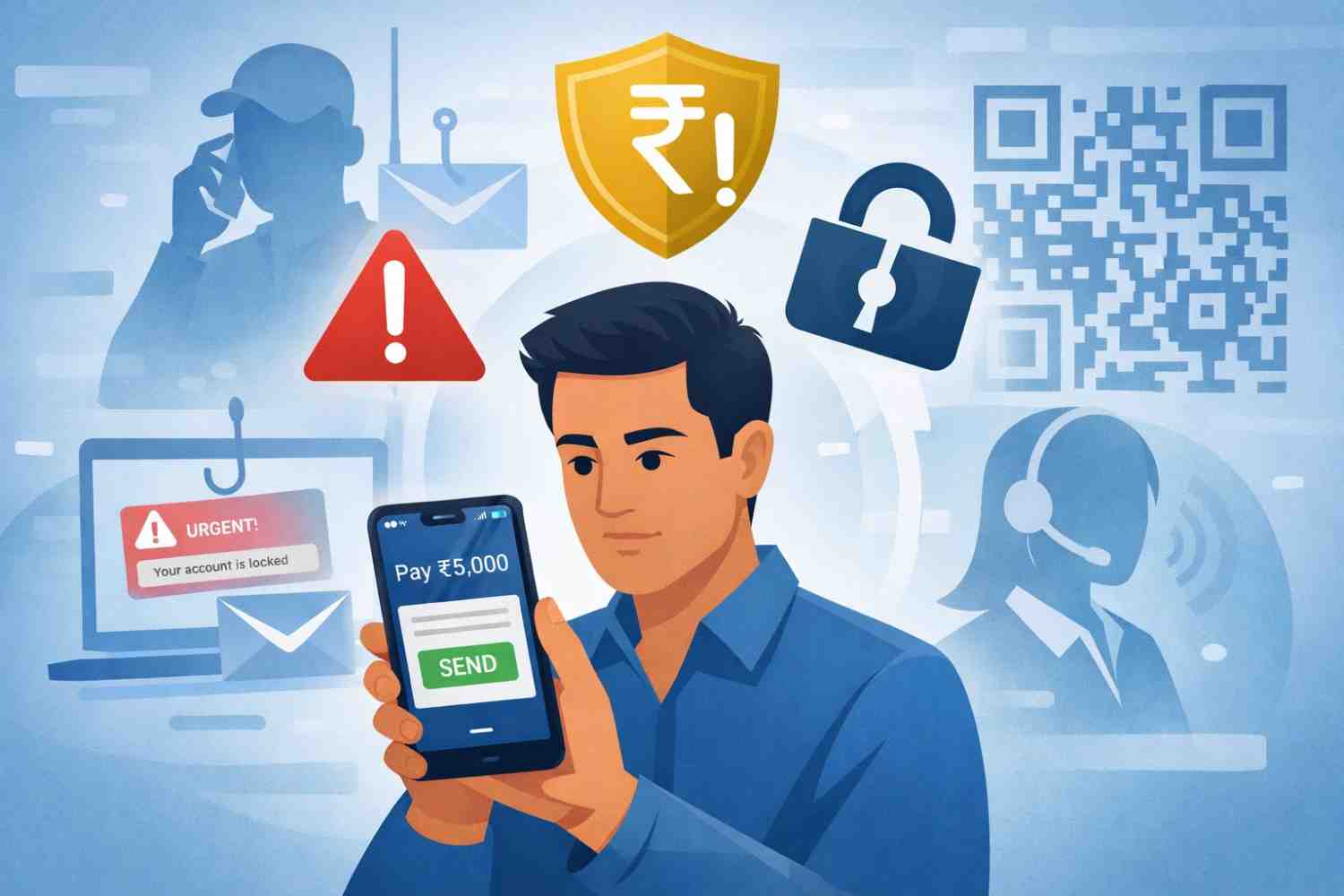
Learn about dangerous digital payment frauds in India, real-life scam examples, warning signs, and practical steps to protect your money online safely. digital payment frauds in India, online fraud reporting India, online payment scams in India, UPI frauds and scams, cyber fraud prevention tips, digital payment safety India.
Introduction
Digital payments have made everyday transactions faster and more convenient in India. From UPI transfers and QR-code payments to mobile wallets and online banking, millions of Indians now rely on digital platforms for daily financial activity. However, this rapid shift has also created fertile ground for fraudsters. Many users assume that OTPs, bank alerts, and secure apps are enough to protect them, but reality shows otherwise.
In recent years, digital payment frauds in India have evolved beyond simple phishing messages. Fraudsters now use psychological manipulation, fake authority, AI-based tools, and technical loopholes to trick even cautious users. What makes these frauds especially dangerous is that victims often realise what has happened only after money is already gone. In many such cases, banks may temporarily restrict accounts to prevent further losses, which often confuses users who are already under stress.
This article explains the most dangerous digital payment frauds Indians are falling for, how they actually work in real life, and what practical steps you can take to protect yourself. The focus is on awareness, not fear—because informed users are always harder to cheat.
Why Digital Payment Frauds Are Increasing in India
The rise in digital fraud is not accidental. Several factors contribute to this growing problem:
- Massive adoption of UPI and mobile payments across all age groups
- Limited cyber awareness among first-time digital users
- Overtrust in SMS alerts, caller identity, and app interfaces
- Delayed reporting due to embarrassment or confusion
- Increasing use of social engineering rather than technical hacking
Fraudsters no longer “hack” systems. Instead, they manipulate people into authorising transactions themselves. This shift makes digital payment frauds harder to detect and prevent at the system level.
Guidelines issued by Reserve Bank of India and cyber agencies clearly state that most digital frauds succeed due to user-level consent, even if that consent is obtained through deception.
1. Fake Refund and Reversal Fraud
Fake refund frauds work because users assume that receiving money requires approval, which is incorrect. In legitimate refund scenarios, money is credited automatically to the original payment source without any user action. Fraudsters exploit this misunderstanding by initiating a “collect request” and labelling it as a refund or reversal.
Once the victim approves the request, the transaction is treated as a voluntary outgoing payment. Since the user authorises it themselves, banks and payment apps often classify it as customer negligence, making recovery difficult. This confusion is similar to situations where users see failed UPI transactions but later discover money was still debited from their account. These frauds are common after failed UPI transactions, cancelled orders, or delivery disputes, where victims are already expecting money.
Real-life example
A homemaker from Nagpur was waiting for a refund from an online fashion platform. She received a WhatsApp call from someone claiming to be customer support and was told the refund could be processed instantly. She was asked to approve a request to “receive” money. Trusting the explanation, she approved it. Instead of getting a refund, ₹14,700 was debited from her account. When she contacted her bank, she was informed that the transaction was authorised from her device.
2. QR Code Scanning Fraud
QR codes are designed only for receiving money, but fraudsters intentionally blur this distinction. Victims are told that scanning a QR code is required to verify identity, accept a payment, or receive a refund. In reality, scanning a QR code opens a payment request from the victim’s own account.
This fraud is particularly dangerous because it feels quick and harmless. Many users scan without carefully reading the on-screen confirmation message, especially when under pressure from a caller or chat message.
Real-life example
A vegetable vendor in Surat listed his phone number online for bulk orders. A fraudster posing as a customer sent a QR code claiming it was needed to pay advance. The vendor scanned it without checking the app message. Within seconds, ₹6,200 was deducted. The fraudster blocked all communication immediately after.
3. Screen-Sharing App Fraud
Screen-sharing frauds rely on psychological authority rather than technical hacking. Fraudsters pretend to be bank officials, KYC agents, or app support staff and convince victims that screen sharing is required for verification or troubleshooting.
Once access is granted, the fraudster can see OTPs, PIN entry screens, and banking actions in real time. Even if the victim does not verbally share OTPs, the fraudster can read them directly from the screen.
Real-life example
A pensioner from Gwalior was told his pension account would be blocked due to incomplete KYC. He was guided to install a screen-sharing app. During the call, the fraudster watched OTPs appear and completed multiple UPI transfers totalling ₹95,000. The victim realised the fraud only after receiving debit alerts.
4. AI Voice Call and Impersonation Fraud
This is one of the most sophisticated digital payment frauds in India today. Fraudsters use AI-generated voice cloning to impersonate trusted individuals such as family members, company executives, or business partners. The call often creates urgency—medical emergencies, confidential deals, or legal threats—leaving no time for verification.
Victims act quickly because the voice sounds genuine and emotionally familiar.
Real-life example
A company accountant in Noida received a call that sounded exactly like his CEO, asking him to urgently transfer ₹3.8 lakh to close a confidential vendor payment. The tone, urgency, and voice matched previous conversations. Only later did he confirm that the CEO never made the call. The funds had already been routed through multiple accounts.
5. Fake Job and Work-from-Home Payment Scams
These scams target financial vulnerability. Fraudsters promise easy income through simple tasks such as liking posts, reviewing products, or data entry. Initial payments are intentionally small to build trust. Once confidence is established, victims are asked to pay registration fees or “unlock” premium tasks.
The scam escalates gradually, making victims believe they are close to earning substantial income.
Real-life example
A final-year student from Ujjain joined a Telegram group offering daily earnings. After earning ₹400 initially, he was asked to pay ₹5,000 to access higher-paying assignments. Once paid, the group disappeared, and all contacts blocked him.
6. SIM Swap Linked Payment Fraud
SIM swap frauds involve identity theft rather than direct payment deception. Fraudsters obtain a duplicate SIM using forged documents or insider assistance. Once activated, the victim’s original SIM stops working, giving fraudsters full access to OTPs and alerts.
This fraud often goes unnoticed until large sums are withdrawn.
Real-life example
A trader in Rajkot lost network connectivity for half a day. Assuming a telecom issue, he ignored it. During this time, fraudsters reset his banking credentials and transferred ₹7.2 lakh. He realised the fraud only after visiting his telecom provider.
7. Fake Customer Care and Helpline Fraud
Fake helpline frauds exploit trust in search results. Fraudsters create lookalike websites and ads displaying fake customer care numbers. When users call, they are asked for OTPs or guided to install apps that compromise security.
Real-life example
A digital wallet user searched for customer support on Google and called the first number shown. The caller asked for OTP verification. Minutes later, multiple unauthorised transactions occurred.
How to Protect Yourself from Digital Payment Frauds
While fraud techniques keep evolving, basic safety practices remain highly effective.
Practical safety tips
- Never approve unknown payment requests
- Do not scan QR codes to receive money
- Avoid installing screen-sharing apps for financial work
- Verify urgent payment requests independently
- Use official apps and verified helpline numbers only
For official safety guidance, users can refer to advisories issued by Indian Computer Emergency Response Team.
WHAT TO DO IF YOU BECOME A VICTIM
- Inform your bank immediately: Contact your bank’s fraud helpline to block further transactions and flag the account as compromised.
- Block UPI, cards, and net banking: Temporarily disabling access prevents additional losses while the investigation begins. Understanding whether your account is under a debit freeze or credit freeze helps you respond correctly without unnecessary panic.
- Register a cybercrime complaint: File a complaint on the national cybercrime portal with transaction details to initiate recovery and legal action.
- Preserve evidence: Save call logs, messages, screenshots, transaction IDs, and app details to support investigation.
- Follow up regularly: Consistent follow-up with banks and cyber authorities increases the chances of fund tracing.
If your bank restricts transactions after suspicious activity, understand why it happens and how to resolve it here.
Conclusion
Digital payments are here to stay, but so are digital frauds. Understanding how digital payment frauds in India actually operate is the first step toward staying safe. Most scams succeed not because systems fail, but because users are manipulated into trusting the wrong signals. In some fraud investigations, banks may also mark a lien on accounts until verification is completed, which users should clearly understand.
By staying alert, verifying requests, and acting quickly when something feels wrong, you can significantly reduce your risk. Awareness, not fear, is the strongest defence in the digital financial world.
FAQs
Q1: Are digital payment frauds in India increasing?
Yes, digital payment frauds in India are increasing due to higher digital adoption and low cyber awareness. Fraudsters now rely more on social engineering than technical hacking, making scams harder to detect.
Q2: Can banks reverse money lost to digital fraud?
Banks may attempt recovery if the fraud is reported immediately, but success depends on how quickly funds are traced. Delays reduce recovery chances significantly.
Q3: Is sharing OTP ever safe?
No, OTPs should never be shared with anyone, including bank or app representatives. Genuine institutions never ask for OTPs over calls or messages.
Q4: Are UPI payments unsafe?
UPI systems are secure, but fraud occurs when users approve fake requests or share sensitive details. Most UPI frauds involve user authorisation obtained through deception.
Q5: Where should digital fraud be reported?
Victims should report fraud to their bank and also file a complaint with Indian Computer Emergency Response Team or the national cybercrime portal for faster action.
Disclaimer
This article is for educational and informational purposes only. It does not constitute legal, financial, or professional advice. Digital fraud methods evolve continuously, and preventive steps may vary depending on individual circumstances, banks, and platforms. Readers are advised to verify information with official sources and consult their bank or authorised agencies before taking any action. The publisher is not responsible for losses arising from reliance on this content.