
Last updated: January 2026
ATM cash withdrawal charges in India explained in detail. Learn free limits, RBI rules, metro vs non-metro charges, failed transactions, and smart ways to avoid extra ATM fees. ATM cash withdrawal charges, ATM withdrawal charges metro vs non-metro, ATM withdrawal charges after free limit, ATM charges per transaction, ATM withdrawal charges India, RBI rules on ATM withdrawal charges, ATM cash withdrawal limit per month, Own bank vs other bank ATM charges ,Failed ATM transaction charges, How to avoid ATM cash withdrawal charges.
Introduction
ATM cash withdrawal charges are one of the most misunderstood banking costs in India. Many people notice small deductions after withdrawing cash and assume banks are charging them unfairly. In reality, ATM cash withdrawal charges are strictly regulated by the Reserve Bank of India (RBI) and apply only when customers cross clearly defined free limits.
With digital payments growing, ATM usage has reduced, but cash withdrawals remain essential—especially for daily expenses, small businesses, and senior citizens. Understanding the rules around ATM withdrawals can help you avoid unnecessary fees, plan withdrawals better, and prevent confusion.
This detailed guide explains ATM cash withdrawal charges in India as applicable in 2026, including RBI rules, free transaction limits, failed transaction protections, and practical tips to save money.
What Are ATM Cash Withdrawal Charges?
ATM cash withdrawal charges are fees that banks may levy only after a customer exhausts the number of free ATM transactions allowed in a month. These charges are not random and cannot be imposed arbitrarily by banks.
Once the free limit is crossed, banks can charge:
- A fixed fee per cash withdrawal
- Applicable GST on the charged amount
These charges apply mainly when using other bank ATMs, though policies for own-bank ATMs may vary based on account type. Understanding this basic structure helps prevent the common fear that banks are charging without reason.
RBI Rules on Free ATM Withdrawals (Updated for 2026)
As per current RBI guidelines, every savings bank account holder is entitled to a fixed number of free ATM transactions per month, which include both financial and non-financial transactions.
Standard RBI-prescribed free limits:
- Other bank ATMs in metro cities: 3 free transactions per month
- Other bank ATMs in non-metro cities: 5 free transactions per month
Transactions at own bank ATMs are generally free, subject to the bank’s internal policy. Once the free limit is exhausted, charges apply per transaction.
To understand how RBI protects customers in banking services and transaction rules, you can refer to RBI’s official customer banking FAQs, which outline customer rights and service standards clearly.
ATM Cash Withdrawal Charges After Free Limit Explained Clearly
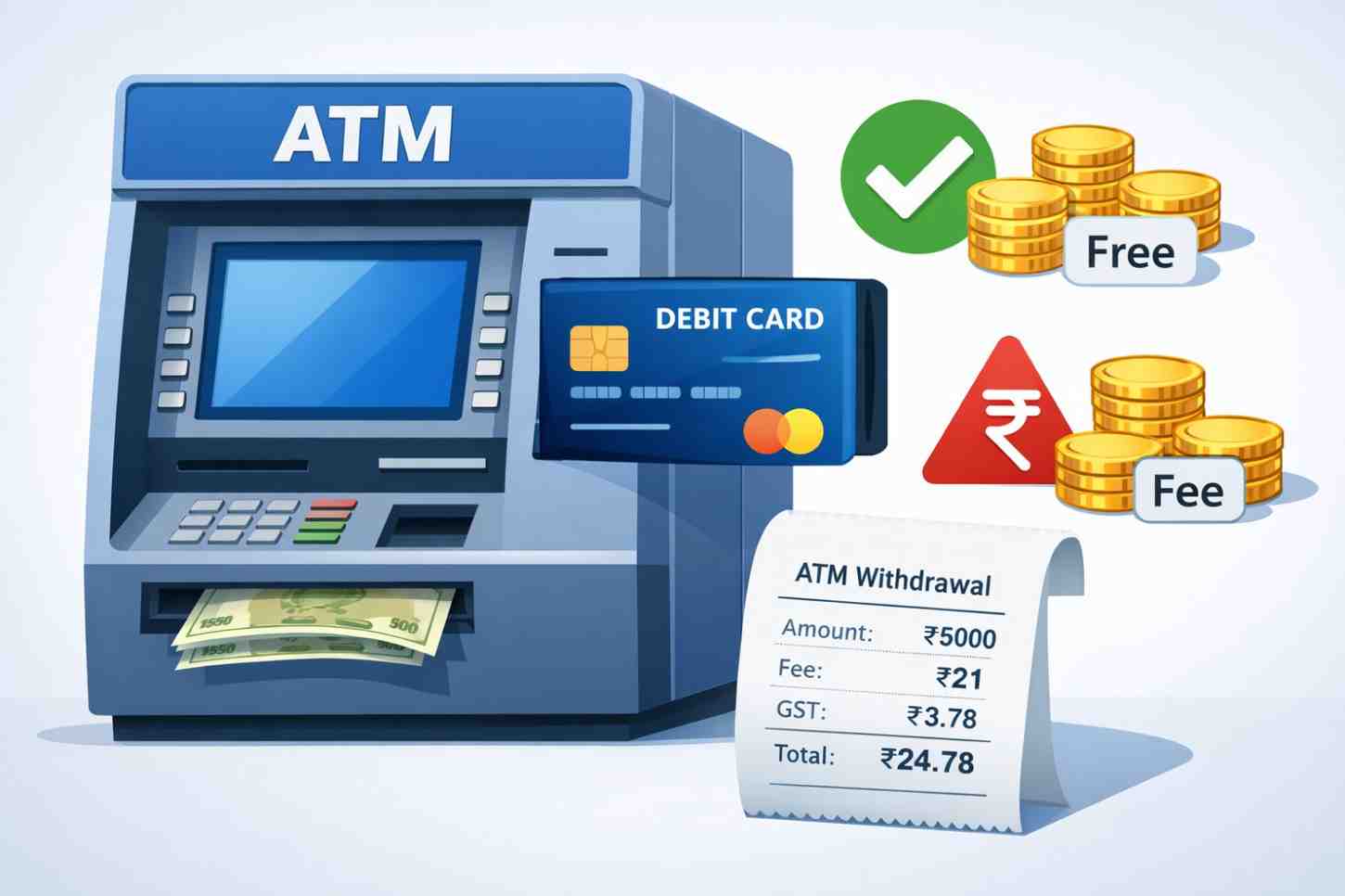
After the free transaction limit is crossed, banks are permitted to charge up to ₹21 per transaction, plus applicable GST. This cap is uniform and applies across banks.
While ₹21 may seem insignificant, repeated withdrawals after crossing the free limit can lead to noticeable monthly deductions. This is especially common when people withdraw small amounts multiple times instead of planning fewer, larger withdrawals.
Being aware of this rule allows customers to control costs simply by adjusting withdrawal habits.
Own Bank vs Other Bank ATM Charges: A Key Difference
ATM charges depend significantly on whether you use:
- Your own bank’s ATM, or
- Another bank’s ATM
Most banks allow more flexibility or higher free usage at their own ATMs. However, when using other bank ATMs, the RBI free-limit rules strictly apply, and charges start once the limit is exhausted.
Many people face confusion when they unknowingly switch between ATMs of different banks. This difference is also closely linked to debit transaction restrictions explained in Debit freeze vs credit freeze in bank accounts, which clarifies how banks control usage without freezing accounts entirely.
Metro vs Non-Metro City Rules You Should Know
RBI classifies ATM withdrawal rules based on city type:
- Metro cities (such as Delhi, Mumbai, Chennai, Kolkata) have fewer free transactions due to high ATM density.
- Non-metro cities allow more free transactions to compensate for limited ATM availability.
Customers who travel frequently often face charges because free limits reset based on the location of ATM usage, not home branch location. This distinction is crucial for people working in metro cities but holding accounts elsewhere.
Failed ATM Transactions: Are Banks Allowed to Charge?
A common concern is whether banks can charge for failed ATM transactions, such as:
- Cash not dispensed but amount debited
- Partial cash dispensed
- ATM out of service errors
As per RBI guidelines, banks cannot charge customers for failed ATM transactions. If money is debited without cash being dispensed, the bank must reverse the amount within the prescribed timeline.
If you frequently face situations where withdrawals fail despite sufficient balance, understanding why ATM cash withdrawal fails even when money is available in your bank account can help identify whether the issue is technical, limit-related, or linked to debit permissions. However, withdrawals can also fail due to account-level holds such as liens, which are explained in detail in Lien Marked on Bank Account, where banks restrict fund usage despite the balance showing correctly.
Smart and Practical Ways to Avoid ATM Cash Withdrawal Charges
Avoiding ATM charges does not require complex steps. Simple habits can make a big difference:
- Withdraw larger amounts fewer times instead of multiple small withdrawals
- Prefer your own bank’s ATM wherever possible
- Track how many free transactions you’ve used in the month
- Avoid unnecessary balance enquiries at other bank ATMs
- Use digital payments for small-value transactions
These steps help reduce both charges and inconvenience.
Real-Life Examples for Better Understanding
Example 1: Repeated Small Withdrawals in a Metro City
A salaried employee withdraws ₹500 several times in a metro city using other bank ATMs. After crossing the free limit, each withdrawal attracts charges, leading to avoidable monthly fees.
Example 2: Failed Transaction Confusion
A customer’s account is debited during an ATM withdrawal, but no cash is received. The amount is reversed within a few working days as per RBI rules, without any charge being levied.
Conclusion: Know the Rules and Keep Your Money Intact
ATM cash withdrawal charges are not hidden penalties but regulated fees designed to manage infrastructure costs fairly. Most customers pay extra simply because they are unaware of free limits or city-based rules.
By understanding ATM cash withdrawal charges in India, tracking usage, and planning withdrawals wisely, you can avoid unnecessary fees and manage cash efficiently in 2026 and beyond.
FAQs
Q1: How many free ATM withdrawals are allowed per month?
Customers get 3 free transactions at other bank ATMs in metro cities and 5 in non-metro cities, as per RBI guidelines. Own bank ATM limits may vary by account type.
Q2: Do ATM balance enquiries count toward free limits?
Yes, balance enquiries at other bank ATMs may count toward free transaction limits, depending on bank policy, and can reduce the number of free cash withdrawals available.
Q3: Can banks change ATM withdrawal charges anytime?
Banks can revise charges only within RBI-prescribed limits and must inform customers in advance. Sudden or undisclosed charges are not permitted.
Q4: Are ATM charges the same for all savings accounts?
No. Salary accounts or premium savings accounts may offer higher free limits compared to basic savings accounts, depending on the bank’s policy.
Q5: What should I do if cash is not received but money is debited?
You should report the issue immediately. Banks are required to reverse the amount within the RBI-defined timeline and cannot levy any charge for such failed transactions.
Q6: Do international ATM withdrawals have different charges?
Yes. International ATM withdrawals usually attract separate charges and currency conversion fees, which are governed by the bank’s foreign transaction policy.
Disclaimer
This article is for informational and educational purposes only and does not constitute financial, legal, or banking advice. ATM charges, limits, and policies may vary by bank and account type and are subject to change as per RBI guidelines. Readers are advised to verify details with their respective bank or official RBI notifications before taking any action.