
Discover 11 proven strategies to redefine the role of savings account with smarter banking habits, automation, liquidity planning, security tips, and modern wealth management ideas. Redefine the Role of Savings Account, modern banking, savings account strategies, smart banking habits, digital banking India, savings account management, emergency fund planning, banking security tips, financial planning India, savings account importance.
Update Note (May 2026): This piece now fits today’s bank setup – fresh for 2026. Shifting how Indians handle money online takes center stage, especially habits shaped by UPI. Inflation’s effect slips into view alongside automated tools. Safety in transactions gets attention, just like handling cash flow more wisely. Saving smarts evolve too. Trends keep moving, pushed by RBI’s tech push and real shifts in what people do with their rupees.
Introduction to Redefine the Role of Savings Account
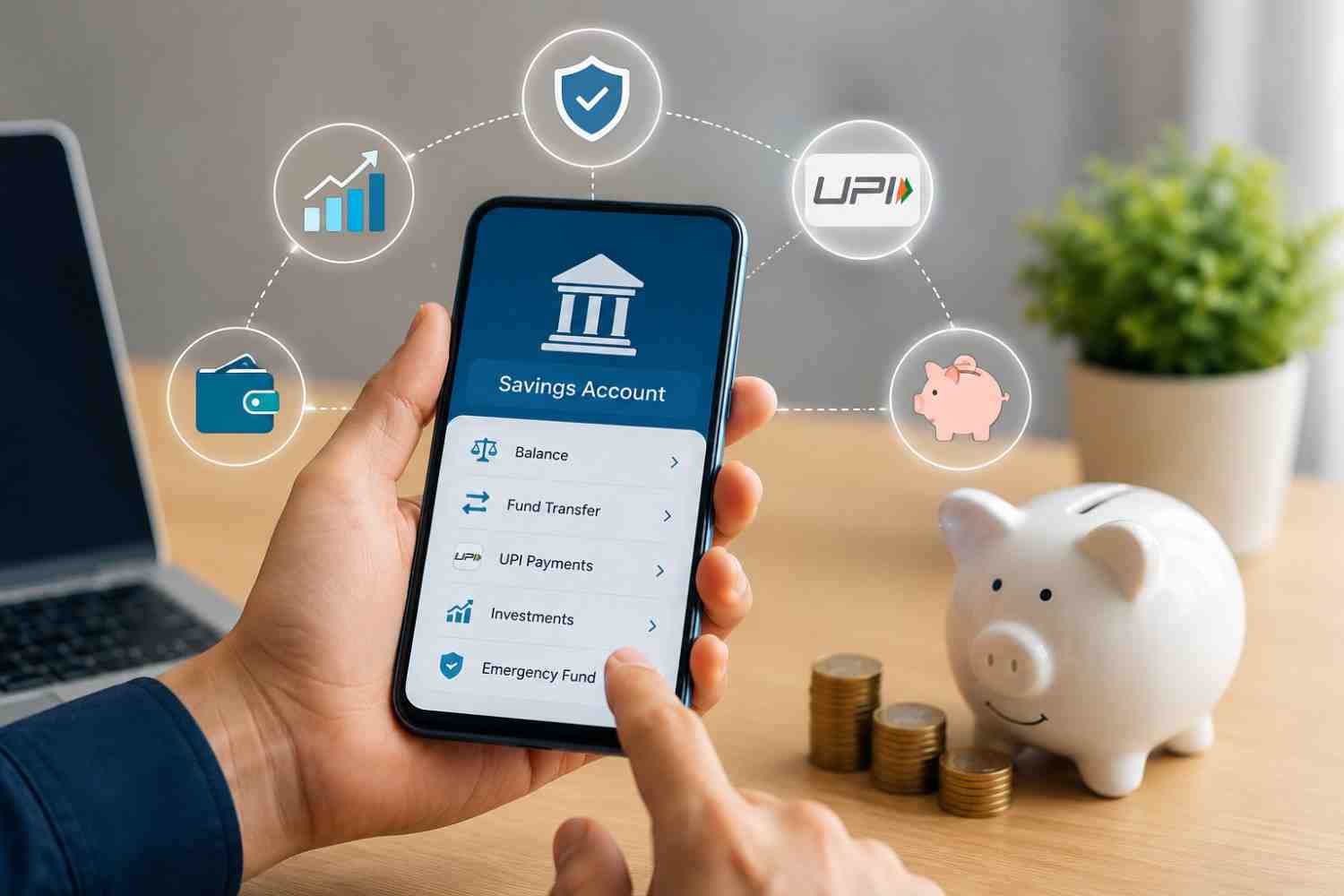
Years went by with everyone thinking a savings account did just one job – holding cash at a bank without risk. Back then, that idea made sense. Now, though, how banks operate isn’t like before. Today’s digital world turned these accounts into hubs where pay checks land, mobile payments go out, money gets set aside automatically, investments start, emergencies are handled, and safety grows quietly behind the scenes. Money moves differently today. Because apps let people bank on phones, send cash fast, trade stocks online, yet also face more scams. Saving isn’t just storing anymore. Think of it like a control hub instead – linking payments, bills, budgets, all through one place.
These days, rising prices chip away at savings while bank fees quietly eat into balances. Money tucked into accounts earning almost nothing now loses ground instead of growing. Hidden costs stack up just when trust in online safety wavers most. Without a clear plan, keeping cash idle brings more risk than ever before. People begin adjusting how they manage funds simply because old routines fail them.
Now here’s a twist – savings accounts aren’t just parking spots for leftover cash anymore. Whether you earn steady pay checks, work project to project, study full time, live on pensions, or run your own shop, how you handle that balance shifts everything. Smarter moves with today’s banking tools bring sharper control over daily access, spending habits, safety nets, even future growth. Those paying attention reshape what money does while it sits still.
According to the Reserve Bank of India, digital banking and electronic transactions continue to grow rapidly across India. Similarly, the National Payments Corporation of India (NPCI) has played a major role in transforming how Indians use banking services through UPI and digital payments.
In 2026 and beyond, this article examines useful tactics that can assist contemporary consumers in using savings accounts more effectively, securely, and wisely.
Why Savings Accounts Matter More Than Ever
Nowadays, nearly all financial transactions rely on banking connectivity, making savings accounts far more crucial. Savings accounts are linked to salaries, investments, insurance premiums, UPI transactions, utility payments, loan EMIs, tax refunds, and emergency needs. This implies that your account is now more than just a place to temporarily keep money. Liquidity has also become more crucial in modern banking. People require rapid access to emergency finances during unpredictable economic times without jeopardizing long-term investments. A well-managed savings account offers financial flexibility in the event of unexpected bills, job loss, or medical problems.
Automation is another important factor that makes savings accounts important in the modern world. Investments, recurrent transfers, bill payments, and savings objectives can now be automated straight from an individual’s account. This greatly enhances financial discipline. The accessibility of digital banking has also raised the possibility of fraud. Because a hacked bank account can disrupt a person’s entire financial ecology, cybersecurity awareness has become crucial.
Maintaining cash-flow visibility is another benefit of savings accounts. Because they don’t routinely check their banking activities, many people lose track of their expenditures. Budgeting and financial literacy are enhanced by prudent account management. Through expenditure categorization, rapid alerts, expense tracking, and digital integrations, contemporary banking apps further enhance the value of savings accounts. Financial administration is now simpler than ever thanks to these features.
People comparing liquidity management options often evaluate cash reserves alongside Ideal Savings Account Balance to avoid both excess idle cash and poor emergency preparedness. To put it short, savings accounts now have a greater impact than ever on wealth management, discipline, convenience, security, and financial stability.
1. Use Your Savings Account as a Financial Control Center
The majority of individuals still use savings accounts in the absence of a formal financial system. Money is received, expenses are paid, and the balance remains uncontrolled. This strategy leads to a lack of financial discipline, poor spending awareness, and confusion. People can turn savings accounts into financial control centers with the help of modern banking. Users can designate specific goals for incoming and departing monies rather than treating the account as a random money pool. It is possible to systematically arrange salary deposits, investment transfers, emergency savings, monthly payments, insurance premiums, and lifestyle expenditures. These days, mobile banking apps offer sophisticated features like category tracking, spending analysis, scheduled reminders, and budgeting insights. These tools assist users in finding wasteful spending and enhancing their monthly money management.
People who struggle with financial discipline often improve their money habits after adopting budgeting systems like 50 30 20 Budget Rule for Beginners because structured banking creates better visibility over expenses and savings. Knowing where every dollar goes helps ease money worries over time. When spending feels clear, choices replace panic each month. At first glance, the change seems tiny – yet slowly, it reshapes how people save. Over months, habits bend toward keeping more.
2. Stop Keeping Excess Idle Cash
Many people think that having a sizable savings account immediately translates into financial security. Although liquidity is crucial, keeping too much cash on hand for extended periods of time can subtly lower purchasing power because inflation increases more quickly than the interest rates on most savings accounts. When living expenses are growing, this becomes even more risky. Every year, money in a low-yield account that is left idle gradually loses real value. People who are unaware of this issue frequently think they are saving appropriately when, in reality, their purchasing power is declining. A more intelligent strategy is to strike a balance between expansion and liquidity. While short-term need and emergency finances should continue to be available, long-term wealth should progressively shift toward profitable assets.
Instead of relying solely on bank accounts, modern investors are increasingly combining diversified financial planning with liquidity management. his mindset becomes especially important when understanding the long-term effects shown in Inflation Impact on 1 Crore. Users should, however, steer clear of the opposite extreme of continuously relying on credit and maintaining extremely low balances. A balanced liquidity structure is necessary for financial stability. Savings accounts are not intended for aggressive long-term wealth growth, but rather for flexibility and short-term stability. For contemporary financial planning, it is essential to comprehend this distinction.
3. Automate Savings Before Spending
Emotional spending is one of the main causes of people’s inconsistent savings. The majority of people put off saving any remaining funds until the end of the month. Unfortunately, hardly much usually survives. This issue is successfully resolved by automation. After salary credit, users of contemporary banking systems can set up automated transfers to emergency funds, recurrent deposits, SIPs, or different savings accounts. This tactic compels savings to occur prior to the start of discretionary spending. Automation gradually fosters sound financial discipline without necessitating ongoing self-control.
Because customers no longer have to manually remember every financial job, automated banking also lessens mental stress. Bills, savings objectives, and investments all proceed methodically in the background. Young professionals and first-time investors often combine automated banking systems with wealth-building strategies like How to Invest Your First Salary Like a Pro to create long-term financial habits early in life.
Consistency in volatile market situations is another advantage of automation. While automatic systems continue to develop financial discipline, people who invest manually frequently stop during uncertain times. Instead of depending solely on incentive, modern banking rewards people who design systems.
4. Build a Dedicated Emergency Banking System
Because it is too simple to abuse, an emergency fund should never be combined with regular spending money. Separating emergency funds through special accounts or banking buckets is made easy by modern banking. Unexpected financial emergencies can occur. Financial strain can be swiftly brought on by medical costs, short-term unemployment, unforeseen travel requirements, family obligations, or necessary repairs. In times of need, those without readily available emergency funds sometimes rely on costly credit cards or loans. Because it establishes a psychological barrier between savings and spending, an emergency banking structure enhances financial stability. When emergency funds are kept apart, people are less inclined to utilize them impulsively.
Due to rising economic uncertainties and erratic revenue cycles, emergency preparedness has become even more crucial. When people actively maintain accessible liquidity rather than relying just on investments, their financial resilience considerably improves. Many users strengthen emergency planning by combining banking discipline with strategies mentioned in Emergency Fund in India to create more stable financial foundations. A well-managed emergency fund reduces financial fear and offers assurance during trying times. The value of that peace of mind alone is enormous.
5. Prioritize Banking Security Like an Investment
The simplicity of digital banking has grown quickly, but so have financial frauds. The rapid rise in digital transaction activity highlighted in the RBI Digital Payments Index also shows why banking security awareness has become essential for modern users. Cybercriminals now use phishing websites, phony customer service calls, OTP scams, harmful apps, UPI frauds, and SIM swap assaults to target customers. Many consumers prioritize investment protection over the security of their savings accounts. Savings accounts are now intricately linked to nearly every financial activity, making it a risky error. Salary access, investments, insurance payments, loan EMIs, and emergency cash can all be interfered with concurrently by a compromised bank account. Because of this, every banking user needs to be aware of cybersecurity.
Enabling transaction notifications, avoiding dubious links, creating secure passwords, turning on biometric authentication, and routinely checking account statements are all recommended for modern consumers. Careless OTP sharing and public Wi-Fi banking should always be avoided. Financial awareness is more crucial than ever due to the rise in digital fraud in India. Individuals trying to improve banking security often become more cautious after reading about risks associated with UPI Fraud in India. In contemporary banking, security is no longer optional. Your entire financial system is at risk if you don’t protect your savings account.
6. Optimize Salary Account Benefits Properly
The usefulness of salary-linked savings accounts is often underestimated by salaried workers. Banks frequently offer salary account holders extra benefits, but customers seldom ever make good use of them. Salary accounts may have reduced minimum balance requirements, free insurance, better lending rates, premium debit cards, cashback offers, or priority customer service, depending on the bank and employer agreement. But relying solely on salary accounts without knowing the terms and fees can also lead to issues. After pay credits cease on a regular basis, several benefits vanish. Others have unstated requirements or sanctions.
Instead of believing all features are immediately advantageous, modern banking consumers should carefully check account terms. When assessing banking expenses and service constraints, this becomes very crucial. People trying to improve banking efficiency often pay closer attention to operational costs after understanding the impact of Hidden Bank Charges in India. Instead of causing undetectable cash leakage, salary accounts should promote financial convenience. Even modest increases in banking efficiency can result in significant long-term savings.
7. Connect Savings Accounts with Smart Investing
Savings accounts are no longer a stand-alone banking product. These days, they serve as entry points to digital gold, bonds, mutual funds, SIPs, retirement plans, and investing platforms. For regular people, this integration has greatly eased investment. Users can now automate investments from their savings accounts in a matter of minutes rather than relying on convoluted financial procedures. This ease of use promotes more methodical investing practices. People who previously delayed investing due to complexity can now start building wealth systematically.
Because automated transfers minimize emotional disruptions, savings accounts also contribute to investment continuity. This is especially crucial in times of market volatility, when financial discipline is frequently disturbed by anxiety. Beginners looking to transition from simple savings toward structured investing frequently explore long-term financial approaches through ETF Investing Guide for Beginners. The objective is not to completely replace liquidity with investments. Rather, the goal is to strike a balance between economic development, security, and accessibility. Modern financial planning is characterized by this balancing.
8. Maintain the Right Savings Account Balance
Most people are unaware of how crucial it is to keep the right amount in a savings account. While too much idle cash lowers the possibility for long-term wealth creation, too little money causes liquidity hardship. Income stability, monthly spending, family obligations, lifestyle choices, and emergency preparedness requirements are some of the variables that determine the perfect balance. Many people either under save due to a lack of financial discipline or over save excessively out of fear. Long-term financial issues result from both circumstances. Users may easily handle emergencies without disrupting investments or relying too much on debt when their accounts are well-balanced. Additionally, it boosts self-assurance in uncertain circumstances.
Because they are aware of their actual cash-flow needs, banking customers that carefully monitor liquidity frequently make wiser financial decisions. This greatly lessens impulsive financial behaviour. Instead of turning into a dangerously low balance account or an ignored cash pile, savings accounts should promote financial flexibility. One of the best pillars of financial stability is prudent liquidity management.
9. Use Multiple Accounts Strategically
Confusion frequently results from using a single savings account for all financial transactions. Financial tracking becomes challenging when salary credits, investments, bills, subscriptions, lifestyle expenditures, and emergency funds are mingled together. Users of modern banking might carefully divide their financial objectives among several accounts. Salary inflows can be handled by one account, investments by another, and emergency funds by a different account. Because users have greater control over their spending habits, this division enhances financial discipline. Additionally, it makes tax tracking and budgeting easier. Operational hazards can also be decreased by having many accounts. Other accounts continue to operate properly even if one is subject to fraud, technical issues, or temporary restrictions.
When account-related emergencies or financial disruptions occur, the significance of structured banking becomes even more apparent. After learning about scenarios involving frozen accounts and operational banking hazards, many consumers begin to prioritize financial segregation. Stronger control over liquidity and spending patterns is achieved through strategic account management. It turns banking into active financial management rather than passive use.
10. Monitor Banking Habits Regularly
Even though everyday banking practices have a significant impact on financial health, most people keep a closer eye on their investments than their banking habits. Over time, unannounced charges and little regular expenses can gradually erode savings. Unnecessary withdrawals, impetuous spending, recurrent auto-debits, ATM fees, and subscriptions frequently go unnoticed and unreviewed. These tiny leaks grow to be monetarily significant over a number of years. Transaction tracking is now simpler than ever thanks to modern banking apps. Now, users may examine spending trends, spot unnecessary spending, and swiftly make better budgetary choices.
Frequent financial evaluations also aid in the early detection of fraud efforts. When users regularly monitor their accounts, it becomes easier to spot unauthorized transactions, questionable auto-debits, or strange payment activity. When people routinely assess their cash-flow practices rather than totally ignoring transaction history, their financial awareness significantly improves. Because they become more aware of the flow of money, people who comprehend their banking activity typically make better long-term financial decisions. Awareness, not simply income, is the foundation of sound financial health.
11. Treat Savings Accounts as Part of Wealth Strategy
Separating savings accounts from comprehensive financial planning is the largest error people make. In actuality, investing, retirement planning, insurance, emergency management, and stable cash flow are all closely related to contemporary banking systems. People’s ability to save, invest, control risk, and deal with financial emergencies is influenced by their savings accounts. Bad banking practices frequently lead to more serious financial issues in the road. Coordination of liquidity, investment discipline, security, and spending behavior is necessary for modern financial planning. All of these areas are supported concurrently by a well-managed savings account.
Structured financial systems, rather than individual financial decisions, are becoming more and more important to those seeking long-term financial stability. In this procedure, banking efficiency is crucial. Therefore, savings accounts should not be used as passive storage goods but rather as active financial tools. The objective is to establish a financial ecosystem in which investing, automation, security, and liquidity all function well together. What really contributes to redefining the function of savings accounts in contemporary banking is this change in perspective. Those that consciously manage their finances will be the ones in charge of personal finance in the future.
Common Savings Account Mistakes to Avoid
- Ignoring Inflation: Silently lowering purchasing power is the result of holding large amounts of idle cash for years. Although savings accounts offer stability, inflation typically increases more quickly than the interest rates on basic savings accounts.
- Maintaining Only One Account: Confusion and increased operational risk result from using a single account for all expenses. Financial control and budgeting are enhanced by strategic separation.
- Neglecting Banking Security: In contemporary banking contexts, fraud exposure is further increased by weak passwords, dubious links, and negligent digital activity.
- Ignoring Hidden Charges: SMS fees, transaction costs, ATM fees, and non-maintenance penalties can gradually decrease savings without customers’ knowledge.
- Treating Savings as Investment: Savings accounts are not intended for aggressive wealth building, but rather for stability and liquidity. More comprehensive investment planning is necessary for long-term financial growth.
How to Choose the Right Savings Account
- Check Interest Rates Carefully: Although higher interest rates can marginally increase returns, consumers should weigh the costs, terms, and account restrictions.
- Evaluate the Quality of Mobile Banking: Convenience, tracking expenses, security alerts, and financial visibility are all greatly enhanced by a trustworthy banking app.
- Recognize Hidden Fees: Before opening an account, always check maintenance fees, ATM limitations, SMS rates, and penalties.
- Assess the Security Features: Select banks that offer sophisticated authentication mechanisms, immediate notifications, and robust fraud monitoring.
- Give customer service first priority: When fraud disputes, technological difficulties, or emergency financial scenarios arise, effective customer service becomes crucial.
Conclusion
In the current era of digital banking, the traditional function of savings accounts has changed dramatically. These days, a savings account is more than simply a safe location to save money; it’s also an effective instrument for managing liquidity, automating tasks, maintaining financial discipline, and conducting safe online transactions. Individuals can strengthen long-term financial habits, lower needless risks, and increase financial stability by cleverly redefining the role of savings accounts. Smarter banking practices can significantly impact obtaining financial security and confidence in a financial environment that is changing quickly.
FAQs
Q1: Why should the function of a savings account be redefined in the modern era?
Digital payments, automated savings, investment access, and financial tracking are now all supported by savings accounts. Instead of being passive storage accounts, they are now active financial management instruments thanks to modern banking.
Q2: What is the ideal amount of money to have in a savings account?
The optimal balance is determined by monthly spending, emergency demands, and income stability. The majority of people keep enough cash on hand to cover several months’ worth of necessities.
Q3: Is it safe to keep all money in one savings account?
In general, using numerous accounts makes you safer and more organized. It lowers operational risks during fraud or banking outages and enhances budgetary transparency.
Q4: Can savings accounts outperform inflation in the long run?
Generally, no. While long-term wealth creation frequently necessitates diversified assets, savings accounts primarily offer liquidity and protection.
Q5: Are applications for digital banking safe to use on a regular basis?
When users adhere to safe habits, such as creating strong passwords, receiving transaction alerts, and avoiding dubious links or OTP sharing, the majority of banking apps are secure.
Q6: Why is automation in banking crucial for saving money?
Automation increases consistency by moving funds to investments or savings before wasteful expenditure takes place. Long-term financial discipline is strengthened as a result.
Disclaimer
This material should not be interpreted as personalized financial, investing, legal, or banking advice; rather, it is intended solely for educational and informational purposes. Features, fees, interest rates, and policies related to banking might differ between banks and fluctuate over time. Before making judgments, readers should independently check financial information. For advice tailored to your own financial circumstances, speak with a licensed financial counsellor or banking specialist.