
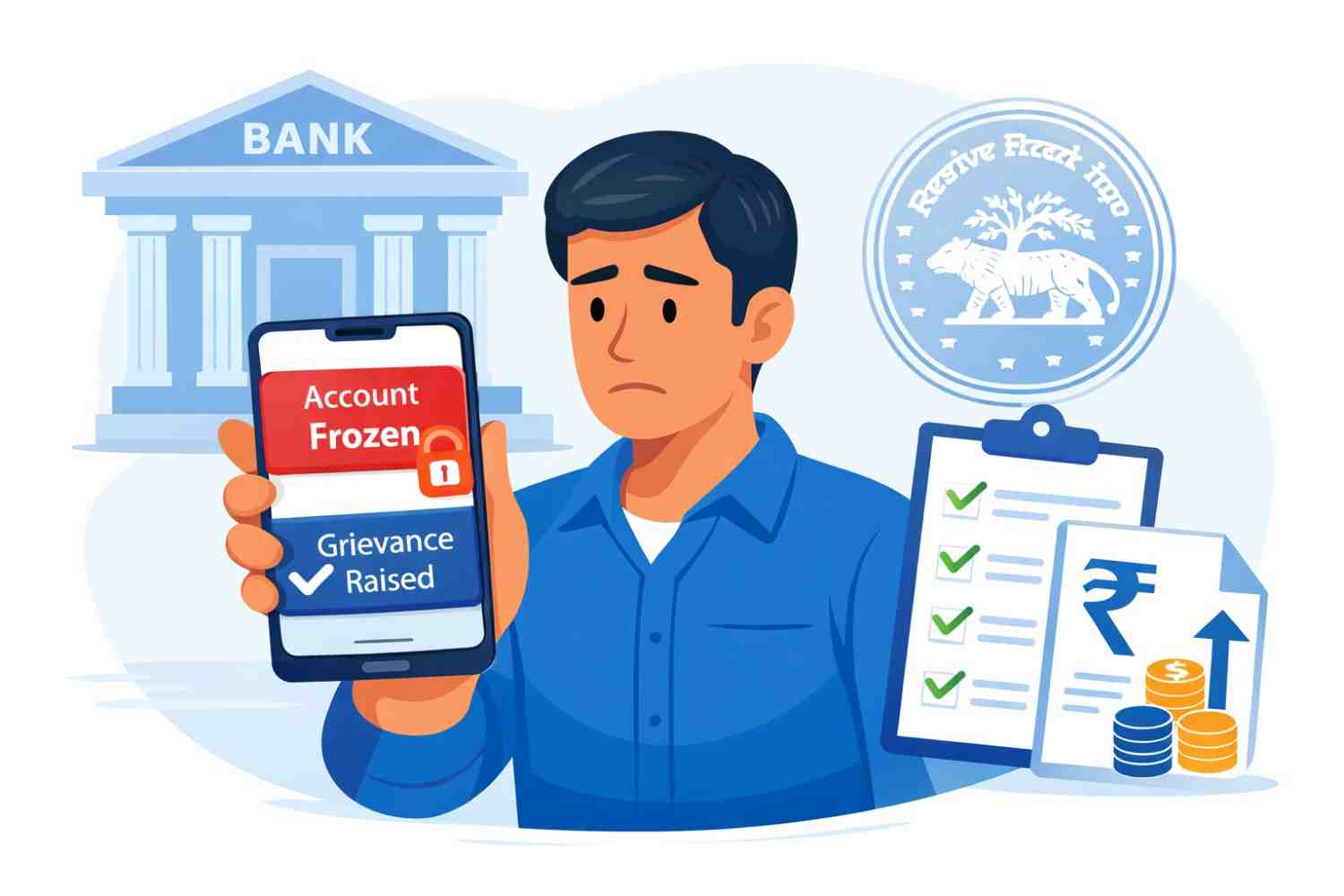
Wrongful bank account freeze in India? Learn when bank account freeze compensation in India is possible, RBI rules, real cases, and steps to claim relief safely. bank account freeze compensation in India, claim compensation from bank India, wrongful bank account freeze India, compensation for bank account freeze, RBI bank grievance compensation, bank account freeze rights India.
Introduction: Bank Account Freeze Compensation in India
A bank account freeze is no longer a rare event in India. With stricter KYC norms, enhanced transaction monitoring, and anti-money laundering checks, banks now freeze accounts more frequently than ever before. While many freezes are legally justified, a growing number of customers face wrongful or prolonged account freezes that disrupt salaries, EMIs, investments, and even business operations.
What most people do not realise is this: a wrongful bank account freeze can entitle you to compensation.
Indian banking regulations, RBI grievance mechanisms, and consumer protection principles recognise that banks must act responsibly. When a bank freezes an account without valid reasons, delays resolution unreasonably, or causes avoidable financial loss, the customer has the right to seek compensation.
This article explains six strong, real-world situations where compensation is possible in India, how banks are held accountable, and what practical steps you should take if you believe your account was frozen unfairly.
Understanding What “Wrongful” Bank Account Freeze Means
A bank account freeze becomes wrongful not merely because it is inconvenient, but because it fails the test of reasonableness, proportionality, or due process.
Banks are allowed to restrict accounts for regulatory reasons such as KYC non-compliance, suspected fraud, court orders, or enforcement agency instructions. These regulatory powers are governed by RBI’s customer service and banking guidelines, which also define how banks must communicate and resolve account restrictions fairly. However, banks are also obligated to:
- Inform customers clearly
- Act within reasonable timelines
- Apply only necessary restrictions
- Restore access promptly after compliance
When these obligations are ignored, the freeze may qualify as wrongful.
If you are still unsure how account freezes legally work, you may first read our detailed guide on bank account frozen rules in India, which explains the regulatory background in simple terms.
This article goes a step further by focusing specifically on compensation rights.
Case 1: Account Frozen Without Prior Notice or Clear Reason
One of the strongest grounds for compensation arises when a bank freezes an account without informing the customer in advance or fails to explain the reason even after repeated follow-ups.
In many cases, customers discover the freeze only when:
- Salary credits fail
- UPI transactions are declined
- Debit cards suddenly stop working
Banks are expected to provide at least basic communication, such as SMS, email, or written intimation, explaining why access was restricted. When no explanation is given, or vague terms like “internal review” are used indefinitely, it creates avoidable hardship.
If the freeze causes financial loss or prolonged uncertainty due to lack of communication, compensation becomes a reasonable claim.
Case 2: Unreasonable Delay After KYC or Document Submission
KYC-related freezes are common, but delay after compliance is not acceptable.
Once a customer submits valid documents—such as Aadhaar, PAN, address proof, or income clarification—the bank is expected to verify and restore access within a reasonable time. Holding an account frozen for weeks or months after documents are submitted may amount to deficiency in service.
This is particularly serious when:
- Salaries or pensions are blocked
- EMIs bounce due to debit restriction
- Essential living expenses are affected
If the delay is caused by bank inefficiency rather than customer fault, compensation is often justified.
Case 3: Excessive Restrictions Beyond What Is Necessary
Another strong compensation scenario arises when banks impose over-restrictive freezes.
For example, in many situations only debit transactions need to be restricted, while credit entries such as salary, interest, or refunds should remain allowed. This distinction between debit and credit restrictions is crucial and is explained clearly in our article on debit freeze vs credit freeze in bank accounts, which many customers overlook during account freezes. When banks unnecessarily block both debit and credit without justification, the freeze becomes disproportionate.
Excessive restrictions can:
- Prevent salary or business income
- Cause missed tax refunds
- Disrupt legitimate cash flows
When such overreach leads to financial damage, customers can reasonably argue that the bank failed to apply proportionate control, strengthening a compensation claim.
Case 4: Freeze Caused by Bank’s Internal Error or System Flag
Banks increasingly rely on automated transaction monitoring systems. While useful, these systems sometimes flag genuine customers incorrectly.
Common examples include:
- Legitimate large transactions flagged as suspicious
- Duplicate accounts wrongly linked
- Technical errors during account migration or merger
- Incorrect tagging under risk categories
If an account is frozen due to a bank’s internal system error and the customer has done nothing wrong, the responsibility lies squarely with the bank. In practice, customers often confuse such freezes with lien markings, even though the legal implications are different, as explained in our guide on lien marked on bank account and what it actually means.
If such errors result in prolonged freezes, missed payments, or reputational harm, compensation claims carry strong merit.
Case 5: Financial Loss Due to Prolonged or Mishandled Freeze
Compensation becomes particularly relevant when a wrongful freeze causes quantifiable financial loss.
This may include:
- EMI penalties and late fees
- Credit score impact due to bounced payments
- Missed investment opportunities
- Business losses due to stalled transactions
Such losses are common when digital payments fail during a freeze, and documenting incidents like failed UPI debits becomes important, as discussed in our article on UPI transaction failed but money debited. Indian consumer forums have repeatedly recognised that banks must compensate customers when their negligence directly causes monetary loss.
The key here is documentation. Losses must be demonstrable, not speculative.
Case 6: Failure to Resolve Grievance Within RBI Timelines
The Reserve Bank of India mandates structured grievance redressal. If a customer files a formal complaint and the bank fails to resolve it within 30 days, escalation is allowed. Customers can escalate unresolved complaints through the RBI’s official Complaint Management System, which monitors response timelines and corrective action by banks.
When banks:
- Ignore complaints
- Provide template replies without resolution
- Close complaints without restoring access
they may be seen as violating RBI service norms.
At this stage, escalation through the RBI’s Complaint Management System often leads banks to act swiftly, and in some cases, compensation is offered to close the grievance.
How Compensation Is Determined in India
There is no fixed compensation amount under Indian banking law. In severe cases involving high losses, consumer forums remain a viable last option. Customers may also approach consumer dispute redressal commissions under India’s consumer protection framework, which handles banking service deficiency cases. Compensation depends on:
- Duration of the freeze
- Severity of impact
- Financial loss suffered
- Bank’s conduct and response
In practice, compensation can range from a few thousand rupees for inconvenience to significantly higher amounts in cases involving business disruption or repeated negligence.
Step-by-Step Approach to Claim Compensation
Before seeking compensation, customers should approach the issue systematically.
Start by documenting the entire timeline—freeze date, communications, submissions, and impact. File a formal written complaint with the bank, clearly stating that you are seeking compensation due to wrongful or prolonged account freeze.
If the response is unsatisfactory or delayed beyond 30 days, escalate through RBI channels. In severe cases involving high losses, consumer forums remain a viable last option.
A calm, documented, and factual approach works far better than emotional escalation.
Conclusion
A bank account freeze does not automatically mean you must accept financial loss or prolonged inconvenience. When an account is frozen wrongfully, delayed unnecessarily, or mishandled due to bank negligence, bank account freeze compensation in India becomes a legitimate and enforceable right. The key lies in understanding when a freeze crosses the line from regulatory action to service deficiency.
By documenting timelines, communicating in writing, and using structured grievance channels, customers can hold banks accountable without confrontation. Compensation is not about confrontation—it is about restoring fairness when banking systems fail to act responsibly. If approached calmly and systematically, many cases are resolved without litigation, reinforcing the importance of informed financial awareness.
FAQs on Bank Account Freeze Compensation in India
Q1: Can I claim bank account freeze compensation in India automatically?
No. Compensation depends on whether the freeze was wrongful, prolonged, or caused by bank negligence. Each case is assessed based on facts and documentation.
Q2: Does RBI directly pay compensation for frozen bank accounts?
No. RBI facilitates grievance resolution, but compensation is usually paid by the bank after escalation or corrective action.
Q3: Can I claim compensation if my salary was blocked due to account freeze?
Yes. If salary blockage occurred without valid justification or due to bank delay, it strengthens a compensation claim.
Q4: Is compensation possible for mental harassment caused by account freeze?
Yes. Consumer forums may consider mental harassment if the inconvenience was prolonged and supported by evidence.
Q5: Is legal action mandatory to get compensation from banks?
No. Many cases are resolved through bank grievance cells or RBI’s complaint mechanism without legal proceedings.
Disclaimer
This article is for general informational purposes only and does not constitute legal or financial advice. Compensation outcomes depend on individual facts, bank policies, and regulatory interpretation. Readers are advised to verify details with their bank or consult a qualified professional before taking action.