

Bank account frozen in India? Learn step-by-step actions, RBI rules, documents required, timelines, and escalation options to unfreeze your account safely. bank account frozen in India, what to do when bank freezes account, how to unfreeze bank account, RBI rules for account freeze, bank account freeze process.
Introduction
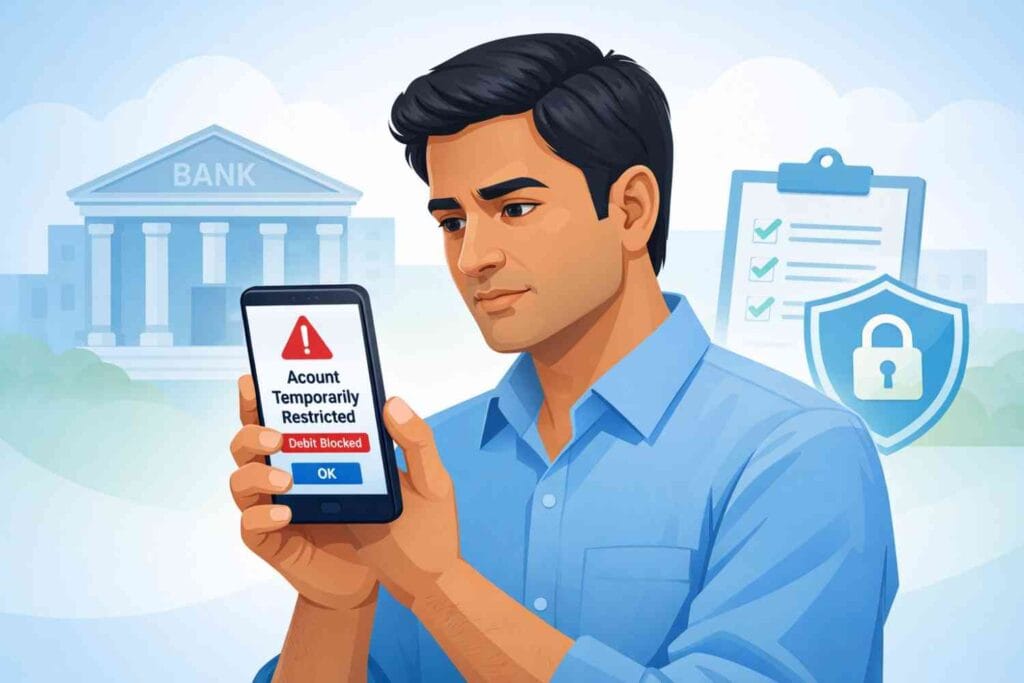
When a bank account frozen in India becomes a reality, the disruption is immediate and unsettling. Salary credits may not reflect, EMIs can bounce, debit cards stop working, and UPI transactions fail without warning. For many people, the panic is amplified by the lack of clarity—banks often communicate the restriction but not the reason in simple terms.
It is crucial to understand one thing at the outset: a bank account frozen in India does not mean your money has been seized or lost. In most cases, the freeze is a temporary control imposed by the bank due to regulatory, compliance, or security requirements. Once the underlying issue is addressed correctly, normal operations are usually restored.
This article explains in detail what to do when your bank account frozen in India, how banks process such cases under RBI-aligned procedures, the documents typically required, realistic timelines, and what steps are available if the bank delays or fails to act.
What Does a Bank Account Freeze Mean in India?
A bank account freeze refers to a restriction placed by the bank that limits how the account can be operated. The restriction may apply only to withdrawals, only to deposits, or to both. In many cases, banks impose a partial freeze where debit transactions are blocked but credits such as salary, pension, or interest continue to be allowed.
Customers often mistake a freeze for account closure or confiscation of funds. That assumption is incorrect. A bank account frozen in India is generally a compliance-driven restriction, not a punitive action. The money remains in the account, but access is limited until the bank’s conditions are met.
To clearly understand how banks technically restrict transactions, especially the difference between debit-only blocks and broader restrictions, you can refer to Debit Freeze vs Credit Freeze in Bank Account, which explains which transactions continue and which are stopped during different types of freezes.
Why Banks Freeze Accounts
Banks do not freeze accounts arbitrarily. Restrictions are triggered by defined events such as incomplete or outdated KYC, unusual transaction patterns flagged by monitoring systems, prolonged inactivity, or instructions from courts and law-enforcement agencies. In some cases, suspected fraud or regulatory alerts also result in temporary freezes to protect customers and prevent further losses.
This article does not repeat those reasons in depth. Instead, it focuses on what actions you should take after the freeze has already occurred, which is where most account holders face uncertainty and delay.
Confirm the Account Restriction Through Official Bank Communication
The first step is verification. Check official SMS alerts, emails sent to your registered address, and your bank’s mobile or internet banking app. Many banks clearly indicate whether the restriction applies to debit transactions, credits, or overall account operations.
If digital access is unavailable, contacting customer care or visiting your home branch becomes necessary. Avoid relying on assumptions, social media advice, or informal opinions. Clear confirmation through official channels prevents errors that may worsen or prolong the restriction.
Identify the Exact Reason for the Freeze
Once the restriction is confirmed, request the exact reason for the freeze in writing. This step is critical because the resolution path depends entirely on the cause. A KYC-related freeze can often be resolved quickly, while a fraud review or court-linked restriction may take significantly longer.
Written clarification also becomes essential if escalation is required later. Verbal explanations rarely help once delays occur or accountability is questioned.
Complete KYC and Verification Formalities Carefully
In a large number of cases, a bank account frozen in India is linked to incomplete or outdated KYC. Banks may request updated identity proof, address verification, PAN linkage confirmation, or clarification of recent transactions that appear inconsistent with the account profile.
Documents should be submitted carefully, forms filled accurately, and acknowledgment receipts collected. Incomplete submissions are one of the most common reasons for unnecessary delays.
If digital payments such as UPI fail during such restrictions, it often creates additional confusion. In such situations, UPI Transaction Failed but Money Debited explains how banks control transactions and process reversals when account-level restrictions exist.
Visit the Bank Branch With Supporting Documents
Although some freezes can be resolved online, many still require a physical branch visit. Carry original documents along with self-attested copies. Banks may also ask for a written explanation regarding recent transactions, especially if large or unusual credits or debits are involved.
In certain cases, restrictions arise due to legal or financial holds rather than routine compliance issues. Understanding this distinction is important, and Lien Marked on Bank Account explains how lien-related restrictions differ from standard account freezes.
Ask for a Clear Timeline and Written Acknowledgment
After submitting documents, request a realistic timeline for unfreezing the account. Banks usually provide a reference number, service request ID, or written acknowledgment once verification is completed. This establishes accountability and gives you a clear basis for follow-up.
If the bank avoids providing timelines or acknowledgment, it often signals the need for closer monitoring or escalation.
RBI Rules and Customer Rights During Account Freezes
The Reserve Bank of India permits banks to restrict account operations for compliance, risk management, and customer protection. However, RBI also expects banks to act transparently, inform customers of the reason for restrictions, and restore access once requirements are fulfilled.
RBI guidelines emphasise proportionality. This means a bank should not impose a blanket freeze when a limited restriction would suffice, and it should not continue restrictions indefinitely once compliance requirements are met.
According to RBI’s official banking safeguards, customers have the right to:
- Be informed about the reason for restriction
- Submit documents to resolve the issue
- Use grievance redressal mechanisms if delays are unreasonable
Understanding these principles helps customers differentiate between legitimate procedural delays and avoidable inaction.
Expected Timelines as per Practical Banking Practice
While RBI does not prescribe rigid timelines for every scenario, practical banking norms provide broad expectations. KYC-related freezes are often resolved within a few working days after verification. Delays beyond this usually indicate missing documents or internal backlogs.
Fraud-review cases may take longer because banks must complete internal checks and sometimes coordinate with multiple departments. Court-ordered freezes generally remain until formal clearance is received and are not under the bank’s discretion.
If your bank account frozen in India continues despite full compliance and no written explanation, escalation becomes justified.
Real-Life Scenarios You Should Be Aware Of
A salary account freeze often creates panic, but in many cases credits continue while debits are restricted. Banks usually prioritise resolving such cases once KYC is updated.
Senior citizens and pensioners may face freezes due to periodic KYC or life-certificate issues. These are usually resolved quickly once verification is completed.
In cases involving suspicious transactions, banks may impose temporary restrictions even if the customer is innocent. Cooperation and timely clarification generally lead to resolution.
What If the Bank Does Not Unfreeze Your Account?
When delays persist, escalation should follow a structured path. Start with the branch manager, then approach the bank’s grievance redressal cell through official channels. If the issue remains unresolved, customers can approach the RBI Banking Ombudsman with documented proof of delay or non-response.
Maintaining records of submissions, acknowledgments, and written communication is essential during escalation.
Common Mistakes That Delay Account Unfreezing
Many customers unintentionally prolong the freeze by ignoring bank emails, submitting partial documents, or relying solely on verbal assurances. Aggressive confrontation at the branch or attempting to bypass restrictions by opening multiple accounts may raise further compliance concerns.
A calm, documented, and procedural approach almost always results in faster resolution.
Conclusion
A bank account frozen in India can be stressful, but it is rarely permanent. Most cases are resolved when customers understand the reason, complete required formalities correctly, and follow up through official channels. Acting calmly, maintaining documentation, and knowing your rights under RBI-aligned procedures ensures the issue is resolved without long-term financial damage.
FAQs
Q1: Can a bank freeze my account without prior notice?
Yes, banks may impose immediate restrictions for compliance or security reasons. Customers must, however, be informed shortly afterward.
Q2: Can money still be credited during an account freeze?
In many debit-freeze cases, credits such as salary or pension may still be allowed, depending on the restriction type.
Q3: Is a court order required for every bank account freeze?
No. Many freezes occur due to KYC or internal compliance issues and do not involve courts.
Q4: Can I open another account if one is frozen?
Opening another account does not resolve the original issue and may raise additional compliance questions.
Q5: How can I complain to RBI if the bank delays action?
After exhausting the bank’s grievance process, customers can approach the RBI Banking Ombudsman with proper documentation.
Disclaimer
This article is for informational purposes only and does not constitute legal or financial advice. Banking procedures may vary based on individual cases and bank policies. Readers should verify details with their bank or consult official RBI resources before taking action. Penny Blue print is not responsible for decisions taken based on this information.