
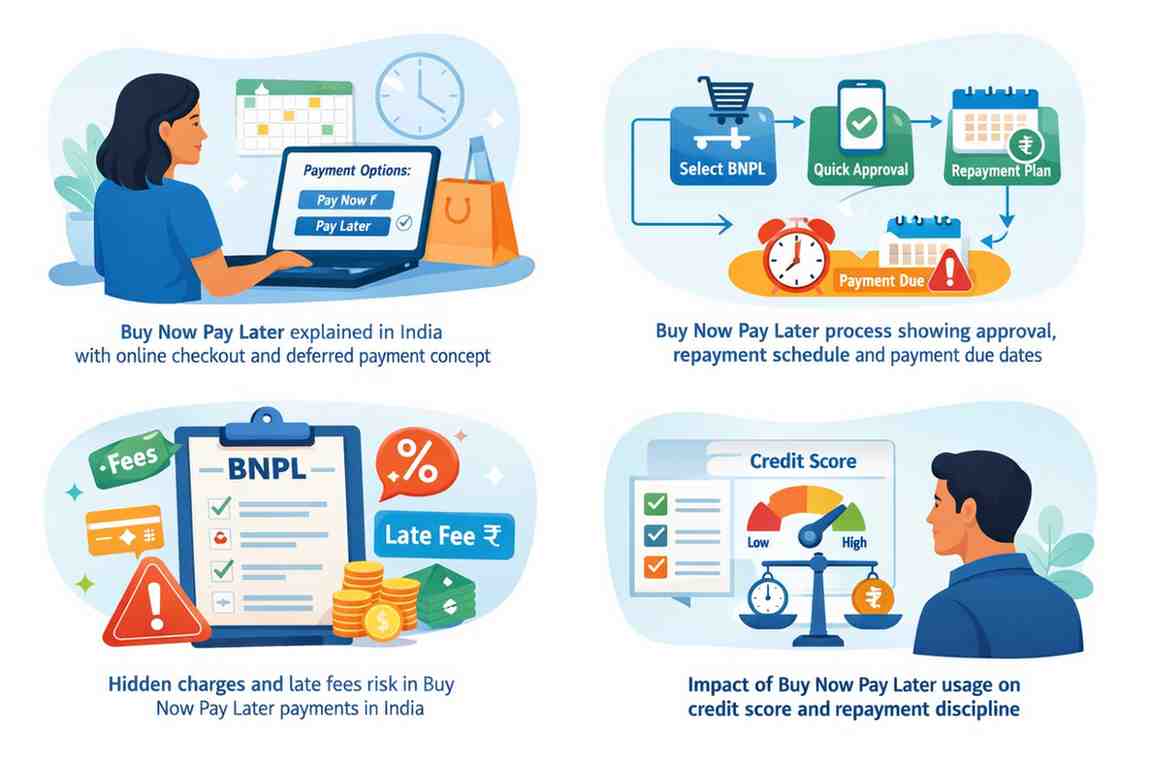
Buy Now Pay Later explained: 9 hard facts every Indian consumer must know — how BNPL works, fees, credit score impact, RBI view, real-life examples and safe use tips. Read before you click “Pay later.” BNPL India, BNPL charges, BNPL credit score, Buy Now Pay Later risks, BNPL vs credit card.
Introduction
Buy Now Pay Later (BNPL) has become a common checkout promise: “Buy now, pay later — interest-free.” For many Indian shoppers it’s convenient, sometimes cheaper than EMI, and frictionless at checkout. But marketing and reality often diverge. This article explains 9 hard facts every Indian consumer should know before using any BNPL option — how BNPL works, where the costs hide, how BNPL can affect your credit history, what the regulator is thinking, and real-life examples that show the outcomes.
If you want a practical, consumer-protection-first guide that you can action today (checklists, what to read in terms & links to relevant regulators), this is it.
Updated: February 2026
This article reflects the latest BNPL practices, credit-reporting trends, and regulatory developments in India.
1. BNPL is not a single product type
Fact: Buy Now Pay Later is not one uniform product. It is an umbrella term that covers multiple payment and credit models offered by different providers. Some BNPL options allow a short interest-free delay of 15–30 days, while others convert the purchase into instalments lasting several months. In certain cases, the merchant funds the delay; in others, a fintech or lending partner underwrites the transaction as an unsecured short-term loan.
Why it matters: The risks, fees, and consumer protections vary entirely based on the underlying model. A deferred payment offered directly by a merchant is very different from a third-party BNPL loan backed by a lender. Understanding which model, you are using determines whether interest applies, how defaults are handled, and whether credit reporting is involved.
Quick distinction to check:
- Is it a simple pay-later facility or a formal credit product?
- Who is underwriting the risk — merchant or lender?
- Does it convert into instalments automatically?
Authoritative context: Regulators and payments analysts classify BNPL within the broader digital lending and payments ecosystem, which is subject to evolving rules. (Reserve Bank of India)
2. How BNPL commonly works at checkout
Fact: Most BNPL transactions follow a predictable three-stage flow, even though the interface may appear seamless. Approval is usually instant, repayment terms are pre-set, and consequences for missed payments are defined upfront — though often overlooked by users.
At checkout, the user selects BNPL and undergoes a lightweight eligibility assessment, which may not involve a hard credit inquiry. Once approved, the repayment structure is fixed, either as a short interest-free window or scheduled instalments. If payments are missed, penalties and escalation mechanisms apply depending on provider policy.
Core stages involved:
- Checkout approval with a soft eligibility check
- Defined repayment schedule with due dates
- Penalties, reporting, or collections if payment is missed
Practical check: Always screenshot or save the repayment schedule and late-fee table before confirming. Many disputes arise because users never review these terms in detail.
Supported by industry reporting showing BNPL is integrated across multiple merchant categories and payment flows.
3. BNPL can be “interest-free” but not always cost-free
Fact: “0% interest” BNPL offers can still involve real costs. While the interest rate may be zero for a limited period, providers often recover revenue through processing fees, convenience charges, or higher penalties if a payment is missed. Instalment conversions are particularly prone to hidden charges.
The effective cost of BNPL increases sharply once fees and penalties are included. What appears cheaper than a credit card EMI at checkout can turn out more expensive over time.
Costs that often go unnoticed:
- Processing or setup fees on instalments
- Price inflation on BNPL-enabled products
- Compounding late fees and recovery charges
Rule of thumb: Treat BNPL like real credit. Calculate the effective annualised cost (APR-equivalent) including all fees and compare it with credit card EMIs or bank loans.
4. Not all BNPL activity shows up on your credit score today — but that’s changing
Fact: Historically, many BNPL transactions did not appear on credit reports because providers did not report short-term pay-later activity to credit bureaus. This is changing rapidly. Globally, lenders and bureaus have started incorporating BNPL data into credit files, meaning repayment behaviour can now influence credit profiles.
In India, some BNPL providers already report repayment patterns, while others may do so in the future as regulations evolve. This shift means BNPL can help build credit if managed well — or damage it if misused. Understanding how credit scores are calculated in India helps put BNPL repayment behaviour into proper context.
What this means for users:
- On-time payments may strengthen credit history
- Missed payments may reduce creditworthiness
- Reporting practices differ by provider
Practical takeaway: Always ask whether the BNPL provider reports to credit bureaus like CIBIL. If they do, treat BNPL exactly like any other loan.
5. RBI is watching; regulatory rules are evolving
Fact: The Reserve Bank of India views BNPL as part of the digital lending and payments ecosystem. Its guidelines on digital lending, KYC, transparency, and grievance redressal increasingly apply to BNPL arrangements, especially where lending is involved.
As oversight increases, BNPL providers may be required to disclose fees more clearly, follow stricter KYC norms, and align with formal lending standards. These expectations align with the Reserve Bank of India’s broader framework for digital lending and borrower protection. This improves consumer protection but may also reshape how BNPL products are offered.
Why this matters to consumers:
- Better transparency on fees and penalties
- Clearer grievance redressal mechanisms
- Potential changes in BNPL availability
6. BNPL increases the risk of “loan stacking”
Fact: BNPL’s ease of access makes it easy for users to accumulate multiple obligations across apps and merchants — a phenomenon known as loan stacking. Because approvals are fast and checks are minimal, users may underestimate their total repayment burden.
Loan stacking increases the risk of missed payments, collections, and long-term credit stress. This risk becomes more severe when multiple unsecured borrowings accumulate without a clear repayment strategy. It can also make future borrowing more expensive or difficult.
Warning signs of loan stacking:
- Multiple BNPL plans with overlapping due dates
- Losing track of total outstanding amounts
- Relying on BNPL for routine spending
Practical tip: Maintain a simple list or tracker of all BNPL commitments and avoid overlapping repayment schedules.
7. BNPL is sometimes cheaper than alternatives — if used perfectly
Fact: BNPL can be cheaper than credit card EMIs or small personal loans only when used exactly as intended — short-term, interest-free, and paid on time. It works best for planned purchases with predictable cash flows.
Once instalments extend or fees apply, BNPL often loses its cost advantage. It should never be used as a substitute for long-term borrowing.
When BNPL makes sense:
- Small, planned purchases with clear repayment timing
- Genuine zero-fee, interest-free windows
- Temporary cash-flow alignment between paychecks
Always calculate the full cost and avoid using BNPL for recurring or lifestyle expenses.
8. Consumer protections vary — read the fine print
Fact: Consumer protections in BNPL differ widely by provider. Refund handling, chargebacks, and dispute resolution can be more complex than standard card payments, especially when refunds must be coordinated between merchants and BNPL platforms.
Some users assume BNPL offers the same protections as credit cards, which is not always the case.
Key questions to check before using BNPL:
- Who processes refunds — merchant or BNPL provider?
- How are disputes escalated and resolved?
- How are partial refunds adjusted across instalments?
If unclear, ask for clarification before completing the transaction.
9. You must treat BNPL like credit and plan repayment
Fact: The safest way to use BNPL is to treat it exactly like short-term credit. Convenience should never replace repayment discipline. Without planning, BNPL can quickly turn into a debt trap. The same discipline applies to all forms of short-term borrowing, including personal loans and credit cards.
Responsible use depends on awareness, reminders, and restraint — not just easy approvals.
Safe-use essentials:
- Use BNPL only for planned purchases
- Set reminders or enable autopay
- Track total BNPL liabilities in your budget
If you wouldn’t take a loan for it, don’t use BNPL for it.
Real-life Examples
Example A — On-time, low-cost use
Scenario: Priya buys a ₹6,000 smartphone accessory and selects a 30-day BNPL “pay later” option with zero fees if paid within 30 days.
Outcome: She pays on day 28 via UPI and has no fees. Her BNPL provider does not report short-term plans to credit bureaus, so the transaction does not affect her credit file. Result: cost = ₹0 for short-term liquidity.
Example B — Instalment conversion and hidden fees
Scenario: Rohit buys a laptop accessory for ₹20,000. At checkout he accepts a 3-month instalment plan that shows “no interest” but includes a ₹400 processing fee and a ₹200 merchant convenience charge. He misses one instalment.
Outcome: Effective cost increases because of processing and late fees (₹400 + ₹200 + late penalty), pushing APR-equivalent beyond basic bank EMI. He also receives reminder calls and a report to a collection agency depending on provider policy.
Example C — Loan stacking and credit impact
Scenario: Aisha uses three different BNPL apps for fashion purchases across the month, each amounting to ₹4,000–₹6,000, with overlapping instalment dates. She misses two instalments due to cashflow issues.
Outcome: Collections escalate; one provider reports the missed payments to a credit bureau, increasing the chance of a lower credit score or higher offers cost for new credit. In a worst-case scenario, repeated defaults create friction for home loan underwriting.
(These are simplified examples — always check the provider’s exact contract.)
Conclusion — Practical verdict
Buy Now Pay Later is a useful tool when used with discipline — like any credit product. It can offer short-term liquidity and convenience, but it also creates real risks: hidden fees, loan stacking, and potential credit reporting consequences. The safest approach is to treat BNPL as short-term credit, read the fine print, compare effective costs, and never rely on BNPL for recurring expenses.
FAQs
Q1: Does Buy Now Pay Later affect my credit score?
It depends on the provider. Some BNPL services report repayment behaviour to credit bureaus, so timely payments can help, and missed payments can hurt your score. Always ask the provider whether they report to bureaux such as CIBIL before you sign up.
Q2: Is Buy Now Pay Later truly interest-free?
Sometimes yes for short windows (15–30 days), but “interest-free” plans can still include processing or convenience fees, and instalment conversions may add costs. Always calculate the effective cost including fees and potential late penalties before choosing BNPL over other options.
Q3: What happens if I miss a BNPL payment?
Providers may charge late fees, report delinquency to credit bureaus (depending on provider policy), and initiate collections. Consequences vary — check the late-fee table in the contract and contact the provider immediately to negotiate or request a hardship plan.
Q4: When is BNPL better than a credit card or personal loan?
BNPL is useful for small, planned purchases you can repay within the interest-free window. It can be cheaper than an EMI for short-term liquidity — but for longer durations, compare the APR-equivalent of the BNPL instalment plan with credit card EMI and bank loans.
Q5: Are BNPL refunds easy if the merchant cancels the order?
Refund handling varies. Some BNPL flows require the merchant to notify the BNPL provider; others automatically reduce your outstanding balance. Always confirm refund flow at purchase time and keep transaction receipts until the refund clears. If the provider and merchant disagree, escalate with consumer grievance channels.
Q6: How can I safely use BNPL?
Treat BNPL like credit: plan repayments, set calendar reminders, avoid multiple overlapping BNPL plans, and do not use BNPL for ongoing living expenses. Prefer providers that clearly state fees, report to credit bureaus (if you want credit-building) and provide easy autopay options.
Disclaimer
This article is published for general information and consumer awareness purposes only. It does not constitute financial, legal, or credit advice, nor should it be treated as a substitute for professional guidance. Buy Now Pay Later (BNPL) terms, charges, credit-reporting practices, and regulatory treatment vary by provider and may change over time. Readers should independently verify current terms, provider policies, and applicable Reserve Bank of India (RBI) guidelines before using any BNPL product or making financial decisions.