
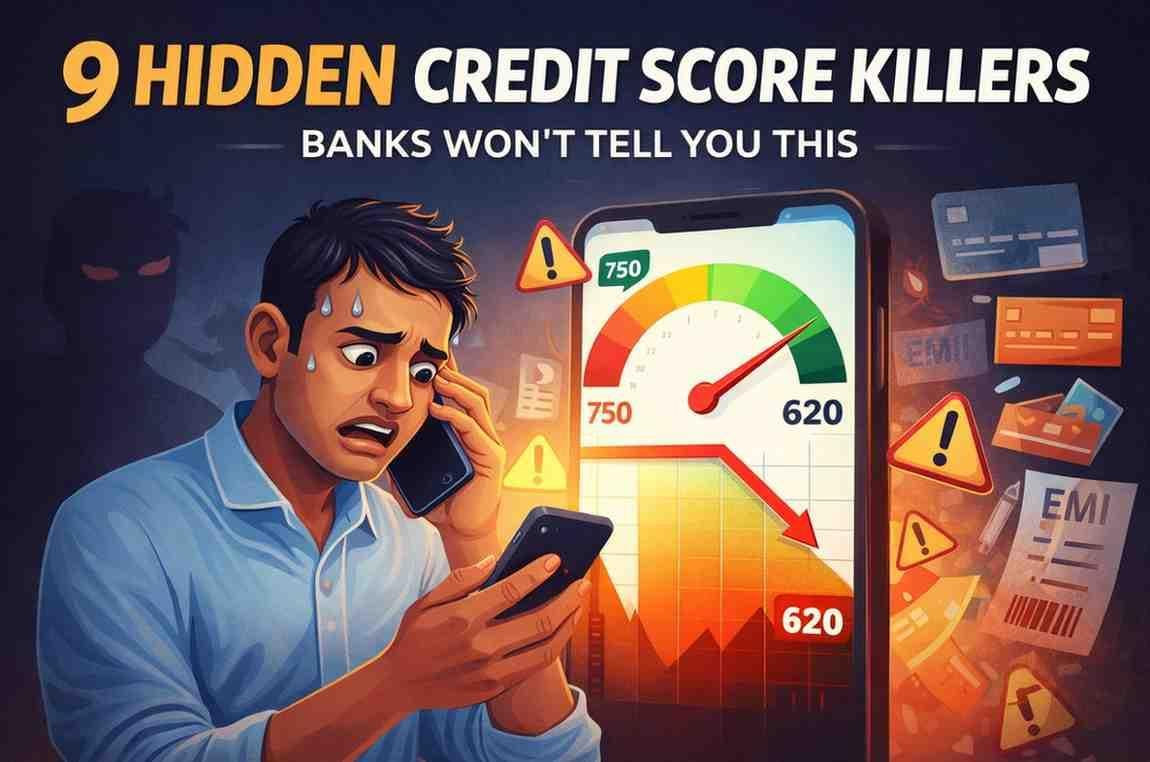
Discover the most dangerous credit score killers in India silently damaging your financial future. Learn how to fix them before it’s too late. credit score killers in India, credit score mistakes, CIBIL score factors, improve credit score India, low credit score reasons, credit report errors India, credit utilization India, loan mistakes India, financial mistakes India.
Introduction: The Silent Damage You Don’t See Coming
The majority of individuals believe that maintaining a good credit profile only requires timely EMI payments, but the truth is much more complicated and frequently uncomfortable. There are several credit score killers in India that work silently in the background, affecting your financial credibility without giving you any direct warning. It could happen: good income, steady savings, yet loan applications keep failing – leaving questions behind. What counts now is not only paying bills on time but the full picture of money choices made week after week. Lenders watch when credit is used, how often requests go out for new lines, and whether actions stay consistent across months. Decisions come down to those quiet routines hidden beneath surface numbers. According to the Reserve Bank of India, maintaining financial discipline and responsible borrowing behavior is essential for a healthy credit profile.
Many individuals unknowingly damage their profile through everyday financial decisions, just like how unnoticed behaviours lead to financial leakages in common savings account mistakes that reduce long-term stability. Most people miss the real problem. It isn’t about earning less, it’s about knowing less. Without clarity on how decisions are made behind the scenes, errors pile up without warning. These unnoticed missteps quietly close doors. That changes everything – grasping what stays unseen now defines progress more than effort alone.
1. High Credit Utilization – The Invisible Red Flag
High credit utilization is one of the most powerful credit score killers in India, yet most people ignore it completely because it doesn’t feel like a mistake. Most times, tapping into nearly all of your credit line makes lenders think you depend too much on borrowing – regardless of timely payments. Staying under 30% is best, yet plenty of people run between 60 and 80 percent, unaware of lasting effects. Heavy use hints at living off debt, slowly weakening how trustworthy you seem when applying later. Borrowing patterns like these quietly shape lender opinions behind the scenes.
Worse things happen once someone juggle more than one card at a time, thinking it’s under control. Actually, each extra line of credit piles up unseen danger. Slowly, lenders start seeing gaps between what comes in and how much goes out. Payments might always arrive on time, yet the number still dips bit by bit without warning. This is especially common among users who frequently rely on buy now pay later services without tracking overall usage. Managing utilization is not about repayment—it is about discipline and perception.
2. Multiple Loan Applications in a Short Time
Lenders notice when someone seeks several loans or credit cards close together. Each request brings a hard check on your record showing you want to borrow money. Seeing many checks in a brief span hints at possible strain regardless of steady paychecks. Past payments might be perfect yet suspicion grows if too many requests pile up fast. The pattern raises questions about how well debts could be managed going forward.
Most folks mess up when checking deals or chasing lower rates, blind to the quiet price they pay. Because loan apps let you shoot applications to many lenders fast, credit checks pile up just as quick. All those looks at your report start weighing down your score bit by bit. Lenders begin to wonder what’s wrong – not about owing money, but how it seems like you’re scrambling. What drags things south isn’t borrowing cash, rather how often you reach out like you’re running short. Planning each move ahead stops harm before it even shows up.
3. Missing Even a Single EMI or Bill
Late by just a day? That slip still counts when lenders report it. One missed EMI or credit card date can dent your number more than expected. Some think brushing it off is fine – truth is, those reports stick around. A drop like that lingers, shaping how banks see you later. Years pass, yet the mark stays, quietly tipping decisions on loans and what rate they offer.
Faster trouble shows up if money moves rely on machines or how much sits in a bank. Situations like technical failures or account restrictions can lead to missed payments, similar to issues EMI failures due to account problems. One slip, not your doing, still stains the record. Watching every payment yourself beats trusting machines alone. Steady repayments build what matters most – ruin arrives fast, even once. Years of care hang by thin threads.
4. Closing Old Credit Cards Too Early
Older credit cards might seem safe to shut down, yet doing so often backfires. Because long-standing accounts build trust over time, removing them shortens your financial timeline. That shift drags down the overall strength of your record. Even if fewer accounts feel cleaner, cutting one from years ago reshapes how lenders see stability.
Closing a card means less credit overall, so your balance looks bigger compared to what you’re allowed – even when spending doesn’t change. That shift hits twice: it shortens how far back your history goes while pushing up that percentage banks watch closely. Both moves drag down the number lenders check first. Lots shut old lines thinking they’re cleaning house, but miss how scoring actually works. Rather than erase those older ones, just let them sit with tiny activity now and then. The longer these links stay open, the more reliable you seem to anyone watching. Steady presence counts more than flashy behavior ever does.
5. Ignoring Errors in Credit Reports
Most folks underestimate how often mistakes show up on credit reports – yet brushing them off might wreck your rating. Wrong payment details could appear alongside double-listed debts, maybe even fake accounts set up while you weren’t looking. Few actually review their files regularly, so problems linger unseen, slowly chipping away at trust. Your credit score is calculated by agencies like TransUnion CIBIL, which rely heavily on accurate data to determine your financial credibility. A quiet hit that adds up.
Watching things closely on a routine basis helps catch mistakes early, so fixing them happens before bigger problems show up. You can track your profile using tools mentioned in checking credit score in India for free to stay updated. When mistakes show up, get them fixed right away by telling the credit bureau. Letting those mismatches slide means you’re stuck with fewer points for no clear cause. What shows on your credit report shapes how lenders see your money habits – keep every detail honest. Always.
6. Becoming a Loan Guarantor Without Understanding Risk
Lending your name to someone else’s loan might feel like helping out, yet it ties you to real money risks. Should payments stop, the law holds you accountable just the same as the person who took the cash. A missed payment lands on your record, regardless of whose choice started the debt.
It sneaks up on you – backing someone financially when they’re unprepared. When payments slide, even a little at first, it tugs at your own standing whether you meant to be involved or not. This is one of the most overlooked credit score killers in India because it does not involve your own spending behaviour. It is crucial to comprehend the dangers and determine whether you are prepared to assume full responsibility for the loan before becoming a guarantor.
7. Settling Loans Instead of Closing Properly
Most times, settling a debt feels like relief when money gets tight. Yet here’s the catch – it shows up on your credit history as unpaid in full. Lenders see that detail and start questioning how responsible you really are with borrowing. Years go by, yet that note stays put, shaping every new lending decision. Hard to move forward when old choices keep showing up.
Settlement might ease things now, yet the effects later often catch folks off guard. Borrowers who finish what they started tend to earn favor with lenders – showing up as someone steady and predictable. When money gets tight, adjusting terms usually works out smarter than closing early. A history of on-time payments opens doors down the line, quietly shaping how much others rely on you.
8. Overdependence on Short-Term Credit
Spending regularly with borrowed money – say, through credit cards or buy-now-pay-later plans – often leads to repeating patterns that drag down your credit rating. Because they’re quick to access, turning to them too often for groceries or bills hints at shaky budget habits. When lenders notice you depend on debt just to cover basics, it suggests earnings aren’t keeping up. That impression makes them less likely to trust your ability to repay future borrowing.
This pattern is similar to financial leakages caused by hidden costs discussed in hidden charges in personal loans, where small expenses accumulate into significant financial pressure. What really matters isn’t whether credit exists, but the way people handle it. Staying clear on spending helps prevent trouble down the road. Handling money with care shapes a solid financial path ahead.
9. Lack of Credit Mix
One kind of credit might hold back how high your score goes. Because lenders like seeing both kinds – loans tied to assets and ones that are not – it shows handling varied money tasks well. When different types come together, trust grows along with the number at the top. What counts is balance across borrowing styles adding up over time.
Lots of folks zero in on just one kind of credit, missing how it affects their number. Mixing things like car payments or house financing with plastic helps build a stronger record. Not about piling up debt – just keeping balance matters here. When lenders see steady handling across types, they tend to say yes later down the road.
The Bigger Problem: You Don’t Know What You Don’t Know
Surprisingly, it’s not errors that pose the biggest risk in handling your credit score – it’s simply not knowing they’re there. Many assume strong income and timely payments equal smart money habits. Yet behind the scenes, unseen patterns shape how lenders judge you. What feels fair rarely matches the reality of automated evaluations. Hidden routines matter more than anyone thinks.
Most times, confusion about the rules means choices miss the mark. Because feelings guide moves instead of understanding, results slowly turn worse. Without clear insight, errors repeat themselves like an old pattern nobody notices. Chances slip away quietly when people assume progress is happening. Even confidence grows on shaky ground if numbers tell a different story. Most people start by learning how things actually work. That clarity makes it easier to take charge over time. When someone misses that piece, progress often stalls – no matter how careful they are. Even strong habits can fall short without context.
What Happens If You Ignore These Credit Score Killers?
Ignoring these credit score killers in India can have serious long-term consequences that go beyond just a low score. When loan applications get turned down again and again, it often brings steeper interest charges along with fewer choices in banking services. Emergencies hit harder if money is tough to reach fast. Missing out on big milestones – like owning property or launching work of your own – tends to pile up the longer things stay this way.
A shaky credit history can weigh heavily on your wallet. Lenders might offer tougher terms because they see you as riskier. Higher costs for loans could follow, even when borrowing the same amount as others. That extra burden often feeds into ongoing money troubles. Problems ignored tend to grow instead of fading away. Acting early helps prevent deeper setbacks down the line.
How Smart People Avoid These Mistakes
Staying ahead financially means skipping guesses entirely. Systems guide how these people handle their credit, making things predictable. Checking credit reports happens often, almost like routine maintenance. Utilization gets watched closely – too much can signal trouble. Borrowing fits into a bigger plan, never random. Problems rarely catch them off guard because warnings are seen early. Prevention becomes normal behavior, built into daily choices. Strength in credit isn’t accidental – it shows up when discipline stays steady.
Most know that staying steady matters more than quick wins. Not after instant rewards, they put trust and consistency first instead. A mix of credit types gets kept healthy, while extra inquiries get skipped entirely. Payments land on time, every time – no exceptions made. Seeing how things actually run, they move just like lenders hope people will. That quiet edge opens doors others find hard to reach.
Final Insight (This Changes Everything)
Lurking behind that three-digit figure is what you’ve done with money over time – every payment, every delay. Lenders look at it to guess whether they should trust you. When it stands tall, banks respond with lower charges and bigger yeses on loans. But if it drags low, choices shrink while prices rise without warning. Seeing things this way alters your money choices. Not just earnings or putting cash aside, but what you do shapes trust in you. That change – how you think – affects lasting outcomes. Your credit number becomes something worth protecting when seen as a real resource. Care grows once strategy kicks in.
But Here’s the Reality Most People Ignore
Most folks still do not act, even once they know what matters. Sticking to old routines feels easier than shifting course. A solid credit standing gets overlooked, though it counts. Effort, attention, and consistency – those are the pieces missing for so many. Willingness to put in work? Often absent. A crowd ends up trapped in money loops, doing fine on paper yet missing real chances. Though pay checks look solid, hidden problems go unseen, so fingers point elsewhere. Shifting gears means rethinking habits, slowly building smarter moves with cash. Knowing what to do changes nothing unless steps follow. Real shift comes only when motion meets intent.
Want to Fix This Before It’s Too Late?
To get ahead financially, start by moving past simple tips and build a clear plan instead. Credit rules might seem confusing at first, yet using them right makes a difference over time. Staying alert helps, so does sticking to routines even when motivation fades. Old patterns tend to stick around unless replaced on purpose. Starting early means small errors won’t weigh as heavily later. A steady approach beats quick fixes when shaping how lenders see you. Mistakes fade faster when time works in your favour. Pushing things off tends to pile up stress down the road. Building trust with banks grows naturally if you begin today. Stronger standing comes from consistency, not sudden moves.
Real-Life Examples
Example 1: High Credit Utilization Trap
Every month, Rohit swiped his card for groceries, bills, meals – life ran on plastic. Living in Delhi, he worked a steady job, trusted he was doing things right by clearing the total amount due each cycle. Yet his balance hovered near 80% of his limit, stacking up without warning signs. Even so, he expected approval when paperwork went in for a house loan. The lender said no. Puzzled, he sat back – he paid on time, always. Not one late notice ever arrived. Later, he discovered that high utilization was one of the biggest credit score killers in India affecting his approval chances. Within a few months, his score gradually improved after cutting consumption below 30% and spreading out spending.
Example 2: Multiple Loan Applications Mistake
Week after week, Priya searched for a good personal loan by sending requests across several online platforms. Because she believed more options meant better savings, she filled out form after form. Each time, though, a mark appeared on her credit history – a record of someone looking too hard. Lenders began noticing the trail, reading it as urgency or neediness. Even when one offer seemed perfect, they turned her down flat – her own effort to compare had backfired. Too many footprints in the snow scared them off. She later realized that this pattern is one of the most ignored credit score killers in India. She was able to get approved after a few months of waiting and carefully applying to just one lender.
Example 3: EMI Miss Due to Negligence
Out of nowhere, Amit thought his loan payments were handled automatically. Yet when surprise costs drained his account, the payment missed its mark. Instead of going through, the system flagged it as late. He only realized what happened after days passed by. Once fixed, the damage had already reached the credit offices. Losing points fast, his credit rating fell hard – loan chances took a hit right after. That single slip-up? It lived on the record much longer than he expected. This shows how even small lapses can turn into serious credit score killers in India if not monitored carefully.
Example 4: Becoming a Guarantor Without Awareness
At first, Suresh thought signing as a guarantor would mean nothing much. Yet things shifted when his friend failed to pay the loan on time. Because he’d signed the papers, the missed payments landed on his record instead. Even though he couldn’t manage how the money was used, the fallout reached him anyway. Later, trying to get a personal loan brought only denials or steeper costs. This experience taught him that being a guarantor is not a small favour but a serious financial commitment and one of the hidden credit score killers in India.
Conclusion
Understanding and avoiding these credit score killers in India is essential for building a strong financial foundation. A strong credit history shapes how easily you handle money matters down the road. Spotting errors others miss – then fixing them fast – often lifts your number over time. Staying steady, paying close attention, plus making thoughtful choices builds lasting stability. Tiny shifts in daily habits sometimes lead to much bigger advantages later on. Acting now puts you ahead when life demands more cash flow or new options appear.
FAQs
Q1: Which factors are most detrimental to credit scores in India?
High credit utilization, missed EMIs, numerous loan applications, and mistakes in credit reports are the main factors that lower credit scores in India. These elements have a direct impact on how lenders assess your financial conduct. These covert errors can drastically lower your creditworthiness and your chances of getting a loan, even if you make a good living.
Q2: Does checking my credit score reduce it?
Checking your own credit score? That’s fine – it counts as a soft inquiry, so no harm done. Feel free to look it up anytime; nothing bad happens. When you apply for loans though – different story. Those are hard checks, each one nudging your number down a bit. Lenders notice that kind of activity. Too many in a short time might make them pause.
Q3: How much credit utilization is safe?
Most experts suggest staying under 30% of your available credit. Lenders see this habit as a sign you manage borrowing wisely. Even with perfect payments, using too much of your limit might drag down your score.
Q4: Can my credit score be impacted by a single missed EMI?
Late once. That’s all it takes for a dent in your credit score, staying on record longer than you’d expect. Missed payment? Lenders see that as shaky follow through. Expect tougher loan approvals ahead – or higher charges when borrowing if they agree at all.
Q5: How much time does it take to raise your credit score?
Paying bills on schedule nudges your number upward little by little. Sticking to small balances matters more than big gestures. Each missed deadline slows progress just as much. Applying for less keeps things stable rather than shaky. Progress shows after several months if habits stay steady. A full year might pass before real change appears clearly.
Q6: Does a loan settlement lower one’s credit score?
Most lenders see settled loans as a red flag since the full balance wasn’t paid. A closed account looks stronger on your record. When money gets tight, settlement might be unavoidable. Repayment in full keeps trust strong with future creditors. Skipping proper closure can linger on reports longer than expected.
Disclaimer
This piece aims to inform, nothing more – financial guidance it is not. Different lenders use different rules when judging creditworthiness. Talking to a qualified money advisor makes sense before taking any steps. Scenarios shown here simply show possibilities, not guarantees for everyone.