
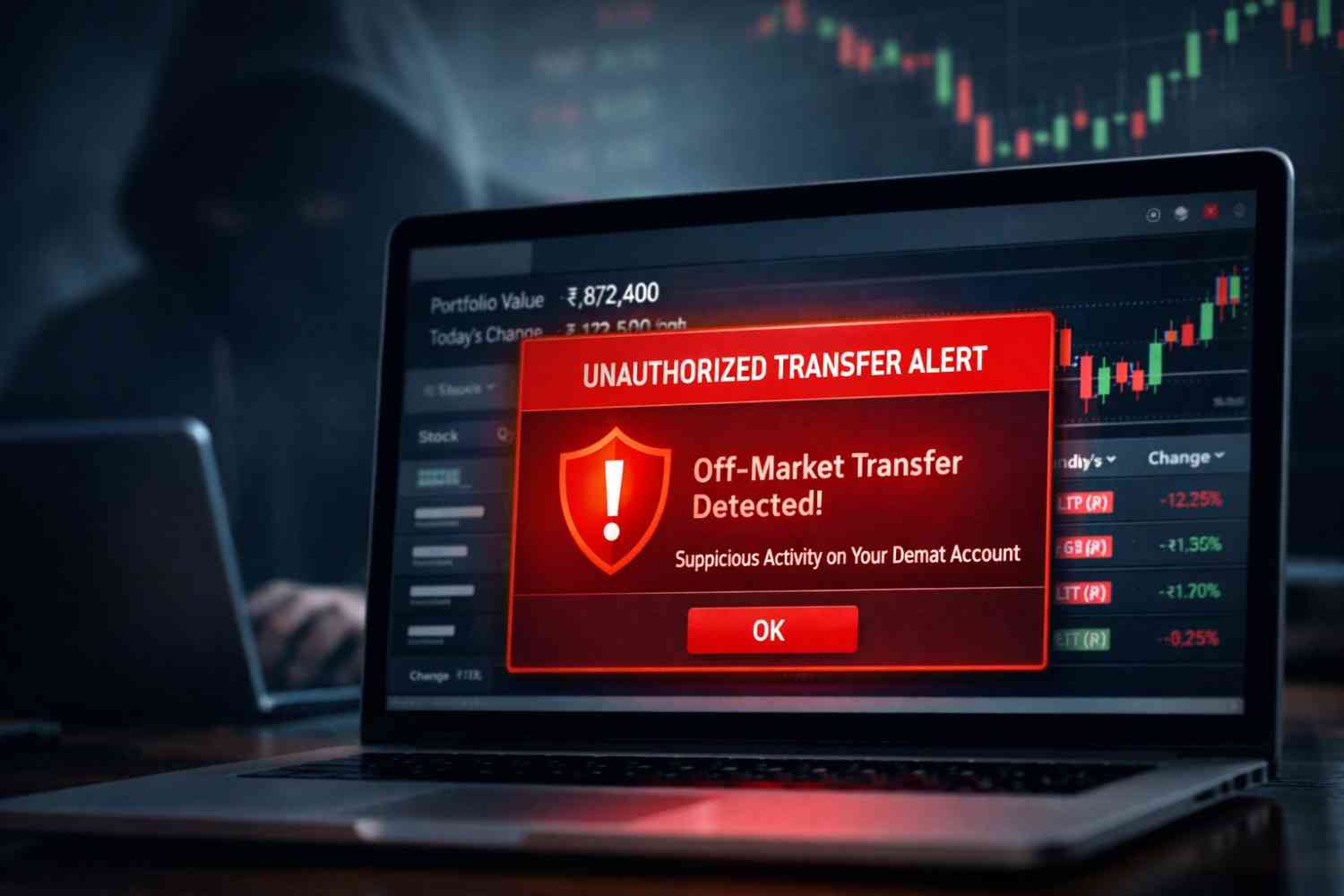
Demat account fraud in India is increasing through OTP theft, SIM swap attacks, off-market transfers and fake advisory traps. Understand 9 dangerous scams, regulatory protection options and a structured prevention framework to secure your investments. Demat account fraud in India, demat account hacking, unauthorized demat transaction, off-market transfer fraud, SIM swap demat fraud, protect demat account, SEBI complaint demat, stock market cyber fraud.
Introduction: The Growing Risk Behind India’s Retail Investing Boom
Out there among the rising numbers, India sees more people joining its stock markets than ever before. A wave of newcomers now owns company shares, stepping into investing via smartphone apps tied to electronic account systems. Jumping in takes little time – bank money moves fast, sign-ups finish quickly, everything clicks on a screen. Yet behind smooth processes lies unseen risk piling up quietly.
Demat account fraud in India is no longer limited to crude phishing emails. Fake operators have plans now – stealing identities, twisting phone systems, pushing mental triggers while hacking tools apart. When markets jump unpredictably, they strike fast, studying how investors react, slipping through rule gaps, using chaos like a key.
A wave of new buyers is making people too comfortable. Because rules exist, some think their money is safe by default. Yet strong online defenses need just as much attention as big returns. Overconfidence during bull markets, a behavioural pattern closely aligned with psychological biases hurting Indian investors, often reduces caution at precisely the wrong time.
Understanding how demat account fraud operates is the first layer of protection.
How Demat Account Fraud in India Actually Works
A typical demat scam moves step by step. Access to login details comes first, usually through stealthy means. Once inside, trades happen fast – holdings vanish via unauthorized sales or quiet transfers between accounts. From there, money or stock slips into distant wallets, far beyond easy recovery.
A fake message shows up pretending to be someone important. Scammers act like they’re from a trading firm, oversight group, or legal team. Pressure builds fast – warnings pop up about account freezes, odd transactions, or cash fines. These tactics mirror social engineering patterns also visible in dangerous UPI scams in India, where urgency precedes credential extraction.
Minutes after entry, deals go through fast. Since off-exchange moves keep things under cover, those paths get picked more often. Sometimes a swapped SIM grabs one-time codes even when passwords stay hidden. With remote view into screens, actions happen quietly – no noise, just access.
Fast moves favor those on offense. Waiting hurts anyone putting money at risk.
1. OTP Takeover Scam
The OTP takeover scam remains one of the most widespread forms of demat account fraud in India because it targets trust rather than technical weakness. Out of nowhere, fake reps reach out pretending to work for real trading platforms or regulators. Instead of calm talk, there’s pressure – warnings pop up about locked accounts, expired checks, or odd activity flagged. Right then, while chatting, they prompt a login which sends an OTP straight to your phone. Because it feels official, you hand over the code thinking it clears some normal step. One wrong move hands criminals full access – resetting passwords, changing account details, approving money moves in seconds. Secrets guard OTP systems well, yet everything falls apart once that number leaks. Minutes after getting the code, scammers push through stock sales or shift funds offline before anyone notices. Since users think giving up their OTP during help chats carries no risk, trickery thrives. Fast execution combined with basic steps blocks most chances to undo the damage.
2. Fake Trading App Clone
Appearing just like real broker apps, fake trading clones trick users through familiar layouts. These lookalike programs pop up via sketchy ads or third-party sites instead of official stores. Promises slip in – no fees, advanced dashboards, perks only insiders get – they sound good at first glance. The moment someone types their username and password, those details vanish into hacker hands. What seems safe turns sharp, fast. Fake versions show fake money screens just to seem trustworthy, making people keep coming back. Top search results often trick investors more than checking who actually built the app. Once stolen, login details let hackers break into actual trading accounts without help. Only when strange trades pop up does anyone question if something went wrong. Smooth looks cover up a basic plan: grab passwords, nothing else matters.
3. Advisory Pump-and-Dump Trap
Trapped by advice, not code – scammers play minds, not systems. Fake analysts pop up in chat circles, whispering about secret reports or elite knowledge. Small-volume shares get pushed hard, easy marks for group-driven spikes. When followers pile in, movement feeds trust, trust fuels more buying. Rising numbers make lies feel real, moment by moment. Prices climb, pulling in more players worried they’ll miss gains. After enough trading builds up, insiders sell off holdings while values are high. Downward motion begins fast – individual buyers stuck holding empty bags. Few check if tip sources hold official approval before jumping in. Trusting titles too much, following crowds – it shuts down second thoughts. Hard to recover when there is no clear view, no rules watching over. Behaviour gaps get used here, not broken tech. What hides in plain sight slows everything down.
4. Screen Sharing Theft
Starting off, screen sharing scams happen if someone tricks an investor into downloading remote access tools while saying it’s needed for tech support. Pretending to be customer service agents from a brokerage, these criminals say they require short-term access to sort out sign-in troubles or glitches on trading apps. With permission given, they see everything happening on the screen – watching passwords get typed and one-time codes appear. From there, trades are altered behind the scenes; shares sold, money moved, all done before anyone realizes what slipped away. When the investor watches the screen, the scam blends into what looks like fixing a problem. Since they have remote entry, hackers can turn off alerts or hide confirmation messages for now. Some traders don’t realize how much power they hand over with these tools. Real brokers do not ask for access to your machine just to place orders. Letting someone take control means letting them run things instead of you.
5. SIM Swap Fraud
SIM swap fraud represents a technically advanced form of demat account fraud in India that bypasses standard OTP security. A fake version of your phone card gets made when scammers trick customer service checks. This new card works only after yours stops – suddenly cutting you off like bad signal. While that happens, secret codes meant for you go straight to them instead. Access opens through those numbers; login details shift under their control. Money moves happen remotely, no need to touch your actual phone at any point. When networks act up, most investors do not think of SIM swaps at first. Instead of working alone, scammers often pair fake IDs with copied SIMs to seem more convincing. In just a few hours, everything can go wrong. Damage stays smaller if phone companies get alerts fast.
6. Power of Attorney Misuse
Sometimes trust opens a door that shouldn’t be left wide. Brokers might take steps too far if given wide control, especially when fine print slips past careful eyes. Rules have grown stricter over time yet old forms or unclear lines linger behind the scenes. With sweeping access, trades could go through under particular circumstances. When checks inside firms don’t catch missteps, room for abuse appears. Paperwork signed at the start of an account often stays untouched afterward. One common belief is that PoA only helps settle trades smoothly. Yet whenever securities can be moved, someone needs to pay close attention. People can cancel these permissions, though most do not act until forced. Brokers who follow rules carefully watch their actions, yet many investors simply do not know enough. Staying safe often comes down to checking the details on your paperwork – over and over.
7. Off-Market Transfer Fraud
Secret shifts of shares skip the open market, sliding straight from one demat account to another. These moves fly under the radar, unlike standard exchange-based deals. With no public trail, suspicious activity stays hidden longer. Criminals choose this path to dodge alarm systems tied to sudden price swings. After landing in new accounts, the stolen assets get sold off slowly, bit by bit. One wrong move here might leave investors blind to quiet withdrawals hiding in depository alerts. Tiny moves, happening again and again, slip under the radar more easily than one big jump. Once those shares change hands beyond the first shift, getting them back twists into a knot. Watching every line on deposit slips isn’t optional – it holds everything together. Even when paper trails look clean, catching glitches fast remains the sole shield that actually works.
8. Fake IPO Allotment Promise
Out there, fake promises about IPO shares play on excitement around new stock launches. Scammers say they can lock in spots even when demand skyrockets, using talk of special access. Money gets funneled through unofficial paths – bypassing standard ASBA rules – all under pressure to act fast. Since real allocations depend on chance, guaranteeing them feels urgent, which pulls people in. Fake papers show up a lot, complete with phony confirmation letters. When investors skip bank protections, they step outside the safety net built into real IPO processes. Money moves out – then silence, no shares ever arrive. Big talk about quick profits quiets doubt. Only using approved ASBA routes keeps things safe.
9. Phishing Email with Deactivation Threat
Fake alerts about frozen accounts show up in messages meant for stock investors. These notes copy real brokerage designs, steering clicks toward shady sign-in pages. Once opened, those sites steal passwords fast – they look just like the actual ones. Attachments sometimes carry hidden programs that track every key pressed afterward. When urgency meets real-looking visuals, it works better. Fast moves by investors, when they skip checking if a site is legit, open doors to hacked accounts. Follow-up calls may reinforce the deception. Escalation of unresolved disputes can be initiated through the SEBI SCORES grievance redressal platform, while immediate reporting on the National Cyber Crime Reporting Portal improves investigative documentation.
Warning Signs Your Demat Account May Be Compromised
Early detection significantly reduces financial damage. Demat account fraud in India rarely happens without subtle signals. Investors who ignore alerts often discover the issue too late.
Odd login messages from places you do not recognize deserve attention. When password resets arrive out of nowhere, someone might be trying to break in. If your phone loses signal for no clear reason, it could mean a SIM swap is underway. Strange texts about trades you did not make need checking right away. Differences in account totals shown online versus official records suggest something is wrong. Every off-market debit alert sent by CDSL or NSDL needs close attention. A small shift – like an unapproved update to your email or mobile number – might mean someone accessed your account. Though rare, these signs often point straight to interference.
When those first warnings get overlooked, scams spread fast. Each red flag might hide trouble – check it before moving on.
Deeper Regulatory Protection Framework in India
Even though rules in India aim to shield investors, knowing about them makes the difference. Brokers must verify users through dual checks and send instant updates on trades – that is what SEBI requires. When shares move outside regular markets, depositories like CDSL and NSDL sound an alarm via alert messages. Money set aside by exchanges can cover certain losses, if conditions are met.
A complaint might find its way to SEBI SCORES when a broker doesn’t fix an issue on their own. Should talks stall, another path opens through exchange-run arbitration panels. Reporting cyber incidents through the National Cyber Crime Reporting Portal strengthens documentation required for investigation.
However, regulatory mechanisms operate reactively. Prevention remains the investor’s primary defense.
Structured Prevention Framework for Demat Account Safety
Protection requires a systematic approach rather than isolated precautions.
- Layer 1: Credential Discipline– Never share OTP, passwords or login credentials under any circumstances. Use strong, unique passwords and change them periodically.
- Layer 2: Device Security– Avoid installing unknown applications. Enable device-level security updates and biometric locks.
- Layer 3: Transaction Monitoring– Review broker trade confirmations daily and depository transaction statements weekly. Activate SMS and email alerts.
- Layer 4: Telecom Vigilance– Report unexplained network disruption immediately to telecom providers to prevent SIM swap exploitation.
- Layer 5: Authorization Review– Revisit Power of Attorney clauses periodically and revoke unnecessary permissions.
- Layer 6: Verification Culture– Verify advisory registration before acting on stock tips. Confirm URLs before logging into trading platforms.
Consistent implementation of these layers significantly reduces exposure.
What To Do Immediately If Fraud Happens
Fast response shapes what happens when fake activity hits a demat account in India. Right after spotting it, get in touch with your broker – ask them to pause trades along with money moves. Insist on receiving a paper trail showing the hold is active, blocking any shifts in holdings while checks happen. Freeze proof stops fresh changes slipping through mid-review.
When strange transfers pop up, access might pause as reviews kick off. Cash flow often shrinks fast here, especially if bank links get tangled. Managing this phase requires calm documentation, structured escalation and clear communication — the same disciplined approach should be approached as in case of bank account is frozen.
Right away, update the login codes for your trading profile, linked email, along with every money-related service tied to it. Should someone copy your SIM card, get in touch with your phone company – shut off the line fast. When brokers fail to act, turn to SEBI’s system for complaints; at the same time, submit a report on cybercrime to create legal proof of what happened. Hold on to text messages, records of trades made, details of calls received, plus any reference numbers – they count as backup later.
Fast timing helps those who cheat. Acting quickly supports people investing money.
Conclusion
Demat account fraud in India reflects the intersection of financial growth and digital vulnerability. One step ahead – that’s where scammers stay, using tech shifts and human habits. Shielding against fraud isn’t just up to watchdogs or trading platforms. Each person needs to act with steady attention. As investing smarts grow, so should caution online. Starting fresh each time keeps things steady. Pressure fades when you pause before reacting. Staying alert matters more than speed ever could. Trust needs proof, not promises. Moving slow builds stronger ground.
A stack of savings sits inside a demat account, tied to future plans that stretch years ahead. Watch it closely, with steady habits instead of last-minute fixes after things go wrong.
FAQs
Q1: Can demat shares be transferred without my direct consent?
Yes, unlawful off-market transfers may happen if login credentials or OTP authentication are compromised. The chance of transactions going undetected is greatly decreased by routinely monitoring depository alerts.
Q2: Is a broker responsible for fraudulent demat accounts?
The conditions and proof of negligence determine liability. Recovery may be restricted if credential sharing led to fraud, although there are still channels for regulatory complaints and arbitration.
Q3: How quickly should fraud be reported?
Fraud should be reported immediately to both the broker and cybercrime authorities. Delays lessen the likelihood of retrieving transferred securities and freezing recipient accounts.
Q4: Do depository alerts offer enough security?
Depository alerts only work if they are promptly evaluated. The benefits of early detection are lost if SMS or email notifications are ignored.
Q5: Which long-term preventative approach is the safest?
The best defense against demat account fraud in India is a multi-layered strategy that combines telecom surveillance, device security, transaction monitoring, and credential discipline.
Disclaimer
This piece serves education alone, never standing as legal or money guidance. Check every deal yourself, turning to licensed helpers if rules ask it. Rules might shift without notice, sometimes overnight. Go straight to verified sources whenever issues arise.