
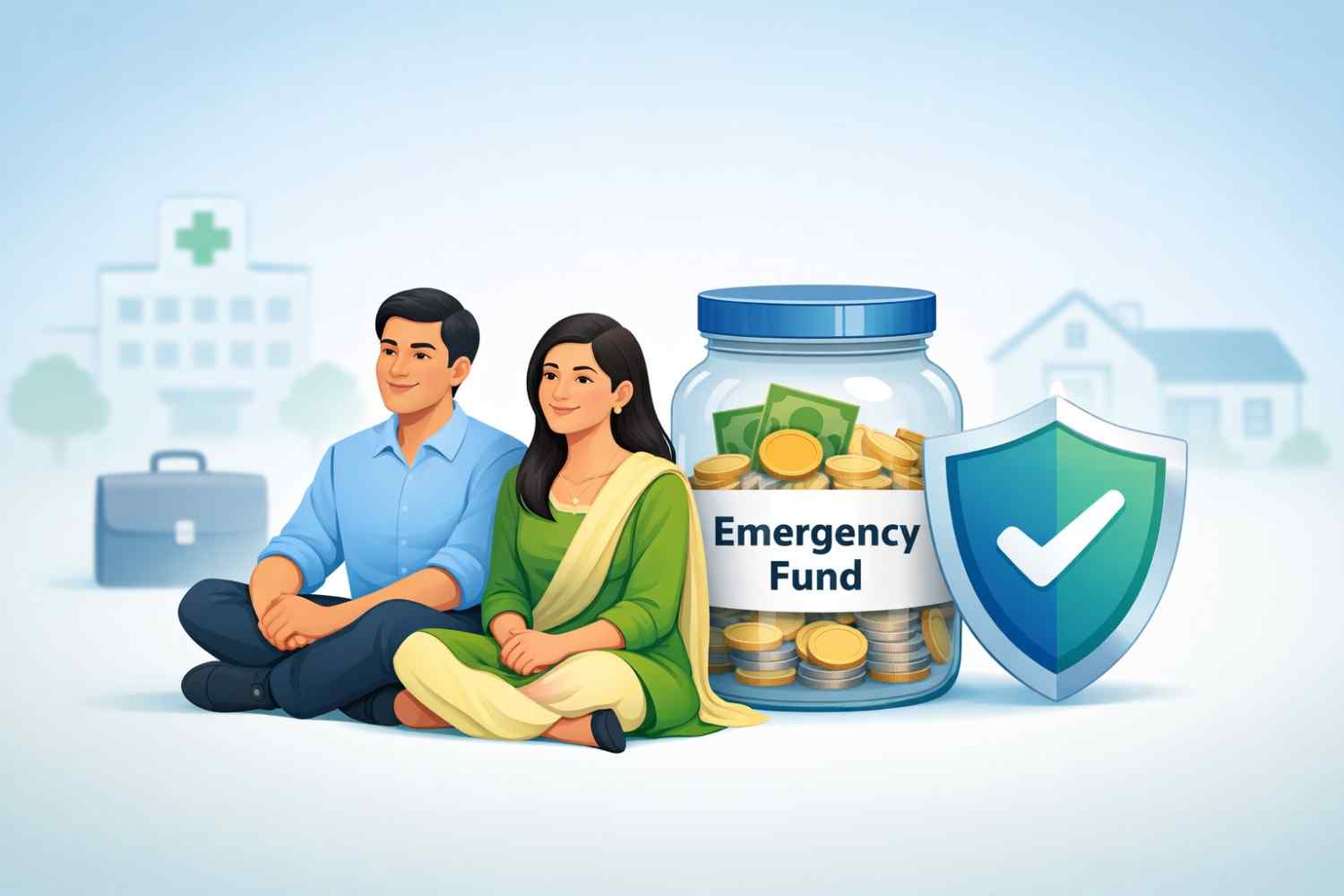
Learn what an emergency fund in India really means, how much is enough, where to keep it safely, common mistakes, real-life examples, and expert-backed rules. emergency fund in India, how much emergency fund is enough, where to keep emergency fund in India, emergency fund for salaried employees, emergency fund for freelancers, emergency savings India, emergency fund investment options.
Introduction: Emergency Funds Are About Financial Control
An emergency fund in India is not about expecting the worst; it is about being prepared for reality. Financial disruptions are not rare events anymore. They are part of modern working life, especially in an economy where income stability, healthcare costs, and employment security are uncertain for a large section of the population.
Most people who face financial emergencies are not careless spenders. They are ordinary earners who underestimated the speed and impact of a sudden expense or income loss. Without an emergency fund, even a temporary disruption can push households into debt, panic-driven decisions, or liquidation of long-term investments.
This article explains emergency funds in depth — not as a rule-of-thumb concept, but as a core financial system that protects your income, investments, and peace of mind.
What Exactly Is an Emergency Fund in India?
An emergency fund in India is a dedicated pool of money set aside exclusively for unexpected and unavoidable expenses. It is not an investment product, not surplus savings, and not money meant to grow aggressively. Its only purpose is protection.
A genuine emergency fund has three defining characteristics. First, it must be highly liquid, meaning the money should be accessible immediately or within a very short time. Second, it must offer capital safety, ensuring that the value does not fall during periods of stress. Third, it must provide predictability, so that you know exactly how much money is available when you need it.
If a financial instrument compromises even one of these characteristics, it is unsuitable for emergency savings. This is why emergency funds are deliberately boring. Their job is not to make you rich, but to stop you from becoming financially vulnerable.
Why Emergency Funds Matter More in India Than You Think
Emergency funds carry greater importance in India because financial risks are largely individualised. Unlike countries with strong social safety nets, Indian households bear most financial shocks themselves.
Healthcare expenses are often paid upfront, employment contracts provide limited protection, and family responsibilities frequently extend beyond the nuclear household. A single event such as job loss, medical treatment, or business slowdown can disrupt cash flow immediately.
Without an emergency fund, people are forced to rely on credit cards, personal loans, or premature withdrawals from long-term investments. This is consistent with liquidity and household risk concerns highlighted by the Reserve Bank of India in its financial stability communications. These actions may solve the short-term problem but create long-term financial damage. An emergency fund prevents a temporary problem from turning into a permanent setback.
Truth #1: Emergency Fund Size Depends on Risk, Not Rules
There is no universally correct emergency fund amount. The popular six-month rule is only a reference point, not a guarantee of safety. Emergency fund size must reflect income stability, profession, dependents, and health risks.
A stable government employee faces very different risks compared to a private-sector professional or a freelancer. Applying the same number blindly often leads to under-preparedness or inefficient capital allocation.
A realistic emergency fund is one that can comfortably sustain your household during a reasonable worst-case scenario without forcing lifestyle-altering decisions.
Truth #2: Salaried Employees Are More Vulnerable Than They Realise
Regular income creates a false sense of security. In reality, salaried employees face risks such as layoffs, delayed salaries, unpaid medical leave, and company shutdowns. These events often occur without warning.
An emergency fund covering at least six months of essential expenses gives salaried professionals the freedom to handle transitions calmly. It allows time to search for suitable opportunities instead of accepting compromised roles under financial pressure.
More importantly, it prevents disruption to long-term investments that are meant for goals like retirement or children’s education.
Truth #3: Freelancers and Business Owners Need Stronger Buffers
For self-employed individuals, income volatility is structural. Projects end, clients delay payments, and business cycles fluctuate. During emergencies, expected income often disappears.
An emergency fund for freelancers should ideally cover nine to twelve months of essential household expenses. This buffer ensures personal stability while allowing rational business decisions instead of desperation-driven compromises.
Without this cushion, even short disruptions can push self-employed individuals into debt, harming both personal finances and business sustainability.
Truth #4: Liquidity Is the Core Purpose of an Emergency Fund
Emergency funds must be accessible when stress levels are high and time is limited. Liquidity is more important than returns.
Many people park emergency savings in instruments that offer slightly higher yields but impose penalties or exit delays. This trade-off defeats the purpose of emergency funds.
Understanding how fixed deposits balance safety and accessibility is important when choosing instruments.
Truth #5: Market-Linked Instruments Are Risky for Emergencies
Equity mutual funds, stocks, ULIPs, and long-term instruments are unsuitable for emergency funds because their value fluctuates. During crises, markets are often down, forcing investors to sell at a loss.
Emergency funds must remain insulated from market conditions, as also emphasized in investor education material published by AMFI India on risk and liquidity. Mixing emergency money with growth assets exposes households to double risk — financial stress and capital loss.
Emergency funds should protect investments, not compete with them.
Truth #6: Building an Emergency Fund Requires Systems, Not Motivation
Many people delay building emergency funds because the target amount feels overwhelming. Waiting for motivation or a surplus often results in inaction.
The practical approach is to build the fund gradually, starting with one month of expenses and increasing it over time. This systematic approach is especially useful for readers exploring debt funds for short-term savings without market stress. Structured saving through low-risk instruments creates discipline without pressure.
Truth #7: Insurance and Emergency Funds Serve Different Roles
Insurance addresses defined risks; emergency funds address uncertainty. Even with comprehensive insurance, immediate cash requirements are common.
Hospital deposits, exclusions, and reimbursement delays often require upfront payments. Emergency funds fill this gap effectively and prevent reliance on high-interest borrowing.
Even with comprehensive insurance, health insurance claim delays and reimbursement gaps often create immediate cash requirements.
Truth #8: Emergency Funds Must Be Rebuilt After Use
Using an emergency fund without replenishing it creates hidden risk. Once the crisis passes, households often resume spending and investing without restoring the buffer.
An emergency fund must be treated as a renewable resource. Rebuilding it should take priority over discretionary expenses or aggressive investments to restore financial resilience.
Truth #9: Emergency Funds Change Financial Behaviour and Mindset
The most overlooked benefit of an emergency fund in India is psychological stability. Financial stress impairs decision-making, increases emotional reactions, and pushes people toward short-term thinking.
Households with adequate emergency funds make calmer choices. They negotiate better, avoid panic borrowing, and stay committed to long-term financial plans during uncertainty.
This behavioural advantage compounds over time. Emergency funds reduce anxiety, improve financial discipline, and create confidence — benefits that go far beyond the money itself.
Real-Life Examples
Example 1: Salaried IT Professional Facing Layoff
A 38-year-old IT manager lost his job during restructuring. His emergency fund covered eight months of household expenses, allowing him to upskill and wait for the right opportunity. He avoided selling equity investments during a market downturn and returned to work without long-term financial damage.
Example 2: Freelancer With Medical Emergency
A freelance consultant required urgent surgery. Despite having health insurance, the hospital demanded upfront payment and reimbursement took weeks. Her emergency fund covered medical costs immediately, preventing credit card debt and allowing her to focus on recovery rather than finances.
Example 3: Small Business Owner During Revenue Decline
A retail business owner faced a prolonged sales slowdown. His emergency fund supported household expenses while he stabilised operations. Without it, he would have taken high-interest loans, increasing both financial and business risk.
Conclusion
An emergency fund in India is the foundation of financial stability, not an optional add-on. It protects your income during disruptions, shields long-term investments from premature liquidation, and prevents debt-driven decisions. More importantly, it gives you the mental clarity to respond thoughtfully rather than react emotionally.
Building an emergency fund may feel slow, but its impact is immediate. Without it, even high incomes remain fragile. With it, financial shocks become manageable events instead of life-altering crises.
FAQs
Q1: How much emergency fund is enough in India?
There is no fixed number. Salaried individuals typically need around six months of expenses, while freelancers and business owners may require nine to twelve months depending on income stability and responsibilities.
Q2: Where should I keep my emergency fund?
Emergency funds should be kept in safe and liquid instruments such as savings accounts, sweep-in fixed deposits, or limited exposure to liquid funds. Accessibility and capital safety matter more than returns.
Q3: Can emergency funds be invested for higher returns?
No. Emergency funds should not be exposed to market risk. Higher returns often come with volatility and exit restrictions, which can be harmful during emergencies.
Q4: Is an emergency fund necessary if I already have insurance?
Yes. Insurance does not cover immediate cash requirements, exclusions, or reimbursement delays. Emergency funds bridge these gaps effectively.
Disclaimer
This article is intended for educational and informational purposes only. It does not constitute financial, investment, or tax advice. Financial decisions should be based on individual circumstances and professional consultation. Penny Blueprint does not guarantee financial outcomes from strategies discussed in this article.