
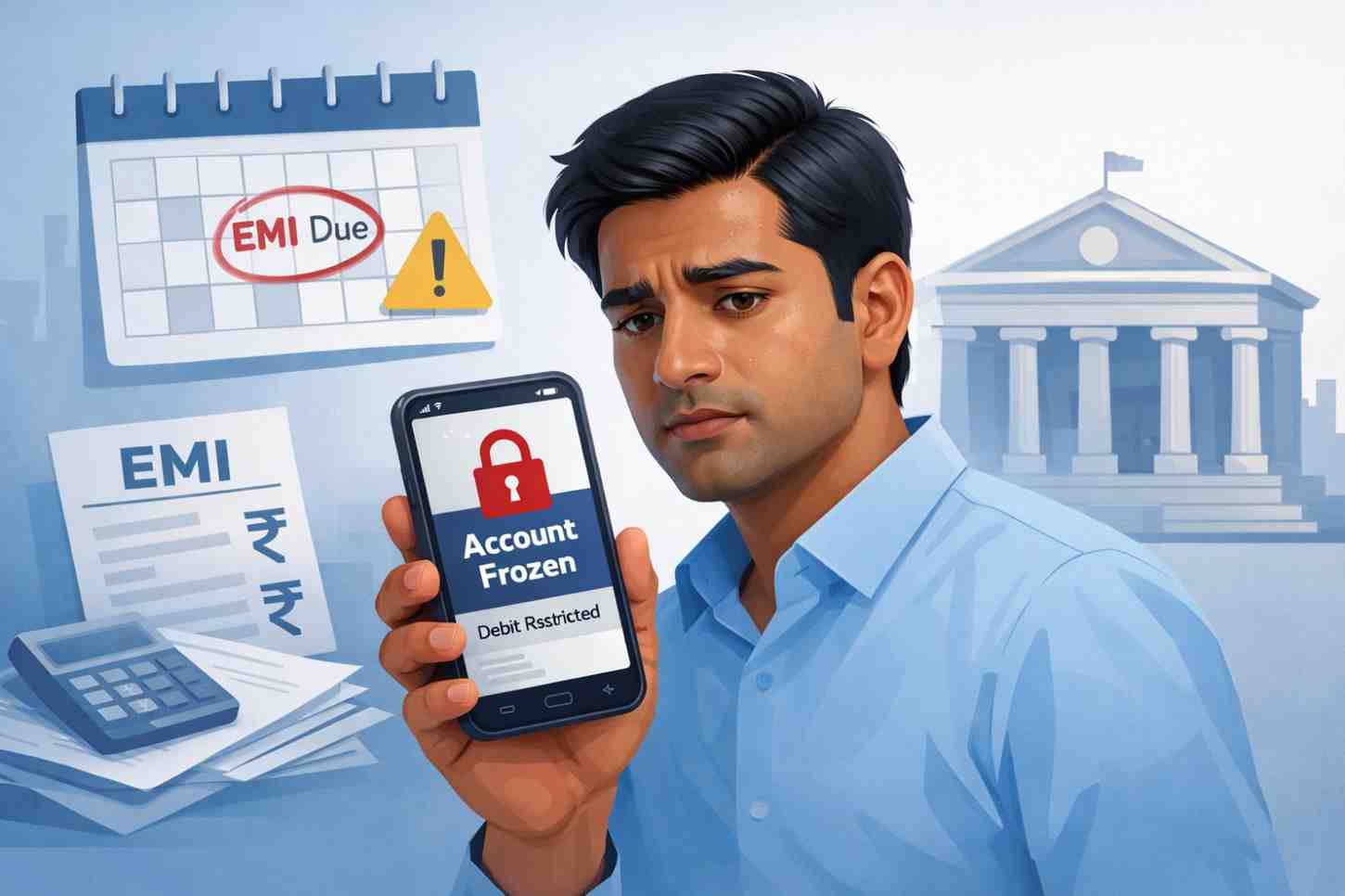
EMI when bank account is frozen in India can create penalties and credit score risks. Learn RBI rules, lender practices, real-life cases, and borrower solutions. EMI when bank account is frozen in India, EMI bounce due to account freeze, RBI rules on EMI debit, loan EMI account freeze, bank account frozen EMI impact.
Introduction
For most borrowers in India, loan EMIs are among the most sensitive financial obligations. Whether it is a personal loan, home loan, or credit card EMI, even a single missed payment can cause anxiety about penalties, credit score damage, or legal follow-ups. This stress multiplies when a borrower suddenly finds that their bank account has been frozen.
In such situations, people often assume the worst — that EMIs will bounce automatically, banks will treat them as defaulters, and their credit profile will be permanently damaged. However, the reality of emi when bank account is frozen in India is far more nuanced. RBI-backed banking principles, lender practices, and borrower rights together determine how such cases are handled.
This article explains the issue in depth, without fear-mongering or oversimplification. It walks you through how EMIs are treated during an account freeze, what rules apply, what risks genuinely exist, and how borrowers can protect themselves with timely and informed action.
1. What a Bank Account Freeze Really Means in Practical Terms
A bank account freeze does not automatically imply that the account has been shut down or that the customer has committed any wrongdoing. In India, account freezes are often preventive or compliance-driven measures imposed by banks to meet regulatory or legal requirements.
When an account is frozen, the bank restricts certain operations based on the reason for the freeze. In many cases, only debit transactions are blocked, while credits such as salary or refunds may still be allowed. In other cases, especially those involving legal orders or fraud investigations, both debit and credit operations may be stopped temporarily.
From an EMI perspective, this distinction is critical. EMIs are executed as automated debit instructions. If debits are restricted, the bank’s system simply cannot execute the EMI mandate, regardless of the borrower’s intent or repayment history.
To clearly understand how different freezes operate, you may refer to Debit Freeze vs Credit Freeze in Bank Accounts.
2. Can EMIs Be Debited When the Bank Account Is Frozen?
In most real-life situations, EMIs cannot be debited from an account that is under a debit freeze. Banks are legally obligated to enforce the restriction and cannot selectively allow outgoing transactions, even for loan repayments.
That said, borrowers should not assume that every freeze blocks EMIs. If the account is under a credit-only freeze, or if the EMI mandate is linked to another active account, the debit may still go through. Some loans are also structured to draw EMIs from overdraft facilities or linked secondary accounts, which may remain operational.
This is why borrowers must confirm the exact nature of the freeze with their bank instead of relying on assumptions. A lack of clarity at this stage often leads to unnecessary panic or delayed corrective action.
3. What RBI Principles Apply to EMI During Account Freeze
The Reserve Bank of India does not issue a separate circular for every possible EMI scenario. Instead, RBI regulates banks through principle-based guidelines that focus on fairness, transparency, and customer protection.
Under RBI principles, banks are required to:
- Enforce account restrictions strictly when mandated by regulation or law
- Inform customers clearly about the reason and scope of restrictions
- Avoid unfair penalisation when service disruption is bank-imposed
- Provide grievance redressal mechanisms for affected customers
Applied to EMI situations, this means that if an EMI fails solely because of a bank-imposed freeze, lenders are expected to assess the case contextually. Such failures should not be equated with wilful defaults or intentional non-payment.
4. What Actually Happens When an EMI Fails Due to Account Freeze
When an EMI fails because the linked account is frozen, it is first recorded as a failed debit in the lender’s system. At this stage, automated processes may trigger late payment alerts, reminder messages, or provisional charges.
However, this initial system response does not represent the final outcome. Once the borrower informs the lender and provides confirmation of the account freeze, many lenders reassess the situation. In genuine cases, late fees and penal interest are often reversed, especially if the issue is resolved within a short period.
Problems arise primarily when borrowers remain silent, assuming that the issue will correct itself automatically. Silence is often interpreted as neglect, whereas timely communication significantly improves outcomes.
5. Impact of EMI Failure on Credit Score and CIBIL Records
A widespread fear among borrowers is that even a single EMI failure during an account freeze will permanently damage their credit score. In reality, credit reporting is not instantaneous and depends on lender submissions to credit bureaus.
If the EMI failure is resolved quickly and the lender acknowledges that it occurred due to account restrictions, it is usually not reported as a default. Short delays caused by compliance-related freezes are often excluded from adverse reporting.
However, if the issue persists across multiple billing cycles without resolution or communication, the risk of credit score impact increases. This is why managing EMI when bank account is frozen in India is as much about communication as it is about resolution.
6. How Different Loan Types Are Affected by Account Freeze
The effect of an account freeze varies depending on the loan product. Personal loans are typically most affected because they rely directly on savings accounts for EMI debit. Home loans may offer slightly more flexibility, as lenders sometimes allow short deferments or alternate arrangements.
Credit card EMIs are particularly sensitive. Even when the underlying reason is a bank freeze, delayed payments can attract finance charges unless addressed quickly. Understanding these differences helps borrowers prioritise actions instead of reacting blindly.
7. What Borrowers Should Do Immediately After an Account Freeze
The moment a borrower becomes aware of an account freeze, especially close to an EMI due date, prompt action becomes critical. Confirming the type of freeze, informing the lender formally, and exploring alternate payment modes can prevent escalation.
If the freeze is related to lien marking or regulatory dues, this guide may help you understand the implications: Lien Marked on Bank Account: Meaning and Impact.
Early engagement almost always results in better outcomes than delayed reaction.
8. When EMI Issues Escalate Into Serious Financial Problems
EMI-related issues turn serious only when freezes remain unresolved for extended periods and borrowers fail to engage proactively. At this stage, repeated EMI failures may trigger credit reporting, legal notices, or loan restructuring discussions.
Such escalation is rarely sudden. It usually results from inaction rather than the freeze itself. Borrowers who treat the issue seriously from the first missed EMI rarely face long-term consequences.
9. Borrower Rights and Bank Responsibilities in the Long Term
Borrowers have the right to transparent communication, fair treatment, and grievance escalation when EMIs are affected by account restrictions. Banks, in turn, are responsible for enforcing freezes lawfully and correcting records once the underlying issue is resolved.
Understanding this balance of rights and responsibilities empowers borrowers to handle account freeze situations calmly and effectively instead of reacting out of fear.
Real-Life Examples: EMI When Bank Account Is Frozen in India
A salaried employee in Bengaluru had his account frozen due to incomplete KYC verification. His personal loan EMI failed once, but after submitting documents and informing the lender, the EMI was reprocessed without penalties or credit score impact.
In another case, a home loan borrower faced a temporary freeze during a fraud investigation linked to a UPI complaint. One EMI bounced, but late fees were reversed after the bank issued written confirmation of the freeze.
A small business owner experienced a lien-based freeze due to tax dues. His EMI continued only after shifting the debit mandate to an alternate active account, avoiding further disruption.
These real-life cases show that timely communication and documentation matter far more than the freeze itself.
Conclusion
Understanding EMI when bank account is frozen in India helps borrowers respond rationally rather than emotionally. An account freeze does not automatically mean default, nor does it guarantee long-term credit damage. What determines the outcome is awareness, speed of action, and communication with lenders. Borrowers who act early and document the situation clearly can navigate EMI disruptions with minimal long-term impact.
FAQs
Q1: Can EMI be debited when a bank account is frozen?
In most cases, EMIs cannot be debited if the account is under debit freeze. Banks are required to strictly enforce restrictions until they are formally lifted.
Q2: Will EMI failure due to account freeze affect my credit score?
Short-term EMI failures caused by account freeze usually do not affect credit scores if resolved quickly and communicated properly to the lender.
Q3: Can I pay EMI manually during an account freeze?
Yes, lenders usually allow alternate payment methods such as NEFT, cheque, or payment from another active account during temporary freezes.
Q4: How long does it take to resolve a bank account freeze?
Resolution timelines depend on the reason. KYC-related freezes may resolve within days, while legal or fraud-related freezes may take several weeks.
Q5: Should I stop EMIs until the freeze is removed?
No. Borrowers should arrange alternate payment methods instead of stopping EMIs voluntarily, as intentional non-payment can worsen outcomes.
Q6: Can banks charge penalties for EMI bounce due to account freeze?
Penalties may be applied initially by automated systems, but they are often reversed once the borrower proves the failure was due to account restrictions.
Disclaimer
This article is for informational and educational purposes only. Banking rules, lender policies, and regulatory guidelines may change over time. Readers should consult their bank or loan provider for advice specific to their situation.