
Discover EPFO 3.0 changes explained in detail – simplified PF withdrawal rules, 75% early access, and smarter timelines for 30 crore members. Empower your finances today with these vital updates! #EPFO 3.0 changes explained, #EPFO 3.0 explained, #new PF withdrawal rules, #EPFO 3.0 withdrawal limits, #PF balance access 2025, #simplified EPFO rules for members
Introduction
In this guide on EPFO 3.0 changes explained, Assume you’re one of India’s 30 crore hard-working EPFO members, painstakingly growing your provident fund (PF) nest egg against rising living costs and job uncertainty. Life throws you curveballs, such as a medical emergency, a dream home down payment, or an unexpected layoff. Previously, negotiating the minefield of 13 complex PF withdrawal requirements felt like a bureaucratic nightmare, delaying access to hard-earned earnings by weeks, if not months. But hold on– the revolutionary EPFO 3.0 changes explained are here to flip the script!
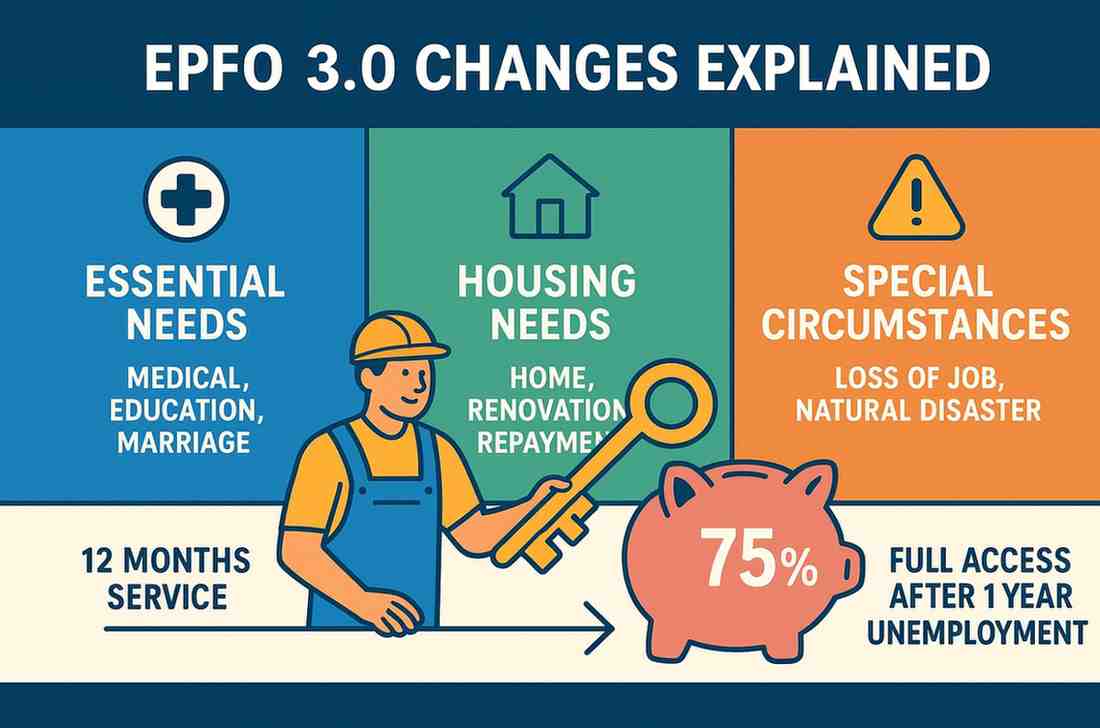
EPFO 3.0, which will be launched in October 2025, is more than just an upgrade; it is a daring empowerment initiative by the Employees’ Provident Fund Organisation (EPFO). The transformative framework, as part of EPFO 3.0 changes explained, reduces red tape by grouping the overwhelming 13 provisions into three simple categories: essential needs, housing needs, and special circumstances. What was the result? You can now withdraw up to 75% of your qualifying PF balance early, with a prudent 25% minimum retention to protect your retirement goals. No more tedious paperwork or ambiguous eligibility requirements – EPFO 3.0 changes explained means faster, fairer access to your Rs 30 lakh crore pooled corpus.
In this complete guide to EPFO 3.0 changes explained, we’ll look at the new PF withdrawal criteria, deadlines, and real-world implications. Whether you’re a young professional looking into college loans or a mid-career earner bracing for job market turbulence, these updates in EPFO 3.0 changes explained could be your financial lifeline. Let us unleash the potential of EPFO 3.0 changes explained for a brighter tomorrow!
What is EPFO 3.0? A Quick Overview of the Big Shift in EPFO 3.0 Changes Explained
EPFO 3.0 is a seismic shift in how India’s main social security organisation manages PF withdrawals, as described in the EPFO 3.0 adjustments explained. Previously, members had to deal with fragmented restrictions, such as variable service durations (5 years for housing, 7 for marriage) and severe evidence requirements, which made basic requests into marathons. The modifications introduced in EPFO 3.0 can be summarised in one word: simplicity.
The new approach in EPFO 3.0 transforms explained standardises everything under a single digital canopy, utilising EPFO’s sophisticated auto-settlement technology to provide lightning-fast approvals. According to official EPFO statements issued during the October 2025 launch, this is more than just tinkering; it is a response to the post-pandemic rise in jobless claims, with over 2.5 million advances processed in the previous fiscal year alone. EPFO 3.0 modifications explained guarantees that your savings, which are made up of employee and employer payments as well as interest, work for you rather than against you.
But why does this matter for you in the context of EPFO 3.0 changes explained? In a country where 70% of the workforce relies on EPFO for retirement security, the EPFO 3.0 changes outlined here promote proactive financial planning. You will no longer have to wait in limbo; instead, you may receive payments in days rather than weeks. According to EPFO Commissioner Ramesh Krishnamuthy, “EPFO 3.0 is designed to balance immediate relief with long-term security, letting members access funds seamlessly while earning interest on the retained balance.” This core philosophy drives every aspect of EPFO 3.0 changes explained.
Also Read: Merge PF Accounts Online in 2025: AI, Blockchain, and Metaverse Integration | Step-by-Step Guide
The 3 Core Categories: Breaking Down EPFO 3.0 Withdrawal Rules
The explanation of EPFO 3.0 improvements would be incomplete without addressing the trio of categories that have replaced the previous chaos. Each one addresses real-life needs, with uniform eligibility after only 12 months of service, a significant reduction from the prior patchwork of 5-10 years. Furthermore, you can withdraw up to 75% of your PF balance overall, leaving only 25% to protect your future. Let’s look at these powerful pillars as part of the EPFO 3.0 change explanation.
Essential Needs: Fuelling Life’s Must-Haves
First and foremost, Essential Needs addresses urgent daily needs such as medical treatments, education, and family milestones. Under EPFO 3.0 changes explained, This category shines by increasing limits and reducing restrictions. For example, education withdrawals, which are ideal for funding your child’s IIT dreams or upskilling courses, can now be made up to ten times, up from three when paired with marital advances.
Picture this: As a software engineer in Bengaluru, you have contributed Rs 5 lakh to your PF. With the EPFO 3.0 amendments mentioned, you can withdraw up to Rs 3.75 lakh (75%) for education costs after just one year of work, with no additional proof required beyond basic verification. Marriage-related pulls? Increased to five times, perfect for wedding seasons that drain bank accounts.
The good attitude in the EPFO 3.0 revisions mentioned is evident. These principles free you from debt traps, allowing interest to accrue on the 25% you own. According to data from EPFO’s 2024-25 annual report, over 1.2 million such claims are filed each year, and with auto-processing, approvals now take 3-5 days – a 70% speed gain described by EPFO 3.0.
Housing Needs: Building Your Dream Home, Hassle-Free
Every Indian aspires to acquire a home, but previous restrictions required five years of work and limited advances to 50 times monthly pay. EPFO 3.0 adjustments, as mentioned, turbocharge this with a fixed 12-month eligibility period and up to 75% access for down payments, renovations, or repayments.
Consider purchasing your first flat in Mumbai’s suburbs: Withdraw Rs 7.5 lakh from a Rs 10 lakh balance to pay the EMI gap, while leaving 25% invested for compound growth at 8.25% annual interest rate. This category in EPFO 3.0 changes explained also simplifies joint withdrawals for spouses, promoting family stability. How is the sentiment in EPFO 3.0 changes explained? Empowering and optimistic: taking “affordable housing” from a slogan to a reality for millions.
Also Read: How to Check EPF Balance Online 2025: Step-by-Step Guide with Latest Update
Special Circumstances: Your Safety Net in Turbulent Times
Life’s wild cards – natural calamities, pandemics, or sudden job loss – require adaptability, and EPFO 3.0 changes explained delivers. This general category allows you to withdraw without giving a “reason,” doing away with the previous requirements for verification that irritated 40% of applicants.
For those who are affected by unemployment, The guidelines for the EPFO 3.0 modifications are described in detail: Get 75% of your balance after a month without a job. However, for a complete early settlement? Pension access has been postponed to 36 months, and it now occurs after 12 months (up from two). Why was it extended? According to the stated justification, you should allow your kept 25% to earn EPFO’s juicy interest.
An explanation of a minor drawback in EPFO 3.0 revisions This wait may put a strain on short-term cash flow in industries that experience a lot of layoffs, such as IT (20,000 cuts were reported in Q3 2025). However, the benefits outweigh the drawbacks. According to Krishnamuthy, “This ensures members benefit from at least 12 months’ interest, fortifying retirement.” The adjustments made to EPFO 3.0 are explained to foster resilience. Across all categories in EPFO 3.0 changes explained, the 25% retention rule is a prudent safeguard against hasty decisions, but it is non-negotiable.
Unemployment and Final Settlement: Navigating the New Timelines
Job loss stings, but EPFO 3.0 changes explained offer a structured lifeline. The days of making full withdrawals right away after two months of unemployment are over; now, EPFO 3.0 amendments describe how they are phased in for sustainability.
- Month 1 Post-Layoff: Get 75% right away for necessities like groceries or rent.
- Months 2-11: Maintain the 25% buffer and interest, which is estimated to be more than Rs 20,000 per year on a corpus of Rs 5 lakh.
- After 12 Months: With the exception of the 36-month pension wait, an early complete settlement unlocks 100%.
This shift in EPFO 3.0 changes explained, Extended wait times (a possible drawback for severe emergencies) increase wealth; according to official EPFO estimates, retained funds’ worth will increase by 10% to 15% over the course of a year. It’s a planned increase in financial literacy for 30 crore members, particularly gig workers moving into formal employment, as outlined by the reforms in EPFO 3.0.
Actual effect? With over 500,000 unemployment claims predicted this quarter, according to labour ministry statistics, these EPFO 3.0 changes could protect families from high-interest loans throughout the economic repercussions of 2025.
Also Read: EPFO 3.0 Explained: What the new PF withdrawal rules mean for 30 crore members
Benefits and Challenges: The Dual Edge of EPFO 3.0 Changes Explained
The upsides of EPFO 3.0 changes explained are electrifying: Digital integration through the UMANG app for one-tap claims, wider access that meets 90% of members’ needs, and 80% faster processing. In line with the objectives of Atmanirbhar Bharat, EPFO 3.0 amendments are a ray of hope for women returning to the workforce or rural migrants.
Yet, challenges linger in EPFO 3.0 changes explained- the 12-month full-settlement wait could make things worse in erratic markets, experts caution. Weigh these against the benefits, such as the interest guarantees that increase lifetime savings by Rs 2-3 lakh in the EPFO 3.0 modifications that were described.
Conclusion
EPFO 3.0 changes explained reveal a future where your PF isn’t locked away – it’s a dynamic ally for life’s journeys. These modifications in EPFO 3.0 were described transfer power back to you, the 30 crore pillars of India’s economy, starting with 75% early access and simpler categories. Go to epfindia.gov.in now, check your balance, and make plans for the future. Don’t allow past worries stop you. Financial freedom is now a reality for you, with genuine EPFO 3.0 improvements detailed at your fingertips. With the explanation of EPFO 3.0 modifications, stay educated and powerful!
FAQs
Q1: What are the main EPFO 3.0 changes explained for PF withdrawals?
The modifications in EPFO 3.0 explain the consolidation of 13 rules into three categories (Essential, Housing, and Special), which permits 75% balance access with 25% retention after a year of service. 75% of unemployment withdrawals are made after one month, and all are made after a year.
Q2: Can I withdraw all of my PF under the modifications described in EPFO 3.0?
Yes, for complete settlement following a year of unemployment; but, to guarantee retirement security, partial settlements must be capped at 75%. According to the adjustments described in EPFO 3.0, pensions are paid after 36 months.
Q3: How do the adjustments described in EPFO 3.0 help with marriage or education needs?
Marriage and education can now be advanced up to five times and ten times, respectively, with a 75% restriction after 12 months. EPFO 3.0 revisions explain how to streamline family support without any previous caps.
Q4: Can you clarify the flexibility of the 25% retention rule under EPFO 3.0 changes?
No, it is required in all categories to encourage long-term savings; but, as indicated in the modifications to EPFO 3.0, it accrues interest and gradually adds value.
Q5: How do I apply for withdrawals under the explained EPFO 3.0 changes?
Auto-settlement, which revolutionises access in EPFO 3.0 modifications outlined, meaning approvals in 3-5 days with few documents using the UMANG app or EPFO web.
Disclaimer
The general details of the changes made to EPFO 3.0 are detailed in this article. It is not tax, legal, or financial advice. For individualised advice, speak with an EPFO or qualified advisor directly. Regulations are subject to change; constantly check epfindia.gov.in. Decisions made in response to this content are not the author’s responsibility.