
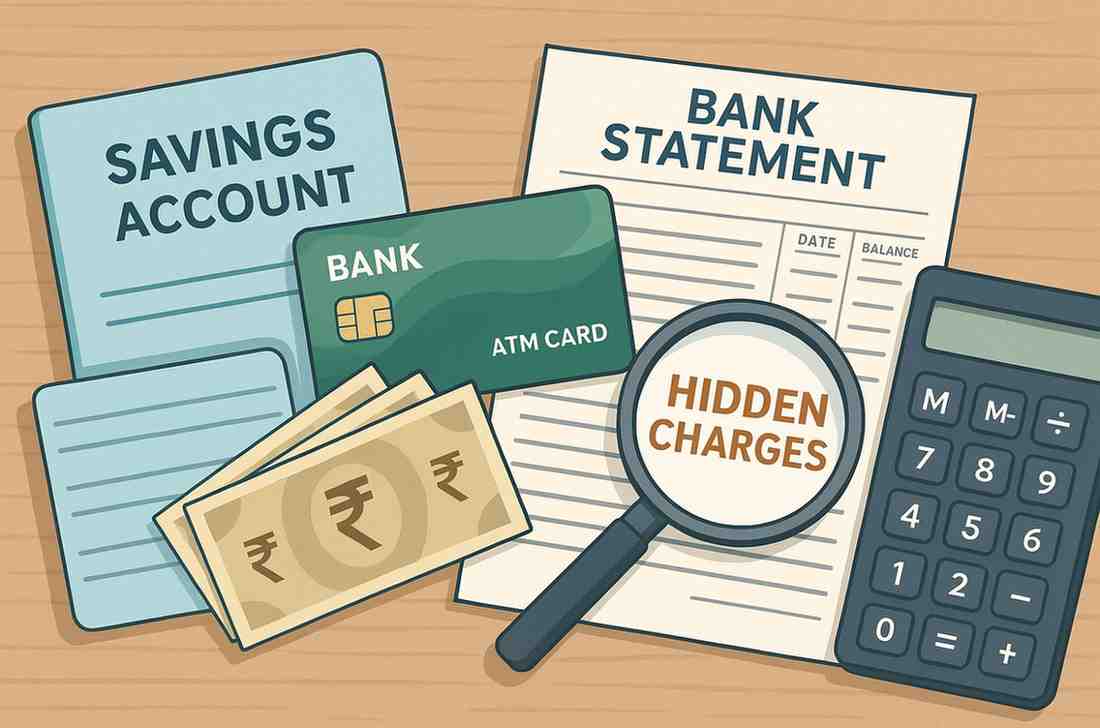
Discover the 7 most common hidden bank charges in India that quietly drain your savings. Learn how these fees work, why they occur, and simple steps to avoid losing money. Hidden bank charges in India, bank charges India, ATM decline fee, minimum balance penalty, SMS alert charges, banking fees India, debit card AMC, cash handling fee.
Introduction
Most Indians assume their bank accounts only include basic, transparent charges. But in reality, several hidden bank charges in India quietly reduce your savings month after month. These fees often go unnoticed because they are small—₹10, ₹25, ₹50—but repeated deductions can accumulate into thousands over a year without you realizing it. What makes them “hidden” is not secrecy, but the fact that the information is buried deep inside long service charge documents that most customers never read.
Banks apply these charges for ATM declines, low balances, branch visits, cash deposits, SMS alerts, and more. While each fee may seem minor, together they create unnecessary financial leakage. Understanding these charges is the first step to preventing them and managing your money more efficiently.
This article breaks down 7 real hidden bank charges, shows how they silently affect your balance, and offers simple, practical ways to avoid them. Whether you’re a beginner in personal finance or already manage multiple accounts, this guide will help you stay one step ahead of unexpected deductions.
ATM Decline Charges
ATM decline charges are among the most common hidden banking deductions. People assume fees apply only when cash is withdrawn, but banks treat every transaction attempt—even if unsuccessful—as a service request, which can lead to charges.
Why ATMs Charge for Failed Transactions
- Banks process every ATM request through authentication servers, even if the transaction fails. This requires computer resources, banking networks, and safety checks.
- Even a failed transaction sends alerts, logs data, and processes multiple verification layers, all of which carry operational costs for the bank.
- For off-us ATMs (other bank ATMs), your bank must pay an interchange fee to the ATM owner, even if the transaction doesn’t succeed, which is why you see deductions.
To understand the full cost of ATM usage, you can also check the latest ATM withdrawal charges in India, which vary based on network, bank type, and monthly limits.
Typical Charges
Most banks charge between ₹15–₹25 per failed transaction, depending on account type and ATM location.
Real Example
Imagine your balance is ₹500 and you try withdrawing ₹1,000. The ATM will decline the request instantly. But because the machine still processed your authentication and communicated with your bank’s servers, you may be charged a decline fee—reducing your already low balance further.
Why It Feels Hidden
Banks often label these deductions vaguely as “ATM Decline,” “Interchange Fee,” or “Transaction Failed Charge,” making them difficult for customers to interpret without prior knowledge.
How to Avoid ATM Decline Charges
- Always check your balance in the bank’s mobile app before visiting an ATM. This helps you avoid attempts that exceed your available funds or your withdrawal limit.
- Try to memorize your PIN and avoid multiple wrong entries. After several incorrect attempts, many ATMs block your card temporarily, which can lead to additional inconvenience and charges.
- Withdraw cash from your own bank’s ATM whenever possible. This reduces the chance of interchange fees and helps you stay within free transaction limits.
Cash Handling Charges
Cash handling charges are applied when customers exceed their monthly free limits for cash deposits or withdrawals at branches. Most users are unaware that these limits exist.
Why These Charges Exist
- Counting, verifying, and circulating cash require manpower and equipment. Banks spend resources on cash-management infrastructure and security, which they recover by applying these fees.
- Branches are expensive to operate, and cash-heavy customers increase the workload significantly. This pushes banks to promote digital payments and reduce cash dependency.
- Digital transactions cost banks almost nothing, so charges on cash encourage customers to shift toward online banking.
You can also review the cash deposit rules and limits in India to understand when banks apply higher charges on cash-based transactions.
Who Gets Affected Most
- Small business owners who deposit cash daily or weekly often cross their free deposit limit without realizing it.
- Individuals withdrawing cash for monthly household expenses may also exceed the free withdrawal cap if they prefer cash over digital payments.
- Salary account holders, who assume all services are free, get penalized when they unknowingly exceed cash limits.
Typical Charges
Banks typically charge:
- ₹25–₹150 per transaction, OR
- ₹2–₹3 per ₹1,000 deposited beyond the free limit.
Why It Feels Hidden
When opening an account, staff rarely explain the free cash deposit and withdrawal limits. Most customers only discover these charges after seeing unexpected deductions in their passbook.
How to Avoid Cash Handling Charges
- Shift larger payments to UPI, NEFT, IMPS, or net banking to avoid cash entirely. Digital transfers are usually free and quicker than branch visits.
- Make fewer but larger deposits instead of frequent small deposits. This helps you stay well within free limits.
- Regularly check your free transaction limits through your banking app so you can plan branch visits more efficiently.
SMS Alert Charges
Despite the rise of mobile banking apps, many banks still charge customers for SMS alerts. These fees often go unnoticed since they are deducted quarterly in small amounts.
Why Banks Charge for SMS Alerts
- Each SMS notification sent for balance updates, OTPs, and transaction alerts costs money. With millions of customers, these costs add up for banks.
- Though apps provide real-time updates, SMS remains a backup communication channel to ensure delivery even without internet connectivity.
- Older systems automatically enroll customers into paid SMS packs unless manually disabled.
With digital payments surging, banks have recently pursued exemptions for SMS alerts on transactions under ₹100, showing how SMS-fee practices are evolving.
Typical Charges
Most banks charge ₹10–₹25 per quarter for SMS alerts.
The Real Problem
Many users rarely check their passbook or e-statement, so these small recurring fees continue for years without detection. Over time, these unnoticed charges can accumulate into hundreds or thousands.
Why It Feels Hidden
Banks rarely notify customers when adding them to SMS packs. In many cases, SMS charges appear under “Service Fee” or “Other Charges,” which makes identification difficult.
How to Avoid SMS Alert Charges
- Shift fully to app-based notifications, which are instant and free. Mobile apps provide detailed transaction history without requiring SMS.
- Disable non-essential SMS alerts through your bank’s settings or customer care if your bank allows customization.
- Choose banks offering free SMS alerts or digital-only accounts with minimal communication charges.
Minimum Balance Penalty
Minimum balance penalties are among the most misunderstood hidden charges. Customers often believe the bank checks only the closing balance, but the reality is very different.
How Banks Calculate MAB (Monthly Average Balance)
- Banks compute the average of your daily closing balances over the entire month, not a single day’s balance.
- Even dipping below the required balance for just one or two days can lower your monthly average and trigger a penalty.
- Higher minimum balance requirements in metro branches lead to more frequent penalties compared to rural accounts.
If you want to compare alternatives, this guide on whether zero-balance accounts are truly free helps understand which accounts avoid MAB penalties altogether.
Typical Penalties
Penalties range between ₹100 and ₹600 per month, depending on your account tier, location, and deficit amount.
Example Scenario
If your required MAB is ₹10,000 and you keep ₹2,000 for 4–5 days, your average balance drops significantly. Even if you later maintain ₹10,000 for the remaining days, the earlier dip is enough to attract charges.
Why It Feels Hidden
Banks emphasize the benefits of the account during onboarding but rarely explain the calculation formula or the high penalty structure. This creates confusion, especially among new customers.
How to Avoid Minimum Balance Penalties
- Maintain a small buffer in your account so short dips do not pull the average below the threshold.
- Set balance alerts or reminders through the app so you are aware of your balance daily.
- If maintaining MAB is difficult, switch to a zero-balance digital account to avoid unnecessary penalties.
Debit Card Annual Maintenance Charges
Most customers assume debit cards are free forever, but banks deduct annual maintenance fees silently once every year, often without prior notification.
Why Banks Charge AMC (Annual Maintenance Charges)
- Debit cards rely on payment networks like RuPay, Visa, or Mastercard, which charge banks for their services.
- Banks also incur security costs due to fraud detection systems, chip upgrades, contactless technology, and replacement logistics.
- Premium or upgraded cards offer additional perks, which increase maintenance costs.
For official limits on ATM usage and applicable charges, you can refer to the RBI’s ATM charges FAQ, which explains free transactions and fee caps for customers.
Typical Charges
Annual fees range from ₹100 to ₹500 depending on the type of debit card. Premium variants may cost even more.
Hidden Issue You May Miss
Banks sometimes upgrade debit cards automatically, offering “free upgrades” but later charging higher annual fees. Customers often notice only when the deduction appears.
How to Avoid Debit Card AMC
- If you don’t use advanced features, request the bank to downgrade your card to a basic version with lower or zero maintenance fees.
- Deactivate unused cards to stop recurring AMC charges, especially if you have multiple accounts.
- Choose modern digital banks that offer zero-AMC debit cards as part of their product model.
Inactive Account Charges
An inactive or dormant account can lead to unexpected charges. Many people leave old salary accounts unused after switching jobs, only to discover deductions months later.
Why Accounts Become Inactive
- If there are no customer-initiated transactions for 12–24 months, banks classify the account as inactive.
- Salary accounts become inactive if salary credits stop for a few months and no other transactions are made.
- Even if your balance remains untouched, inactivity triggers compliance protocols.
If your account has already become inactive, here is a simple guide on reactivating an inactive bank account without paying unnecessary penalties.
Typical Charges
Banks may charge ₹50–₹300 as reactivation or service fees. Some banks impose annual dormancy charges if the account remains unused for long.
Hidden Issue
If your account holds a small balance, these charges can gradually erode the entire amount. Many customers find their dormant accounts emptied when finally checking after years.
How to Avoid Inactive Account Charges
- Make at least one transaction every few months—such as a small transfer, mobile recharge, or balance inquiry.
- If the account is no longer needed, close it permanently instead of letting charges accumulate.
- Keep a list of all your bank accounts and track which ones you actively use.
Cheque Book & Branch Service Charges
Cheque books and branch services are not fully free. Banks typically offer limited free leaves and free transactions only up to a certain threshold.
Common Branch Charges
- Extra cheque leaves beyond the free quota cost ₹3–₹5 per leaf.
- Demand drafts and pay orders may attract charges of ₹20–₹50, depending on the bank and amount.
- Cash deposits at branches beyond the limit can cost ₹25+ per transaction.
- Duplicate passbooks or signature change requests may incur small service fees.
Why It Feels Hidden
Customers assume branch services are included as part of their account benefits. Most banks don’t notify customers when they exceed limits, resulting in surprise deductions.
How to Avoid These Charges
- Use net banking or mobile banking platforms for services like cheque requests, statement downloads, or draft generation. These services are often free online.
- Shift to digital payments instead of using cheques for routine transactions.
- Track your free branch visit and cheque limits in your mobile banking app.
[Internal Link: Add your link here → Example: “How to Use NetBanking Safely”]
Pros & Cons of Modern Banking Charges
Pros
- Banks invest heavily in digital security, fraud prevention, ATM networks, and customer service infrastructure. These charges help them cover essential operating costs and maintain banking quality.
- Fees encourage customers to shift from cash-based transactions to digital platforms, which are safer, faster, and more cost-effective for both banks and users.
- Transparency has improved over the years, with all banks publishing detailed service charge documents online, though customers still need to make the effort to review them.
Cons
- Hidden charges create confusion among customers who don’t monitor their accounts closely or understand banking terminology.
- Multiple small charges accumulated throughout the year can significantly reduce savings, especially for low-income users.
- Each bank has different rules and limits, making it hard for customers to compare accounts or know which bank is most cost-effective.
- Customers rarely receive real-time alerts for deductions like minimum balance penalties, making these charges easy to miss.
Conclusion
Hidden bank charges may seem insignificant, but over time they can drain a substantial portion of your savings without your knowledge. By understanding how these charges work and learning simple techniques to avoid them, you can take full control of your financial health. Regularly reviewing your statements, using mobile apps intelligently, minimizing branch visits, and avoiding unnecessary ATM attempts are all effective strategies to reduce your banking costs.
To continue improving your financial awareness, explore more educational guides and stay informed about the charges associated with your account type. A little attention today can help you prevent unnecessary losses tomorrow.
[Internal Link: Add your link here → Example: “How to Manage Your Savings Account Smartly”]
FAQs
Q1: Are banks allowed to deduct hidden charges?
Yes, banks are permitted to deduct charges listed in their official service charge documents. The problem arises because customers do not read these documents, leading to confusion when charges appear unexpectedly.
Q2: How can I check which charges were applied to my account?
Review your monthly statement and look specifically for entries under “Service Charges,” “Other Fees,” “ATM Decline,” or “SMS Charges.” Most fees are recorded clearly, but the descriptions may require some interpretation.
Q3: Which banks apply fewer hidden charges?
Digital banks often apply fewer charges, but no bank is completely free. Even zero-balance accounts have specific terms, so it is essential to read the complete schedule of charges before choosing a bank.
Q4: How can I avoid unnecessary ATM decline fees?
Check your balance before withdrawing, avoid wrong PIN attempts, and use your own bank’s ATM to stay within free limits. Following these steps reduces the risk of failed transactions.
Q5: What should I do if I believe a charge was wrongly applied?
Start by raising a complaint with your bank’s customer care or grievance officer. If the issue remains unresolved, escalate it through the RBI Ombudsman platform, which is designed to protect customers.
Disclaimer
This article is for educational purposes only. Banking charges differ by bank, account type, and location. Readers should verify fees using official bank documents and guidelines. This content does not provide personalized financial advice.