
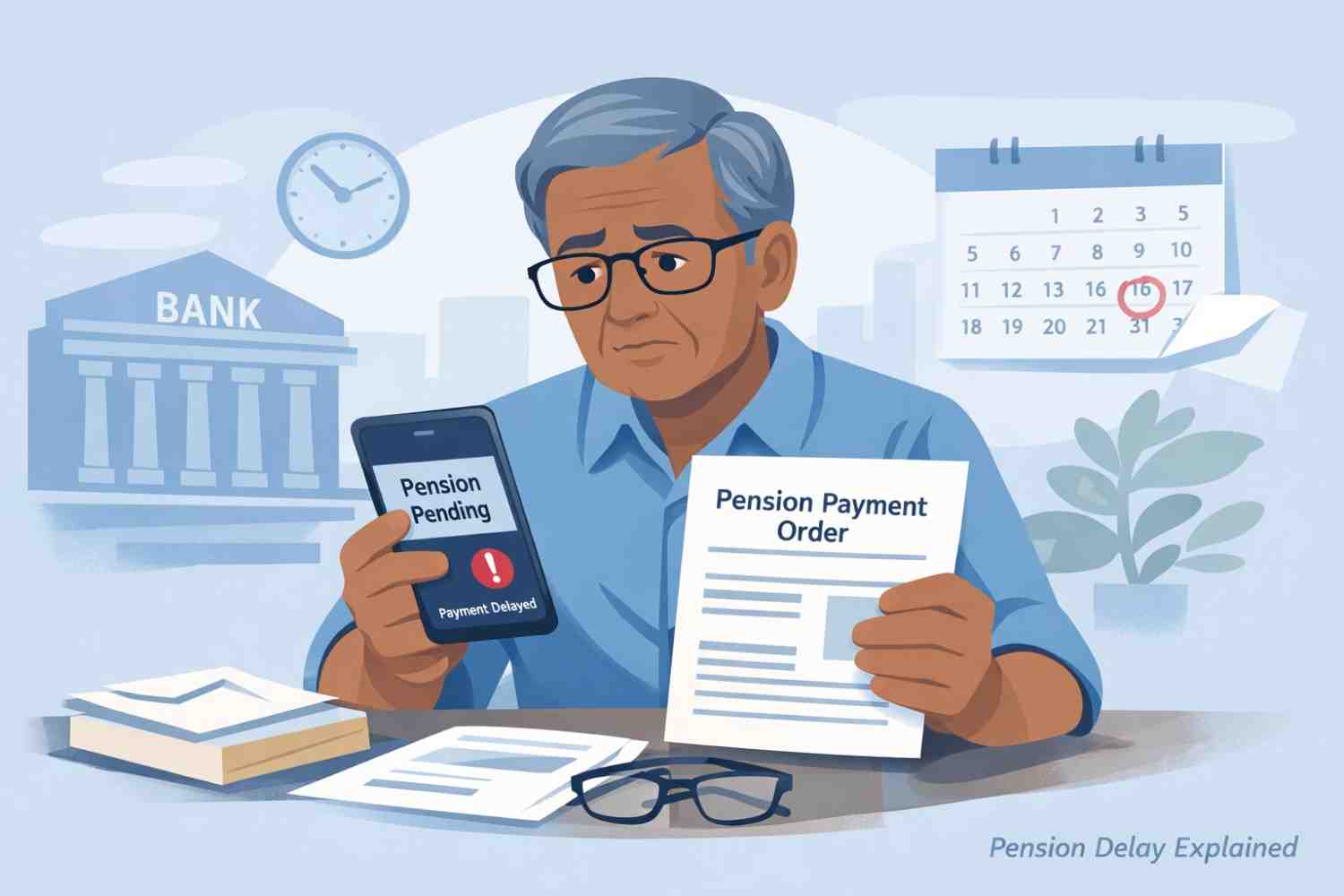
Pension delayed after retirement can cause financial stress. Learn 9 critical reasons, RBI rules, legal remedies, and steps to resolve pension delays in India. pension delayed after retirement, pension delay reasons in India, pension not credited after retirement, pension grievance portal India, RBI rules on pension payment, pension arrears delay, bank pension payment delay.
Introduction
Retirement is expected to bring financial stability and peace of mind. However, for many retirees in India, this phase begins with anxiety when pension payments are delayed after retirement. A delayed pension is not merely an administrative inconvenience—it directly affects monthly household expenses, medical treatment, loan obligations, and emotional well-being. Rising living costs further intensify the problem, especially when retirement income fails to keep pace with inflation over time.
When regular income stops suddenly, retirees are often forced to depend on savings meant for emergencies.
The problem of pension delayed after retirement is more common than most people realize. While pension rules and grievance mechanisms exist, lack of awareness and procedural complexity often prevent timely resolution. Rising living costs further worsen the impact
This article explains the nine most critical reasons behind pension delays, the regulatory framework governing pension payments, and the legal remedies available to retirees in India, supported by real-life examples and practical action steps.
1. Incomplete or Incorrect Pension Documentation
One of the primary causes of pension delay after retirement is incomplete or inaccurate documentation submitted during retirement processing. Pension authorities and banks rely entirely on official records, and even minor discrepancies can stop pension payments. Errors in name spelling, date of birth, bank account number, or nominee details often trigger verification holds.
Many retirees assume that documentation submitted during service is automatically updated at retirement, which is rarely the case. When documents such as identity proof or KYC records do not match the Pension Payment Order (PPO), banks are unable to release pension funds. These issues usually come to light only after the expected pension credit fails, leading to prolonged follow-ups.
2. Delay in Issuance of Pension Payment Order (PPO)
The Pension Payment Order is the foundation of pension disbursement. Without a valid PPO, no bank can begin pension payments. Delays in PPO issuance are common due to pending service record verification, departmental audits, or administrative backlogs.
Government departments, PSUs, and autonomous bodies follow different internal workflows, which can slow down PPO approval even after retirement is officially processed. Retirees often confuse retirement approval with pension authorization, not realizing that pension begins only after PPO issuance and transmission to the pension disbursing bank.
3. Bank-Level Processing Delays After PPO Submission
Even after PPO issuance, pension delayed after retirement can occur due to bank-side processing delays. This situation is similar to cases where the payment is approved internally but money is present in the bank account but cannot be accessed due to verification or operational restrictions.
Banks must authenticate PPO details, complete KYC validation, and map the pension account correctly before initiating payments. This initial processing stage often takes longer than expected.
As per the guidelines issued by the Reserve Bank of India, banks are responsible for timely pension disbursement once all documents are verified. However, delays frequently persist unless the retiree actively follows up.
4. Issues During Transition from Salary Account to Pension Account
Many pension delays arise when salary accounts are not properly converted or mapped to pension accounts. Pension payments are not always credited to the existing salary account unless specific instructions are followed. If the salary account is closed prematurely or not designated correctly, pension credit may fail.
Branch mergers, IFSC changes, or account status modifications further complicate this transition. Retirees often assume this conversion happens automatically, but in practice, written confirmation and verification are usually required. Any lapse during this stage can result in delayed pension payments.
5. Government System Migration and Digital Data Mismatch
With increasing digitization, pension systems are being migrated to centralized platforms. While this improves long-term efficiency, it has introduced technical challenges. Data mismatches between departmental databases and banking systems often result in temporary suspension or delay of pension credits.
Aadhaar linkage issues, incomplete digital records, or system migration errors disproportionately affect senior citizens. Resolving such issues typically requires coordination between departments and banks, which can significantly delay pension disbursement.
6. Life Certificate Submission and Verification Problems
Submission of a life certificate is mandatory for continued pension payments. Failure to submit it within the prescribed timeline can lead to temporary stoppage or delay of pension. Even when submitted, verification issues can arise if digital records fail to update correctly.
Many retirees face delays during peak submission periods, especially toward the end of the year. Since pension resumes only after successful verification, even a short delay in life certificate processing can disrupt monthly income and lead to arrears accumulation.
7. Delay in Pension Arrears and Backdated Calculations
Pension arrears are often delayed even after regular pension payments begin. Prolonged arrears often force retirees to depend on
alternate income sources during retirement to manage essential expenses. Arrears usually arise due to retrospective benefit revisions or pay commission updates, which require recalculation and separate approvals. This additional layer of processing increases the likelihood of delay.
Retirees frequently assume arrears will be credited automatically, but in reality, follow-up is often required.
8. RBI Rules and Government Guidelines on Pension Disbursement
The Reserve Bank of India has issued clear instructions stating that banks must ensure timely pension payments once documentation is complete. Pension is treated as a priority payment, and undue delay without valid reasons is discouraged.
In certain cases, banks may be liable to compensate pensioners for delays, depending on circumstances and grievance outcomes. Awareness of these rules empowers retirees to demand accountability instead of accepting delays as unavoidable administrative issues.
9. Legal Remedies and Escalation Options Available to Retirees
When pension delayed after retirement persists despite repeated follow-ups, retirees have the right to escalate the issue formally. The escalation process typically begins with a written complaint to the bank branch, followed by escalation to the bank’s grievance redressal cell and the pension disbursing authority.
If the issue remains unresolved, retirees can file complaints through the Centralised Public Grievance Redress And Monitoring System (CPGRAMS) or approach the banking ombudsman. Legal notice is generally considered a last resort when administrative remedies fail.
Real-Life Examples of Pension Delay
Example 1: Government Employee Facing PPO Delay
A retired central government employee waited nearly four months for his pension because the PPO was pending internal audit approval. Although retirement benefits were sanctioned, service record verification caused delays. During this period, he relied on personal savings for medical and household expenses. After submitting written representations, the PPO was issued and pension along with arrears was credited.
Example 2: PSU Retiree Facing Bank-Level Delay
A PSU retiree received confirmation that his pension was sanctioned, yet no credit was received for over two months. The delay was caused by a KYC mismatch between PPO details and bank records. After escalating the issue to the bank’s grievance redressal cell, verification was completed and pension payments resumed with arrears.
Example 3: Pension Stopped Due to Life Certificate Issue
An elderly pensioner experienced sudden pension stoppage because her digital life certificate failed to update correctly. She remained unaware until the monthly credit stopped. After resubmitting the certificate and verification, pension resumed and pending arrears were released in the next cycle.
WHAT TO DO IF YOUR PENSION IS DELAYED
Step 1: Verify PPO and Pension Sanction Status
First, confirm whether the PPO has been officially issued and transmitted to the bank. Many delays occur because retirees assume PPO issuance is complete when it is still pending at the departmental level.
Step 2: Recheck Bank Account Mapping and KYC
Ensure that the pension is mapped to the correct bank account and that KYC details such as name, date of birth, and Aadhaar are consistent. Even minor mismatches can halt pension credit.
Step 3: Confirm Life Certificate Submission
Check whether the life certificate has been successfully submitted and updated in the system. If submitted digitally, confirm acknowledgment; if physical, verify that the bank has processed it.
Step 4: Submit Written Complaint to Bank or Authority
Always submit complaints in writing—either via email or official grievance forms. Written communication creates a record and significantly improves response time.
Step 5: Escalate Systematically if Delay Continues
If the issue is unresolved, escalate step by step through bank grievance cells, pension authorities, government portals, and finally the banking ombudsman if required.
Conclusion
Pension delayed after retirement is a systemic issue caused by documentation gaps, procedural delays, and coordination failures between departments and banks. For retirees, the financial and emotional impact can be significant, especially when pension is the primary source of income. The good news is that most pension delays are resolvable through timely verification, written follow-ups, and structured escalation. Awareness of rules, RBI guidelines, and grievance mechanisms empowers retirees to act confidently. Retirees should also review other post-retirement financial rules, including EPF rules after retirement, to avoid income disruption during later years.
Pension is a right earned through years of service, and no retiree should hesitate to seek timely resolution.
FAQs
Q1: How long can pension be delayed after retirement in India?
While no fixed timeline exists, pension usually starts within a few months after retirement once documentation is complete. Extended delays often indicate procedural or verification issues.
Q2: Can banks be held responsible for delayed pension payments?
Yes, banks may be held accountable if delays occur despite complete documentation. Formal escalation is essential to establish responsibility.
Q3: Is interest paid on delayed pension arrears?
Interest may be applicable in specific cases, depending on rules and authority decisions. It is not automatically credited.
Q4: What if PPO is issued but pension is not credited?
This generally indicates bank-level processing delays. Immediate follow-up with the pension disbursing bank is required.
Q5: Can pension be stopped without prior notice?
Pension can be temporarily stopped due to non-submission of life certificate or verification issues, but it should resume once compliance is completed.
Q6: Where can retirees complain about pension delays?
Complaints can be raised with banks, pension authorities, CPGRAMS, or the banking ombudsman if necessary.
Disclaimer
This article is for informational purposes only and does not constitute legal or financial advice. Pension rules and procedures may change over time. Readers are advised to verify details with official authorities or consult professionals before taking action.