
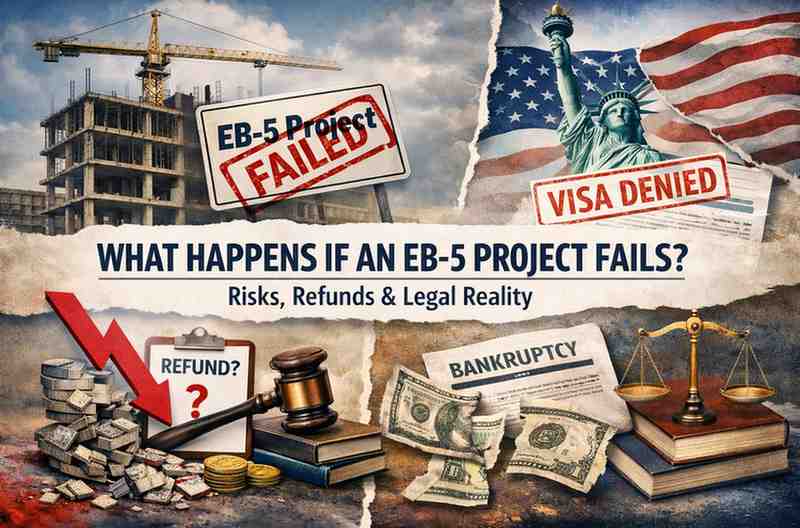
What happens if an EB-5 project fails? Understand EB-5 investment risks, refund rules, legal outcomes, and how project failure can affect both money and U.S. residency. what happens if an EB-5 project fails, EB-5 project failure risks, EB-5 refund rules, EB-5 investment risks.
Introduction
Before investing large sums into an immigration-linked program, one critical question investors must ask is what happens if an EB-5 project fails. While the EB-5 Immigrant Investor Program is legally recognised by U.S. authorities, the investment itself is not protected from commercial risk.
Many investors mistakenly assume that immigration approval guarantees financial safety. In reality, EB-5 investments are required to remain “at risk,” meaning losses are legally possible. If a project collapses, investors may face capital loss, immigration delays, or even visa denial. This article explains the real risks, refund realities, and legal consequences associated with EB-5 project failure.
How EB-5 Projects Are Structured
Most EB-5 investments are routed through regional centers, where multiple investors pool capital into large commercial projects such as hotels, residential developments, or infrastructure ventures. These projects are expected to generate employment, which forms the foundation for immigration eligibility.
From an immigration perspective, the U.S. government focuses on job creation, not profitability. From an investment perspective, the project operates like any other private venture, exposed to market risks, execution failures, and financing constraints. Importantly, U.S. immigration authorities do not guarantee project performance or capital repayment.
According to U.S. Citizenship and Immigration Services, EB-5 capital must remain at risk for the investment to qualify, explicitly acknowledging the possibility of loss.
What Happens If an EB-5 Project Fails?
When investors ask what happens if an EB-5 project fails, the outcome depends on both timing and severity.
If failure occurs before job creation targets are met, immigration petitions may be denied or placed under prolonged review. In such cases, investors risk losing both their capital and their opportunity for U.S. residency. If the project fails after job creation is completed, immigration benefits may still be granted, but financial recovery becomes uncertain.
In practical terms, project failure can lead to:
- Loss of invested capital
- Lengthy legal proceedings
- Asset liquidation at discounted values
- Extended immigration processing timelines
The separation between immigration approval and financial outcome makes EB-5 uniquely complex.
Does EB-5 Project Failure Automatically Cancel Residency?
Not necessarily, but there is no guarantee.
If job creation can be proven through direct or indirect economic activity before the project fails, some investors may still qualify for permanent residency. However, if job creation is incomplete or disputed, immigration approval is at serious risk.
This uncertainty highlights why EB-5 should never be viewed as a guaranteed immigration route. The immigration benefit depends on compliance, documentation, and timing—not project success alone.
Are Refunds Guaranteed If an EB-5 Project Fails?
Refund expectations are one of the biggest misconceptions in EB-5 investing.
There is no automatic refund mechanism under EB-5 regulations. Whether investors recover any money depends on the legal structure of the project, escrow arrangements, loan or equity terms, and remaining assets after liquidation. In many cases, investors rank as unsecured creditors, meaning recovery may be partial or non-existent.
This legal reality reinforces why understanding what happens if an EB-5 project fails is essential before committing capital.
Legal Reality: Who Bears the Risk?
Legally, the investor bears the commercial risk, not the U.S. government.
Regional centers are required to disclose risks, but they are not obligated to guarantee returns or refunds. Immigration approval is assessed separately from financial outcomes, creating a dual-risk scenario where investors may succeed in one area and fail in another.
Compared to wealth-preservation strategies such as safe-haven assets like gold, EB-5 carries significantly higher downside exposure, as its primary purpose is immigration rather than capital protection.
Real-Life Examples
Example 1: Project Failure Before Job Creation
A group of investors funded an EB-5 hotel project that stalled due to financing disputes. Construction halted, job creation targets were missed, and immigration petitions were denied. Most investors faced prolonged litigation with limited capital recovery.
Example 2: Immigration Approved, Capital Lost
In another case, job creation milestones were achieved early, allowing immigration approval. However, the project later defaulted on loans, and asset liquidation resulted in only partial capital repayment to investors.
Example 3: Misleading “Low-Risk” Claims
Some investors relied on marketing claims suggesting capital safety. When the project underperformed, they discovered that EB-5 rules legally require funds to remain at risk, leaving no basis for guaranteed refunds.
How Investors Can Reduce EB-5 Failure Risk
Risk cannot be eliminated, but it can be reduced through informed decision-making.
Investors should:
- Evaluate the regional center’s track record
- Understand escrow and exit clauses
- Avoid unrealistic return promises
- Seek independent legal and financial advice
Due diligence matters more than projected returns in EB-5 investments.
Conclusion
Understanding what happens if an EB-5 project fails is critical before committing capital to an immigration-linked investment. While the EB-5 program is legally recognised, the projects themselves carry real commercial and execution risks. Project failure can lead to capital loss, immigration delays, or both, and refunds are not guaranteed. Investors should approach EB-5 with realistic expectations, thorough due diligence, and professional guidance rather than assumptions of safety.
FAQs
Q1: What happens if an EB-5 project fails before job creation?
If job creation requirements are not met, immigration petitions may be denied or delayed. Investors may lose both capital and immigration benefits, depending on documentation and project status. Outcomes vary based on timing and compliance.
Q2: Can investors get refunds if an EB-5 project fails?
Refunds are not guaranteed under EB-5 rules. Capital recovery depends on contractual terms, asset liquidation, and creditor priority. In many cases, investors recover only a portion—or nothing at all.
Q3: Does EB-5 project failure always cancel permanent residency?
No. If job creation can be proven before failure, some investors may still qualify for residency. However, financial losses may still occur even if immigration approval is granted.
Q4: Is EB-5 considered a safe investment option?
EB-5 is a regulated immigration program but not a low-risk investment. It involves commercial, regulatory, and timing risks that must be carefully evaluated before participation.
Q5: Should EB-5 be treated as an investment or immigration decision?
Primarily as an immigration-linked investment with high risk. Financial returns are uncertain, and the main objective should be residency rather than profit.
Disclaimer
This article is for informational purposes only and does not constitute legal, immigration, or investment advice. EB-5 investments involve financial and regulatory risks, and outcomes may vary based on project structure and compliance. Immigration rules and timelines may change over time. Readers should consult qualified professionals before making any decisions.