

Unlock what is CAS in investment management – the tool consolidating demat accounts, mutual funds, and securities into one statement. End tracking headaches and boost financial control. Learn more! #what is CAS in investment management, #CAS consolidated account statement benefits, #how CAS simplifies mutual fund tracking, #CAS for consolidating securities, #generate CAS statement online, #CAS investment portfolio simplification, #benefits of CAS for demat accounts, #CAS vs multiple account statements.
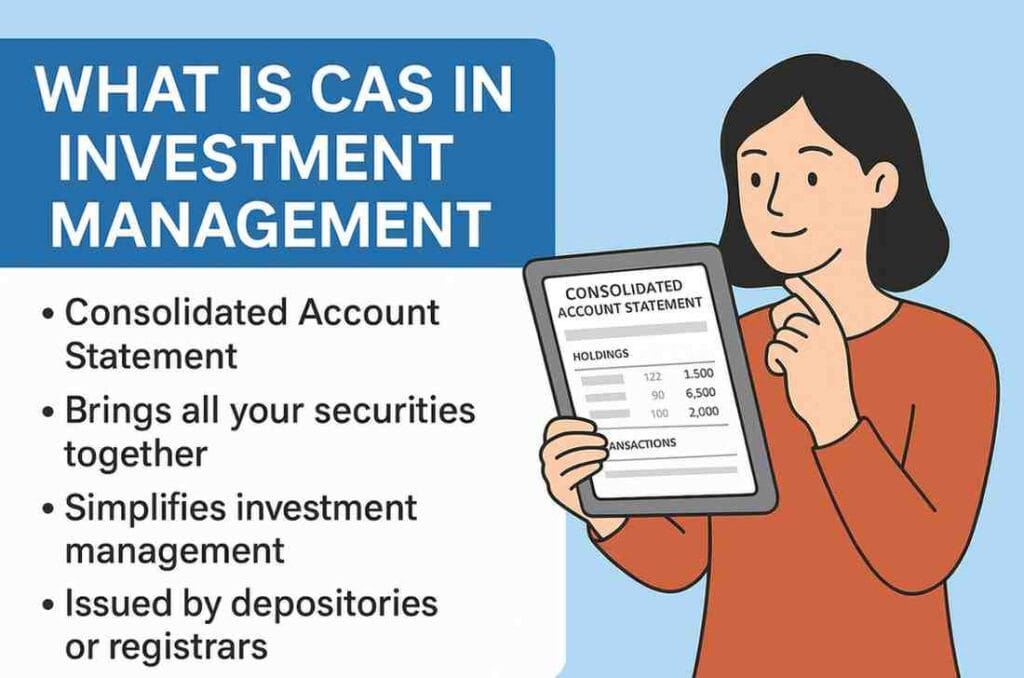
Introduction: Tired of Investment Overload? What is CAS in Investment Management and Why It’s Your New Best Friend
Consider this: You have a tonne of emails, applications, and statements from several depositories, brokers, and mutual fund institutions. It seems intimidating to have so many demat accounts, equities shares, and SIPs in your portfolio. For millions of Indian investors managing a variety of investments, that is the unpleasant truth. But what if you could cut through that mess with a single, easy-to-use tool and get a clear picture of everything in one place? Presenting the Consolidated Account Statement (CAS), a revolutionary concept in the field of investment management.
We will dispel the mystery of CAS in investment management by examining its history, workings, and disruptive potential in this extensive book. Whether you’re an experienced professional with a sizable portfolio or a novice just starting out in stocks, understanding what is CAS in investment management can revolutionize how you track, analyse, and grow your wealth. We’ll find seven incredible benefits that will simplify your life and improve your financial decision-making, all supported by official regulatory information. Are you prepared to start investing? Let’s dive deep into what is CAS in investment management and why ignoring it could cost you big time.
Also Read: Warren Buffett Investment Secrets: 7 Proven Strategies to Build Wealth Like the Oracle of Omaha
What is CAS in Investment Management? The Basics Unveiled
The essence of CAS in investment management is a single, powerful document that compiles all of your financial transactions and holdings. Essentially, the Consolidated Account Statement (CAS) is a single, all-inclusive report that includes information from your mutual fund folios, demat accounts (held with depositories such as NSDL or CDSL), and even other securities like bonds or government schemes, all of which are connected to your Permanent Account Number (PAN). CAS provides everything in a single, easily readable manner, eliminating the need to sort through fragmented emails or log onto multiple portals.
But let’s break it down further: What is CAS in investment management without the jargon? Consider it the personal GPS of your portfolio. It keeps tabs on everything from stock transactions and dividend disbursements to SIP contributions and business activities like splits or bonuses. In an era where India’s demat accounts have risen over 20 crore as of August 2025, the Securities and Exchange Board of India (SEBI) claims that CAS guarantees investors receive a comprehensive view of their assets, promoting transparency and discipline. This rapid expansion demonstrates why understanding what CAS in investment management is essential for contemporary investors.
Since its introduction as a statutory requirement, CAS has proven to be an indispensable safeguard against the dangers of fragmented investing. According to data from the National Securities Depository Limited (NSDL), CAS empowers a variety of investors throughout India by incorporating holdings in equity shares, preference shares, mutual funds, and more, all in a standardised framework that is accessible in 23 regional languages. What is CAS in investment management, in short? Portfolio paralysis is countered by it, which effortlessly and precisely transforms complexity into clarity.
Also Read: Essential Factors for Investing: 10 Key Principles for Success
The Evolution: A Quick History CAS
We need to go back to its origins in order to fully understand what CAS in investment management is. When SEBI issued a directive requiring depositories to generate CAS for all qualified investors in November 2014, the idea took off. The government’s goal from the Interim Budget to establish a single financial asset record for all citizens, which was fully implemented in March 2015, was in line with this deliberate policy change.
By 2025, CAS in investment management has developed into a digital powerhouse. Recent SEBI modifications in February 2025 shortened delays and improved accessibility by revising issuance timelines and guaranteeing monthly CAS for current transactions and half-yearly summary otherwise. According to the Central Depository Services Limited (CDSL), CAS now seamlessly combines mutual fund units and demat holdings from both CDSL and NSDL for a comprehensive overview.
Why the quick ascent? According to industry statistics, as of August 2025, there were over 24.89 crore accounts in the mutual fund sector alone in India. Investors confront a nightmare of mismatched formats and missed facts in the absence of CAS. More than 5.53 crore mutual fund investors may now handle diversification with ease thanks to CAS in investment management, which is a monument to legislative foresight.
Also Read: 7 Compelling Reasons the Power of Staying Invested Builds Lasting Wealth
How Does What is CAS in Investment Management Actually Work? Step-by-Step Breakdown
Curious about the magic behind what is CAS in investment management? With your PAN serving as the key and depositories, Registrar and Transfer Agents (RTAs) working together seamlessly, it’s easier than you may imagine.
The powerhouse procedure is as follows:
- Data Aggregation: Systems extract transactions from your mutual fund folios (SIPs, redemptions, switches) and demat accounts (bonds, stocks) once a month (or half-yearly if dormant). It’s all depository magic if your mutual funds are demat-held; if not, RTAs like CAMS or KFintech are involved.
- Default Depository Assignment: The issuer is the depository of your first-opened demat account (NSDL or CDSL). Notify your Depository Participant (DP) to change it at any time.
- Electronic Delivery: Choose eCAS, which is password-protected, environmentally sustainable, and blazingly fast, and register your email with your DP. No e-mail? Digital is the way to go in 2025, although physical copies are still available.
- Explosion of Content: What is included in CAS for investment management? Asset allocation pie charts, dividend credits, transaction history, holdings valuation, and even performance trend analytics. It’s the storytelling bible for your portfolio.
Pro tip: Create your CAS online using only your PAN and basic KYC through the NSDL portal or CDSL login. You’re equipped with knowledge that dispels speculation in less than five minutes.
Because of this optimised process, CAS in investment management is praised as a simplification rockstar, cutting down on manual reconciliation time from hours to seconds.
7 Explosive Benefits of What is CAS in Investment Management: From Chaos to Control
Now, the juicy part: Why obsess over what is CAS in investment management? These seven revolutionary benefits will astound you and transform possible drawbacks into opportunities for increased revenue.
- Unified Oversight – Kiss Fragmentation Goodbye: What is CAS in investment management eliminates the dread of multiple logins. One statement highlights overlaps or underperformers in its tracking of demat and MF holdings. Feeling good: Complete control. On the down side, steer clear of expensive diversification blind spots.
- Dynamo of Informed Decisions: Analytics show changes in asset allocation, assisting in rebalancing before market collapse. Every SIP and redemption is detailed by CAS, per AMFI, which encourages more intelligent actions.
- Superhero Time-Saving: Manual consolidation? ancient times. Instant delivery of eCAS frees up hours for real investing. According to recent surveys, investors claim 70% less stress from tracking.
- Transparency Triumph: Quickly identify unapproved trades or overlooked dividends. It protects you from fraud and creates enduring trust in your financial system.
- Multilingual Mastery: CAS in investment management, which is accessible in 23 Indian languages, democratises access and enables non-native English speakers to overcome difficulty.
- Eco and Cost Warrior: Using digital formats reduces postal costs and paper waste. Half-yearly summaries help you stay green and save money.
- Performance Powerhouse: Use integrated analytics to monitor returns across investments. When it comes to investment management, CAS instills discipline and transforms mediocre portfolios into wealth machines; yet, if it is disregarded, opportunities will pass you by.
With CAS usage soaring in 2025, SEBI’s drive for investor inclusiveness demonstrates that these advantages are real.
Who Qualifies for CAS in Investment Management? Eligibility and Easy Access
Most people receive the full CAS grandeur, but not all do. Your PAN-linked possessions determine your eligibility: Any investor who has mutual fund folios or demat accounts (across NSDL/CDSL) is eligible. RTAs create it even if you’re SOA-only for MFs.
Holdings in joint? They only count if you are the principal holder. Not a PAN? You’re out, but connecting your Aadhaar can solve that.
Getting started with what is CAS in investment management is a breeze:
- Step 1: Connect your smartphone and email to your DP.
- Step 2: Use their portal to choose e-delivery.
- Step 3: Use PAN to download from NSDL/CDSL websites.
- Step 4: Track monthly or semi-annual declines.
Instant access for registered users is confirmed by NSDL’s portal as of November 1, 2025. Advantage: effortless. Cons: It takes ten minutes to set up first, but it’s worth it.
Also Read: How to Balance Strategic and Tactical Investing
The Flip Side: Limitations of CAS in Investment Management You Should Know
No tool is flawless, and what is CAS in investment management has its shadows. It omits non-PAN assets, like as insurance or real gold, which could leave holes in ultra-diversified portfolios. Real-time views may be delayed by RTA data sync delays, and inactive investors may see fewer peaks during half-yearly dormancy.
Moreover, what is CAS in investment management shines for demat/MF but not alternatives like P2P lending. Simply connect CAS with apps for full-spectrum tracking, and these drawbacks pale in comparison to the benefits.
Also Read: How CAS is simplifying investment management by bringing all your securities together
Conclusion: Embrace What is CAS in Investment Management – Your Ticket to Financial Nirvana
We’ve journeyed through the what, why, and how of CAS in investment management, In India’s expanding markets, CAS is more than just a statement; it’s a strategic ally that can smash clutter with unified views and spark well-informed decisions that drive wealth growth.
Don’t let the chaos of your portfolio stop you. Sign up for eCAS now, get your first statement, and see how things have changed. What is CAS in investment management waiting for? Your safe, easy, and incredibly empowering journey to mastery begins right now. Live more freely and invest wisely.
FAQs: Key Answers on What is CAS in Investment Management
Q1: What is CAS in investment management, and how does it differ from a regular account statement?
Consolidated Account Statements, or CASs, are PAN-linked reports that combine dividends, transactions, mutual funds, and demat assets into a single view. In contrast to dispersed broker/fund statements that need numerous logins, CAS offers a comprehensive, standardised summary from NSDL/CDSL, making tracking easier and identifying patterns to reduce errors.
Q2: What causes a monthly versus half-yearly issuance, and how often is a CAS generated?
Monthly CAS is required by SEBI for demat/mutual fund transactions such as buys, sells, and SIPs. To cut down on clutter, inactive accounts receive half-yearly summaries. Online on-demand at any time for flexible, economical supervision.
Q3: Is it possible to create a CAS statement online, and if so, what is required to do so?
Yes, through the NSDL/CDSL portals using your KYC, email address, and PAN. Download safe, digital PDFs with charts in a matter of minutes. For convenience, link details via your Depository Participant first.
Q4: What categories of assets are covered by CAS, and are there any significant exclusions?
covers transactions such as dividends from NSDL/CDSL, mutual funds (demat/SOA), and demat securities (equities, bonds, and ETFs). excludes non-demats like as insurance, FDs, and physical gold; for complete coverage, track those separately.
Q5: What precautions can I take to safeguard my data, and how safe is the eCAS process?
Unique passwords from depositories governed by SEBI are used to encrypt eCAS. Use secure networks, check emails, and turn on encryption to stay safe. safer than several apps; if necessary, start with physical.
Disclaimer
This article on what is CAS in investment management is for educational purposes only and does not constitute financial, investment, or legal advice. Risks associated with investing in securities include the potential for principal loss. A competent financial counsellor should always be consulted before making decisions. Any actions based on this text are not the author’s responsibility.