
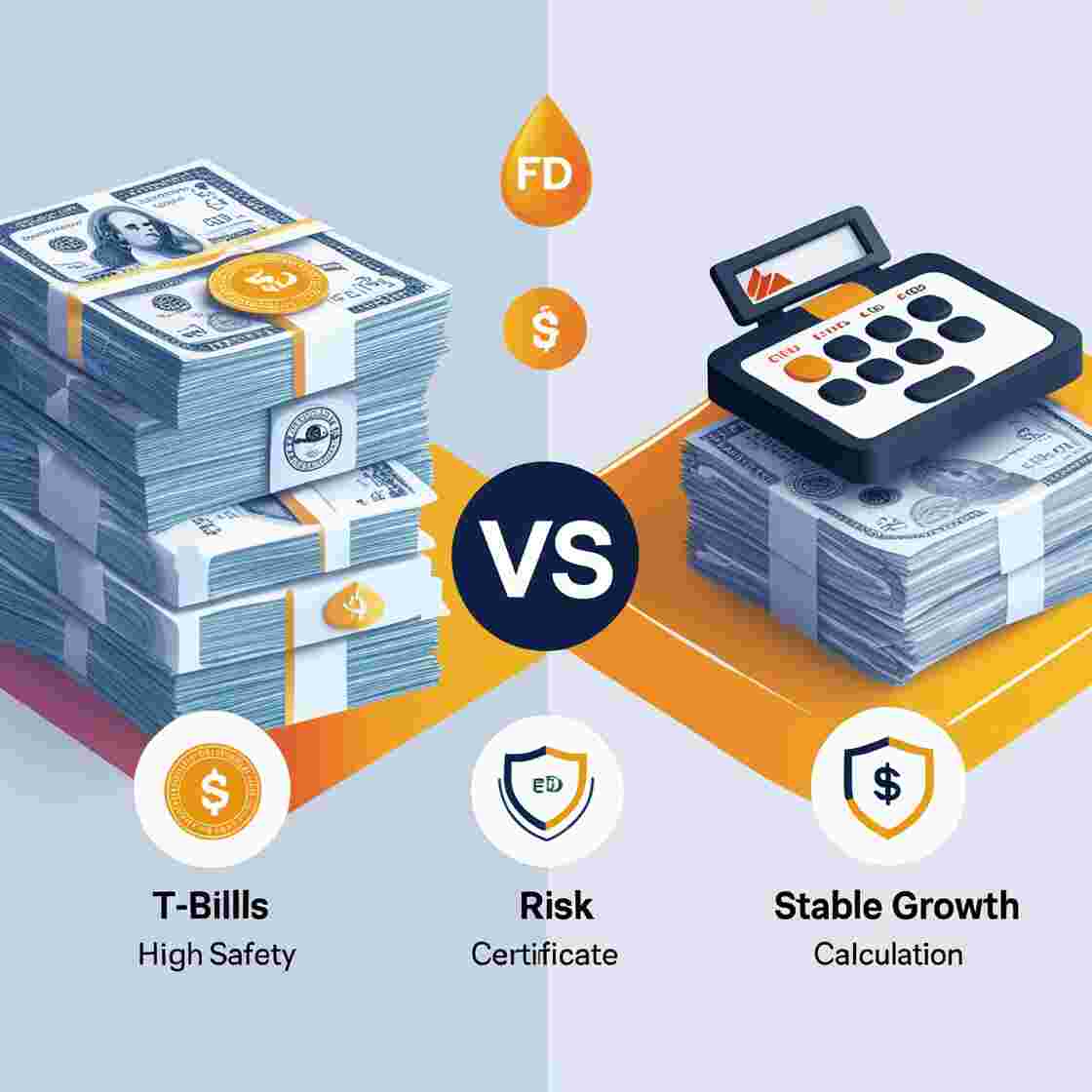
Explore T-Bills SIP vs Fixed Deposits in 2025 to uncover which offers superior safety, liquidity, and growth. Compare risks, taxation, and benefits to make an informed investment decision for your financial goals. #t-bills sip vs fixed deposits, #treasury bills sip investment, #t-bills returns 2025, #fd vs t-bills risks, #treasury bills advantages over fd, #t-bills taxation benefits, #rbi retail direct sip, #fd interest rates august 2025, #treasury bills yields India
Introduction
Selecting a safe investment is crucial for preserving wealth in the volatile financial world of August 2025, when markets are unstable and inflation is around 5%. The debate of T-Bills SIP vs Fixed Deposits has increased significantly since the Reserve Bank of India (RBI) made automated investments starting at ₹10,000 possible through Systematic Investment Plans (SIPs) for Treasury Bills (T-Bills) on its Retail Direct platform. In the meantime, fixed deposits (FDs), which are offered by banks like SBI, HDFC, and ICICI, continue to be a popular choice among households because to their consistent growth.
So, how do T-Bills SIP vs Fixed Deposits compare for safety, liquidity, and returns? This post examines T-Bills SIP vs Fixed Deposits, breaking down yields, risks, taxes, and other factors to help you make an informed choice. Knowing T-Bills SIP vs. Fixed Deposits could change your financial approach, regardless of whether you’re a youthful investor accumulating wealth or a retiree looking for stability. Let’s investigate which is the better alternative for 2025.
What Are Treasury Bills and How Does SIP Work?
The RBI issues Treasury Bills (T-Bills), which are short-term government securities with 91-, 182-, and 364-day maturities, to cover short-term demands. They are the foundation of safe investing and are sold at a discount (for example, a ₹100 T-Bill for ₹94, with the difference being your gain). In T-Bills SIP vs Fixed Deposits, Improved in 2025, the RBI Retail Direct platform’s SIP feature enables weekly auto-bidding beginning at ₹10,000 with automatic maturity reinvestment. T-Bills SIP vs Fixed Deposits is revolutionary for low-risk, disciplined investors because of this automation.
Understanding Fixed Deposits
Banks and NBFCs provide time-bound deposits called fixed deposits, which lock money for seven days to ten years at a set rate with quarterly or annual compound interest. T-Bills SIP vs Fixed Deposits: FDs are preferred for their ease of use and security, with DICGC insuring them up to ₹5 lakh. T-Bills SIP vs. Fixed Deposits is a crucial comparison for savers as of August 2025 since big banks like Axis and HDFC give competitive rates, while smaller finance banks like Suryoday push higher for longer tenures.
Comparing T-Bills SIP vs Fixed Deposits: Key Differences
To clarify T-Bills SIP vs Fixed Deposits, here’s a detailed breakdown:
| Aspect | T-Bills SIP | Fixed Deposits |
|---|---|---|
| Issuer | Government (RBI) | Banks/NBFCs |
| Tenure | 91, 182, 364 days | 7 days to 10 years |
| Minimum Investment | ₹10,000 | ₹1,000 (varies) |
| Returns (Aug 2025) | 5.45% (91-day), 5.93% (182-day) | 6-7% (1-year major banks) |
| Risk | Zero credit risk | Low, insured up to ₹5 lakh |
| Liquidity | High (secondary market) | Moderate (penalties on withdrawal) |
| Taxation | Interest at slab rates, no TDS | Interest at slab rates, TDS if >₹40k |
| Suitability | Short-term, low-risk goals | Medium-long term, steady income |
This table emphasises that the decision between T-Bills SIP and fixed deposits depends on your time horizon and investment objectives.
Advantages of T-Bills SIP Over Fixed Deposits
T-Bills excel in the following areas when compared to fixed deposits:
- Unparalleled Safety: T-Bills are government-backed and carry no credit risk, which is a significant advantage for cautious investors when comparing T-Bills SIP to fixed deposits.
- Strong Short-Term Gains: T-Bills are perfect for short-term fund parking because they frequently outperform FDs for durations of 91 and 182 days.
- Automated Discipline: By enabling weekly auto-bids, the SIP function simplifies T-Bills SIP vs. Fixed Deposits and promotes consistent investing.
- Tax-Friendly: T-Bills have no TDS, unlike FDs, which improves cash flow as compared to fixed deposits.
- High Liquidity: There are no penalties for selling T-Bills in secondary markets, which is a definite benefit when comparing T-Bills SIP to fixed deposits.
Because of these advantages, T-Bills SIP vs Fixed Deposits is an appealing option for safe, short-term investing.
Drawbacks of T-Bills SIP Compared to Fixed Deposits
T-Bills SIP vs Fixed Deposits, however, highlights certain drawbacks:
- Lower Long-Term Gains: When comparing T-Bills SIP vs. Fixed Deposits, FDs outperform T-Bills in terms of returns for durations longer than six months.
- No Automatic Compounding: Unlike FDs, which compound automatically, T-Bills need to be reinvested manually or through SIP.
- Limited Tenures: FDs can last up to 10 years in T-Bills SIP vs. Fixed Deposits, but T-Bills have a maximum of 364 days.
- Yield Variability: T-Bills SIP vs. Fixed Deposits are somewhat unclear because to the volatility of auction-based yields.
- Adoption Challenges: T-Bills SIP’s low retail adoption rate may be due to knowledge or complexity concerns in comparison to more well-known FDs.
Returns: T-Bills SIP vs Fixed Deposits in 2025
T-Bills SIP vs Fixed Deposits revolves about returns. By August 2025:
- T-Bills: 364-day at roughly 5.5-6%, 182-day at 5.93%, and 91-day at 5.45%.
- FDs: Seniors can get up to 7.5%, small banks can get up to 8.4%, and major banks can provide 6.5-7% for 1-2 years.
A one-year FD at 7% yields approximately ₹7,000 (compound) for ₹1 lakh, whereas a 91-day T-Bill yields approximately ₹1,360. T-Bills are superior for short-term investments, whereas fixed deposits are superior for longer-term ones. Real returns (0.5–3%) with 5% inflation highlight the need of diversification.
Risk Analysis: T-Bills SIP vs Fixed Deposits
When comparing T-Bills SIP to fixed deposits, risk is essential:
- T-Bills: Low interest rate risk for short tenures, but reinvestment risk arises if rates decline; zero credit risk because of government backing.
- FDs: Opportunity cost in dropping rate scenarios; interest rate risk if rates increase after lock-in; low credit risk (insured up to ₹5 lakh).
Favours of T-Bills SIP over Fixed Deposits Although both are low-risk choices, T-Bills are recommended for safety.
Liquidity: Accessing Your Money
T-Bills SIP differs from fixed deposits in terms of liquidity:
- T-Bills: Excellent for emergencies, they have no fines and high liquidity through secondary markets.
- FDs: Gains are reduced by 0.5–1% penalty for early withdrawal.
T-Bills SIP vs. Fixed Deposits favours T-Bills in terms of flexibility.
Taxation: T-Bills SIP vs Fixed Deposits
Net returns in T-Bills SIP vs fixed deposits are impacted by taxes:
- Both are subject to slab rates, which can reach 30%.
- T-Bills: Improve cash flow with no TDS.
- FDs: If interest above ₹40,000 (₹50,000 for seniors), TDS is applicable.
For wealthy earners, T-Bills SIP offers a small tax advantage over fixed deposits.
Who Should Choose T-Bills SIP vs Fixed Deposits?
- T-Bills SIP: Perfect for investors who are risk cautious, have short-term objectives (3–12 months), or require automation and liquidity.
- Fixed Deposits: Ideal for seniors looking for higher rates, people who value simplicity, and those with medium-to-long-term goals.
Safety and growth are maximised when T-Bills SIP vs. Fixed Deposits are balanced.
How to Start Investing
- T-Bills SIP: Create a weekly auction SIP by registering on RBI Retail Direct.
- FDs: Open by selecting a tenure and rate using bank apps or branches.
Conclusion
Your financial objectives will determine which option you choose between T-Bills SIP and fixed deposits. While fixed deposits give dependable long-term growth, T-Bills SIP offers unparalleled safety and short-term flexibility. Combining T-Bills SIP vs. Fixed Deposits could improve your portfolio in 2025 because of the competitive yields. To customise your approach and begin accumulating wealth right now, speak with a financial counsellor.
FAQs
Q1: What’s the minimum investment for T-Bills SIP vs Fixed Deposits?
SIP for T-Bills is ₹10,000, whereas FDs cost ₹1,000 (varies).
Q2: Compared to fixed deposits, is T-Bills SIP safer?
In fact, FDs are guaranteed up to ₹5 lakh, whereas T-Bills carry no credit risk.
Q3: What is the difference in returns between fixed deposits and T-Bills SIP?
FDs: 6-8.4% (1+ years); T-Bills: 5.45-5.93% (short-term).
Q4: Are T-Bills SIP and Fixed Deposits subject to different taxes?
Both are subject to slab rates; FDs pay above ₹40,000 in taxes, but T-Bills do not.
Q5: Unlike fixed deposits, can I take money out of my T-Bills SIP early?
Yes, through the secondary market, T-Bills. FDs: With consequences, yes.
Q6: Compared to fixed deposits, who gains from T-Bills SIP?
FDs for long-term or older citizens; T-Bills for short-term.
Q7: How does T-Bills’ SIP operate?
Auto-bids with reinvestment every week on the RBI platform.
Q8: Do T-Bills SIP costs differ from those for fixed deposits?
FDs may charge for early withdrawal, but there are no fees.
Disclaimer
This comparison of T-Bills SIP and fixed deposits is just informative and should not be construed as financial advice. Risks associated with investing include possible loss. Data is subject to change and is based on August 2025. Before making an investment, speak with a professional financial planner. Future outcomes are not guaranteed by past success.
Also Read: