
Learn how to identify fake loan apps in India, verify RBI approval, avoid harassment, protect your privacy, and stay safe from illegal instant loan scams. fake loan apps in India, RBI approved loan apps, illegal loan apps India, instant loan app scams, fake lending apps, loan app fraud India, digital lending scams, RBI loan app rules, personal loan scam apps, fake instant loan apps.
Introduction
Nowhere is the rise of instant credit more visible than across Indian smartphones, where speed often wins over caution. These digital platforms lure users with promises of cash within minutes when trouble strikes. Yet behind slick interfaces sit shady operators who exploit private information without consent. Money lands in accounts – then the pressure begins, piling unseen charges along with constant threats. What feels like rescue quickly turns into a trap. Later on, some people realize the app had no connection to lenders supervised by the RBI. Many borrowers make panic decisions without understanding how to check credit score in India for free before applying for emergency loans. What follows reveals ways to spot counterfeit loan apps, confirm ties to genuine RBI-recognized institutions, steer clear of online lending frauds, keep finances safe, shield personal information, and stay mentally at ease.
What Are Fake Loan Apps?
Out of nowhere, some apps show up claiming they can send cash fast. Instead of helping, though, they break rules or bend laws while pretending to lend money. A sudden pop-up might say you’re approved already – no paperwork needed. Minutes later, your details could be slipping into hidden channels. Emergency moments make people click faster, handing over private data without realizing the risk. Most real lenders follow rules, yet these imitation apps often skip sharing key facts – missing things like official company names or contact info for complaints. Instead of being clear, certain services grab extra phone rights they do not need, reaching into messages, photos, your list of friends, even voice inputs. When payments get delayed, that data can turn against you, fueling threats, pressure tactics, or worse outcomes down the line.
Hidden fees pop up in plenty of unlawful loan apps, along with repayment windows that barely give breathing room, while collectors resort to harsh tactics. Though some borrowers get less cash than promised due to sneaky cuts, they must return the complete sum – penalties included. Borrowers already facing debt pressure should understand the risks of hidden charges in personal loans before trusting unknown instant lending platforms. False loan applications are more than simply financial pitfalls. They frequently turn into privacy and cybercrime risks that have the potential to negatively impact a borrower’s reputation, emotional health, and peace of mind.
Why Fake Loan Apps Are Growing Rapidly in India
- 1. Rising Emergency Borrowing: Many consumers are looking for urgent finance solutions due to medical problems, inflation, unstable employment, and escalating living expenses. Borrowers who are struggling financially are natural targets for dubious rapid loan apps because traditional banks frequently demand proof and verification.
- 2. Low Financial Awareness: Many consumers are still unaware of the distinction between an unverified app and a legitimate lender subject to RBI regulation. Borrowers frequently prioritize “fast approval” over verifying the lender’s authenticity, repayment schedule, or data protection policies.
- 3. Fear of Loan Rejection: Sometimes, people with poor credit profiles think banks will reject them right away. They are drawn to dangerous apps that guarantee approval because of this dread. Understanding minimum CIBIL score for loan approval can help borrowers avoid panic-driven borrowing decisions.
- 4. Aggressive Digital Advertising: Social media advertisements, WhatsApp promotions, SMS marketing, and phony web reviews are all used by illicit apps to fabricate trust. Emotional messaging, such as “instant cash for emergencies,” is frequently used in commercials to swiftly draw in financially vulnerable consumers.
Difference Between RBI Approved and Fake Loan Apps
Many consumers mistakenly think that every online loan application is directly approved by the RBI. While digital apps typically function as platforms linked to registered financial firms, the RBI actually governs banks and NBFCs. A legitimate app typically offers accurate corporate information, information about lending partners, grievance redressal mechanisms, and clear loan terms.
Verifiable lender information is frequently avoided by fraudulent apps. They might utilize solely cell numbers for assistance, conceal ownership information, or give fictitious addresses. In terms of consent, repayment disclosures, client privacy, and grievance handling, legitimate lenders typically adhere to standardized compliance procedures.
Transparency is another significant distinction. Prior to loan acceptance, regulated lenders provide clear information about interest rates, processing costs, repayment plans, and penalties. Hidden deductions and deceptive repayment plans are common tactics used by illegal applications to emotionally and financially ensnare consumers.
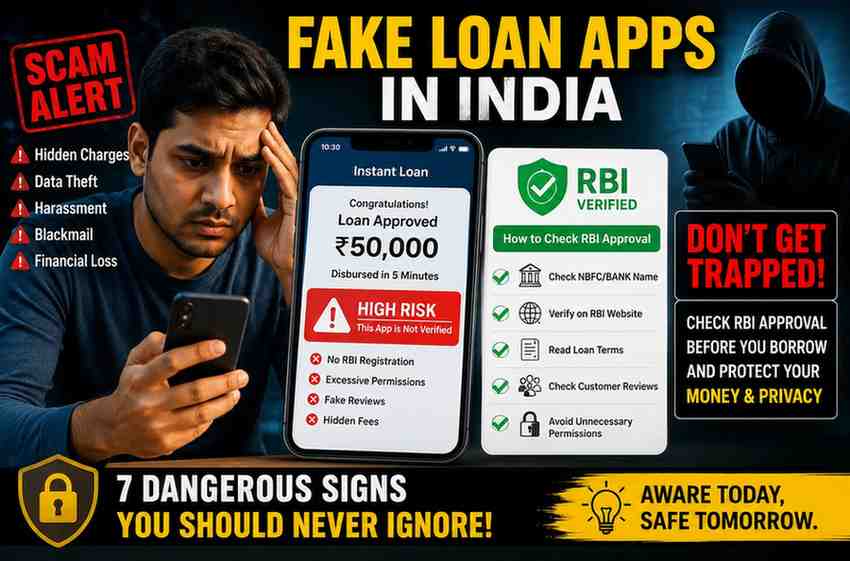
7 Dangerous Signs of Fake Loan Apps in India
1. No Clear RBI-Registered NBFC or Bank Mentioned
The lack of a distinct loan partner is one of the major red flags. On their website and app interface, legitimate apps often publicly identify the affiliated bank or RBI-registered NBFC. Because they don’t want borrowers to independently check them, fraudulent apps frequently refrain from disclosing accurate registration information. An app should never be trusted by borrowers just because it has eye-catching ads or a polished appearance. Users should verify whether the lender’s name is listed on official regulatory platforms prior to applying. In order to establish artificial legitimacy, many fraudulent apps use fictitious firm names or deceptive branding.
The office address, customer service details, loan agreement details, and grievance channels are often openly disclosed by a regulated lender. The software should be used with care right away if these details are absent or hard to confirm. Before sharing papers or bank information, users can check registered financial companies on the Reserve Bank of India’s official website.
2. Excessive Permission Requests
Many fraudulent loan applications request permits that have nothing to do with lending. Contacts, a gallery, a microphone, SMS, call records, and even private files are a few examples. Due of their immediate need for funds, borrowers frequently provide these permits swiftly. Scammers then exploit this information for blackmail and intimidation. After reimbursement delays, some victims claim that recovery agents made direct contact with friends, family, or co-workers. Others received threatening texts or altered photos intended to put them under emotional strain.
Financial information and identity verification may be required by a reputable lender, but needless access to personal information should always be questioned. Excessive requests for permission are frequently early indicators of cybercrime risk and privacy violation. Data theft and emotional manipulation are increasingly combined in modern financial schemes. Similar tactics are visible in many dangerous UPI scams in India where fraudsters misuse digital access to pressure victims financially.
3. Guaranteed Loan Approval Without Verification
No reputable lender promises to accept every applicant. Before approving loans, legitimate lenders consider credit history, employment position, income stability, and repayment capacity. Because they put data collecting and aggressive recovery ahead of responsible financing, fraudulent apps frequently offer “100% guaranteed approval.” Financially anxious consumers who are afraid of being turned down by banks or NBFCs are the focus of these irrational promises. Because they think traditional institutions are unreachable, some borrowers develop an emotional dependence on mobile apps.
Based on repayment risk, a reliable lender may limit or reject loans. Instant acceptance without significant vetting is typically a serious warning sign. Platforms that advertise loans as “approval for everyone” without doing a thorough evaluation should be avoided by borrowers.
4. Hidden Charges and Upfront Deductions
Before releasing money, many fraudulent apps levy hefty processing fees, platform fees, or unstated penalties. For instance, a borrower who was expecting ₹10,000 might only get ₹6,000 or ₹7,000, but they would still have to pay back the entire amount that was approved plus interest. Due to the borrower receiving less money than anticipated and having a greater repayment load, this causes acute financial stress. Additionally, some apps impose unclear punishments that are hard to comprehend.
These strategies easily take advantage of borrowers who do not carefully study loan terms. Financially stressed users should understand 7 shocking hidden charges in personal loans before accepting any instant digital loan offer. Before accepting a loan, transparent lenders typically make all fees very clear. Unethical lending practices are frequently indicated by hidden deductions.
5. Extremely Short Repayment Periods
Loans with repayment terms as short as seven or fourteen days are offered by a number of illicit apps. These deadlines put immediate pressure on borrowers and raise the likelihood that they won’t make their payments. Financially strapped borrowers frequently find it difficult to arrange payments in a timely manner. Aggressive harassment typically starts when users don’t make their repayments by the short deadline. To instill fear and humiliation, fraudulent recovery agents may call debtors repeatedly, threaten legal action, or get in touch with family members.
Realistic repayment plans based on borrower capacity are typically offered by ethical lenders. The primary purpose of incredibly short repayment cycles is to put users under emotional strain and penalty charges. Before taking out emergency loans, borrowers should carefully consider repayment plans, particularly when they are under financial strain.
6. No Proper Customer Support or Office Address
Proper customer support systems, such as email support, grievance officers, office addresses, and escalation routes, are often maintained by legitimate financial firms. Fake apps usually simply offer WhatsApp numbers for contact or conceal ownership information. When borrowers encounter difficulties, they frequently find that there is no dependable support system in place. Some apps alter their names frequently to evade scrutiny, or even simply vanish after complaints.
It is nearly impossible to resolve disputes when there is a lack of transparency. Borrowers should refrain from submitting important papers right away if an app does not explicitly reveal the company’s identity, registered office information, and official support channels. Reputable lenders are accountable, however fraudulent apps typically attempt to evade detection.
7. Harassment and Threatening Recovery Practices
The harsh recovery behaviour of fraudulent loan apps is one of their most harmful features. After reimbursement delays, many victims claim emotional intimidation, contact-list harassment, repeated calls, and threatening texts. To publicly humiliate borrowers, some con artists email altered images or disparaging notes to relatives and co-workers. These strategies induce severe anxiety and mental strain. Rather than due to legal duties, borrowers frequently make aggressive repayments just to put an end to pestering.
Threats, extortion, and public humiliation are not typical financial practices, even though legitimate lenders may adhere to established recovery procedures. Victims experiencing such harassment should preserve evidence carefully and report incidents through the official National Cyber Crime Portal.
How Fake Loan Apps Trap Borrowers Emotionally
Fake loan applications are made to exploit people’s emotions in addition to collecting repayments. These sites cater to people who are in dire need of quick money, emotionally fragile, or under financial strain. Temporary relief brought about by the promise of “instant approval” reduces prudence and promotes speedy permission approvals.
Emotional coercion strategies start to appear gradually as the app has access to personal information. Regular reminders, intimidating communications, or fear-based alerts of legal action may be sent to borrowers. Certain apps purposefully incite fear so that users will pay right away without questioning the costs or their legality.
In extreme situations, con artists get in touch with family members or co-workers to publicly humiliate borrowers. Because victims are more afraid of social humiliation than financial loss, this emotional manipulation becomes quite powerful. Learning how to spot personal loan scams online can help borrowers recognize these psychological traps before they become victims.
How to Check Whether a Loan App Is Genuine
- 1. Verify the Lending Partner: Always make sure the app is linked to an RBI-regulated NBFC or a registered bank. This information is typically freely disclosed by legitimate lenders.
- 2. Review Transparency: A reliable app ought to offer information about the business, office address, grievance procedures, loan agreements, and privacy policies. One of the biggest red flags is concealed ownership information.
- 3. Read User Reviews Carefully: Recurring accusations about extortion, hidden charges, or harassment should not be disregarded. Users should be in mind, nevertheless, that phony good reviews are widespread.
- 4. Avoid Unnecessary Permissions: Typically, a lending app doesn’t need access to a microphone, gallery, or irrelevant personal files. Privacy hazards are greatly increased by excessive permissions.
- 5. Check Regulatory Warnings: Borrowers can also review suspicious financial activities through the RBI-backed Sachet Portal before trusting unfamiliar lending apps.
What Happens If You Already Installed a Fake Loan App?
You must act right away if you think you downloaded a dubious loan app. First, go to your phone’s settings, remove the app, and remove any extra permissions. Important passwords should be changed, and users should closely monitor their bank account activities. Even after deleting the app, scammers may still exploit stored data, so borrowers need to keep an eye on SMS warnings, UPI activity, and connected accounts. Another way to find harmful software or hidden malware on a device is to run a security scan on it.
Screenshots, evidence of repayment, threatening texts, and transaction data should be saved by victims as they may be useful in complaints or investigations. When someone is being harassed online, they should seek official cybercrime support right once to prevent panic. Scams using digital loans are becoming more closely linked to more general internet fraud trends. Awareness about UPI frauds in India can help borrowers recognize suspicious financial activity early.
Can Fake Loan Apps Damage Your Credit Score?
A borrower’s credit profile may occasionally be indirectly impacted by fraudulent loan applications, particularly if the lending company is linked to reporting systems or employs unethical collection techniques. However, rather than structured credit reporting, a lot of illicit apps prioritize aggressive recovery. Financial and emotional instability provide a greater danger. Repayment of regulated loans, credit card bills, and legitimate EMIs may be neglected by borrowers caught in harassing cycles. Over time, this secondary financial disruption may have a detrimental impact on credit health.
Under duress, people occasionally take out new loans to pay off their current debts, which can lead to a risky borrowing cycle. Avoiding panic borrowing and routinely checking credit reports are crucial measures for preserving long-term financial stability.
Common Psychological Tricks Used by Fake Loan Apps
- Messages Based on Fear: In order to swiftly instill fear, scammers frequently send threatening alerts about police complaints, legal action, or account freezes.
- Pressure of Urgency: Warnings such as “pay within 30 minutes” may be given to borrowers in an attempt to discourage them from obtaining counsel or using reason.
- Shame Strategies: Certain applications make threats to get in touch with friends, family, or employers. Embarrassment in public turns into a potent emotional weapon.
- False Empathy: Before applying harsh pressure to debtors, some recovery agents attempt to “help” them emotionally.
These psychological techniques are intended to impair judgment and compel prompt payback.
Why Google Play Store Presence Does Not Guarantee Safety
Many consumers assume that an app must be authentic and secure just because it is available on the Google Play Store. Sadly, this presumption isn’t always accurate. Some dubious apps evade platform reviews for a short while before abusing borrower data or using unethical recovery techniques. In order to evade detection, fraudulent developers may regularly alter app names, branding, or publisher information. Sometimes a false sense of trust is created by phony reviews and inflated ratings. Without verifying the lender’s true regulatory status, borrowers frequently depend solely on ratings.
Before providing papers or personal information, users should independently confirm the affiliated NBFC or bank, even if the app looks properly developed. The existence of an app store should never take the place of careful financial scrutiny.
Safe Alternatives to Risky Instant Loan Apps
Instead of downloading haphazard rapid lending apps, borrowers with pressing financial demands can look into safer options. Although they may need documents, traditional banks and regulated NBFCs often adhere to open lending policies and grievance procedures. In an emergency, certain salaried people might also think about secured loans, gold-backed borrowing options, company support, or pay advances. Compared to dubious digital lending apps, these choices frequently pose fewer privacy and harassment hazards.
People comparing borrowing choices should understand secured vs unsecured personal loans difference before selecting emergency funding solutions. Making wise borrowing choices can help avoid long-term financial strain and psychological harm.
What To Do If You Are Being Harassed by a Loan App
Because scammers rely largely on emotional anxiety, borrowers who are being harassed should first try not to worry. Evidence like as screenshots, call logs, cash receipts, and threatening texts should be saved right away by victims. In order to prevent emotional reactions in the event that scammers try public intimidation, family members and close contacts should be notified beforehand. While blocking strange numbers may temporarily lessen direct harassment, formal reporting is still crucial.
Victims should contact cybercrime authorities to report severe abuse, blackmail, or privacy violations, and if needed, seek legal counsel. In such circumstances, borrowers can also manage tension more composedly with the emotional assistance of dependable family members.
RBI Guidelines and Digital Lending Rules
RBI has focused more on borrower protection and transparency in digital lending in recent years. Prior to loan approval, regulated businesses must explicitly identify lending partners, repayment terms, fees, and grievance procedures. Guidelines also place a strong emphasis on ethical data collection methods. Before apps access sensitive data, borrowers should give their informed consent. From the standpoint of consumer protection, excessive or irrelevant permission requests are increasingly seen as undesirable.
Throughout India’s expanding digital lending sector, these steps are intended to lessen abusive recovery tactics, hidden fees, and privacy concerns.
How Borrowers Can Protect Themselves in the Future
- Build Emergency Savings: During times of financial strain, an emergency fund lessens reliance on hazardous short-term borrowing.
- Improve Credit Health: Access to safer and more regulated loan choices is enhanced by stronger credit profiles.
- Avoid Emotional Borrowing: Never download a loan app while you’re scared or feeling pressured by others.
- Read Terms Carefully: Borrowers ought to examine payback plans, fines, processing fees, lender identity, and privacy regulations.
- Stay Updated About Digital Frauds: Scam techniques evolve continuously, making financial awareness extremely important in today’s digital environment.
Real-Life Example
Example 1: After reading an advertisement on social media, a college student who desperately needed ₹8,000 for hostel bills downloaded a rapid lending app. After swiftly approving the loan, the app began aggressively reminding users to make their repayments. The borrower reportedly received threatening calls and messages when payments was a little behind schedule. Later, the student found that the app lacked enough customer service and verified NBFC information.
Example 2: During a medical emergency, a paid employee downloaded a borrowing app with “guaranteed approval.” The app sought full payback with penalties after deducting hidden fees before disbursing the money. Recovery agents are said to have called individuals from the borrower’s phonebook after a little wait. Eventually, the borrower cancelled all app access and reported the issue via cybercrime channels.
Conclusion
In India, fraudulent loan applications are posing a significant risk to people’s finances and privacy. Borrowers should never divulge sensitive information without verification or naively believe claims of rapid approval. Major financial and emotional hardship can be avoided by thoroughly comprehending repayment terms, avoiding needless permits, and verifying the legitimacy of the lender. You can safeguard your finances, privacy, and dignity tomorrow with a few minutes of research today.
FAQs
Q1: Does RBI directly approve loan apps?
Rather of actively regulating individual apps, RBI typically regulates banks and NBFCs. Typically, legitimate loan applications run through financial institutions that have been registered. Prior to applying, borrowers should always confirm the financing partner.
Q2: Can fake loan apps misuse personal data?
Indeed, a lot of dubious apps abuse contacts, gallery access, SMS, and call log permissions. Later on, during repayment disputes, this information might be used for harassment or intimidation.
Q3: Are all instant loan apps fraudulent?
No, certain rapid loan applications adhere to compliance regulations and are linked to regulated lenders. Before borrowing, consumers should, however, independently confirm the authenticity of the lender and its openness.
Q4: If a loan application begins to frighten me, what should I do?
Victims should report harassment to cybercrime authorities, cancel permits, avoid panic, and preserve evidence. In order to prevent emotional pressure from con artists, family members should also be informed.
Q5: Is it allowed for phony loan applications to get in touch with friends and family?
Blackmail, public humiliation, and harassment may breach legal and privacy rights. When borrowers encounter such activity, they should notify authorities right away.
Q6: Why are fraudulent loan applications risky, even for modest loans?
Even tiny loans have the potential to reveal private information and put people under emotional strain. Despite borrowing comparatively little, many victims experience stress, harassment, and privacy violations.
Disclaimer
Only financial awareness and education are the goals of this post. It is not financial, legal, or regulatory advice. Digital lending methods, RBI rules, and loan regulations are subject to change. Before deciding whether to borrow money, readers should independently check lender information and speak with authorized experts or authorities. Before utilizing any financial app, thoroughly read the terms, privacy rules, and repayment terms.