
Form 130 replacing Form 16 may change salary tax reporting for employees in India. Learn its impact on tax filing, TDS, deductions, loans, and salary documentation. form 130 replacing form 16, form 130 explained, form 130 vs form 16, new tax form for salaried employees, form 16 replacement, income tax changes India, salaried employee tax rules, TDS certificate changes, salary tax reporting India, new income tax framework.
Introduction
Now things feel uncertain for many workers across India. That old paper called Form 16, used each year when paying taxes, suddenly shares space with something unfamiliar. People once relied on it to prove earnings, file returns, even show deducted tax amounts. But changes arrived quietly through updated rules. Out of nowhere, a fresh name appears – Form 130. However, recent reports about Form 130 replacing Form 16 have increased confusion among salaried employees regarding future tax filing and salary reporting changes. Its role isn’t clear yet, though whispers spread fast. Fear crept in fast when whispers spread that Form 130 might take over from Form 16. Workers wondered if everything about taxes was shifting overnight. Could paychecks face a new way of being taxed? Then came the nagging doubt – would paperwork pile up even more than before?
Everything employees need to know about Form 130 is explained in clear terms in this article. You will comprehend its meaning, how it varies from Form 16, if it impacts your tax liability, what businesses would need to adjust, and how workers should get ready without fear or false information.
What Is Form 130?
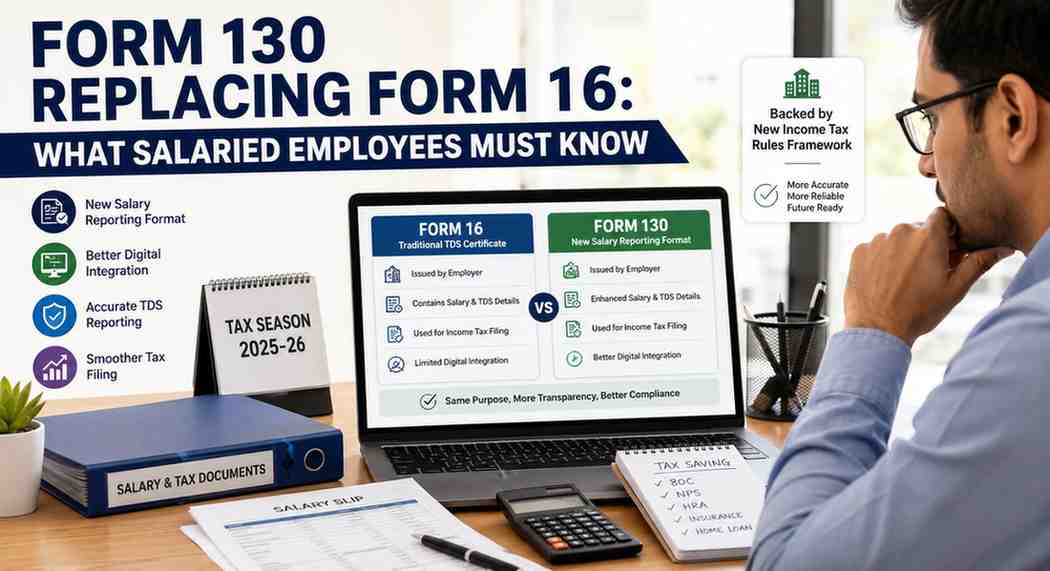
Form 130 is anticipated to be included in the enhanced salary tax reporting structure that India’s updated income tax regime introduces. Form 16 has historically been the main TDS certificate that businesses provide to paid workers. It includes information about salaries, employer-deducted taxes, claimed deductions, and taxable income that is used to file income tax forms. In order to modernize this reporting procedure, Form 130 is being considered as the updated version or replacement structure.
Form 130 is intended to simplify tax reporting relating to salaries rather than to establish a new tax. Employer records, PAN information, AIS data, and income tax returns are all linked in India’s expanding digitized financial environment, and tax authorities are shifting to automated verification systems. By establishing more uniform reporting formats that minimize inconsistencies and streamline compliance, Form 130 may facilitate this shift.
The most important thing for salaried employees to know is that Form 130 still focuses on TDS paperwork and salary reporting. It doesn’t need to be registered separately as a tax document. As part of the larger modernization of India’s tax infrastructure, it is anticipated to serve as a more digitally aligned salary tax certificate. Employees can also track official Income Tax Department updates to understand how salary tax reporting systems may evolve under the revised framework.
Employees who already understand concepts like choosing the correct ITR form based on income sources may find it easier to adapt to these evolving reporting systems.
Why Is Form 16 Being Replaced?
Form 16’s replacement or restructure is a component of India’s larger initiative to enhance digital integration across financial institutions and modernize tax administration. The government has concentrated more in recent years on streamlining tax filing, lowering manual mismatches, and bolstering centralized verification systems. Modernization is crucial because salary reporting is one of the biggest parts of filing income taxes in India.
Inaccurate PAN entries, TDS mismatches, delayed employer reporting, and difficulties with refund processing were common problems with traditional tax systems. Authorities are attempting to develop more synchronized reporting frameworks where wage details directly match centralized databases in response to the growing usage of automated compliance systems. By enhancing interoperability with contemporary digital reporting systems, Form 130 is anticipated to facilitate this change.
The increasing use of pre-filled ITR forms and computerized tax verification is another significant factor contributing to this shift. Data gathered from banks, investment firms, employers, and other financial organizations is becoming more and more important to the government. A more current reporting style could provide a more seamless integration of tax records and wage disclosures. Employees who actively track financial updates such as important changes in the new tax regime are already seeing how rapidly India’s tax systems are evolving toward centralized digital compliance.
Is Form 16 Completely Discontinued?
There is currently no proof that Form 16 for salaried staff would vanish overnight. In India, financial reporting changes are typically implemented gradually to prevent misunderstandings among taxpayers, payroll departments, employers, and tax experts. Employers may continue to use well-known reporting references while adjusting to the new framework throughout the transition period.
In the past, a lot of financial reforms in India have been implemented in stages, allowing both outdated and modern systems to coexist for a while. This makes it easier for accounting teams, HR departments, and payroll software suppliers to progressively adapt to operational changes without interfering with tax filing cycles. Employees should therefore refrain from thinking that Form 16 becomes invalid or useless right away.
Modernization, not disruption, is the primary goal. Several latest transition-related tax updates indicate that salary reporting modernization is expected to happen gradually rather than through sudden disruption. Employers are still required to provide salaried workers with tax documentation pertaining to their salaries, and the actual filing procedure may remain mostly unchanged. The reporting structure and backend integration are the main areas of change.
Employees who regularly monitor compliance-sensitive topics such as avoiding income tax penalties due to filing errors understand that accurate documentation matters more than the document name itself.
Form 130 vs Form 16: Key Differences
| Feature | Form 16 | Form 130 |
|---|---|---|
| Purpose | Salary TDS certificate | Updated salary reporting framework |
| Used By | Salaried employees | Salaried employees |
| Contains TDS Details | Yes | Expected yes |
| Employer Issued | Yes | Expected yes |
| Digital Integration | Limited | Higher expected integration |
| Linked to Modern Tax Systems | Partial | Greater alignment expected |
| Filing Utility | Income tax filing | Income tax filing |
What Information Will Form 130 Include?
- Employer Details: Complete employer identity information, including the company name, TAN number, address, and reporting credentials, must be included on Form 130. This aids tax authorities in confirming that employer filings appropriately reflect salary and TDS data. Inconsistencies that previously resulted in employee verification notices or refund delays can be minimized with standardized employer reporting.
- Employee PAN Information: PAN information for staff sits at the heart of income tax reporting. When these numbers are wrong, TDS links break, refunds stall, or official letters arrive. With Form 130 rolling in, better alignment should emerge – connecting worker PANs directly into national tax networks. Precision during submission may rise as a result.
- Salary Breakup: Form 130 may still contain a detailed salary breakdown that includes basic pay, HRA, allowances, bonuses, and reimbursements. Employees are better equipped to comprehend taxable and non-taxable components when reporting is transparent. Additionally, this enhances verification for loan applications and income evaluations.
- Tax Deducted at Source (TDS): One of the most crucial uses of salary tax certificates is still TDS reporting. Taxes withheld by employers during the fiscal year must be explicitly mentioned on Form 130. The growing speed at which automated tax systems identify discrepancies makes accurate TDS reporting crucial.
- Deductions and Exemptions: Salary reporting structures may continue to represent deductions made by employees under Section 80C, NPS, insurance, or house loans. Despite digitalization, maintaining appropriate proofs is still crucial. Employees investing in options such as tax-saving fixed deposits or National Pension System contributions should continue maintaining supporting documentation carefully.
- Employment Duration: The updated reporting approach may also make employment start and end dates seem more systematically. This enhances income consistency verification and lessens misunderstanding for workers who change employment during the fiscal year.
- Taxable Income Summary: Employees can better understand how their overall tax liability has been determined by viewing a condensed version of their taxable salary income. Taxpayer confusion is decreased and clarity is enhanced by standardized reporting.
Will Form 130 Affect Your Income Tax Liability?
Many workers believe filling out Form 130 leads to higher taxes right away. Actually, the form alone doesn’t raise what you owe. Taxes rely on how your pay is built, what write-offs apply, savings choices, claimed benefits, plus which tax system fits your case.
Form 130 aims to make salary reports clearer, along with smoother digital connections – no new taxes involved. Still, workers might find checks happen faster now that everything ties into one system. Since errors pop up quicker, people need to double-check what they enter on forms.
Later on, office workers will need every paper in order since machines could cross-check data from employers, AIS logs, and tax forms. When someone reports wrong details, a notice might arrive quicker than it used to. People already managing tax-saving investments and financial planning through methods like smart first salary investing strategies are usually better prepared to maintain organized financial records and deduction proofs.
How Form 130 Could Affect Salaried Employees
- Better Digital Verification: Automated verification is becoming more and more important in today’s tax systems. The synchronization of employee tax filings and employer salary data may be enhanced via Form 130. This can strengthen refund accuracy, decrease mismatches, and enhance centralized compliance systems. When processing returns, employees could have a more seamless validation experience. Additionally, automated verification may lessen duplicate deduction claims and fraudulent reporting. Digitally integrated wage reporting may eventually make it easier for salaried people to handle their taxes in general.
- Reduced Manual Errors: Refund and filing issues have typically been caused by incorrect TDS entries, pay mismatches, and improper PAN reporting. Such manual errors could be greatly decreased with a standardized framework. Accuracy can be increased by improved data synchronization between tax authorities and employers. During filing season, employees might spend less time fixing errors. Additionally, automated solutions may lessen reliance on tedious manual verification procedures.
- Faster Tax Processing: It is anticipated that modern reporting frameworks will increase processing efficiency. If wage records accurately match centralized databases, employees may benefit from faster refund processing and return validation. Standardized reporting can assist reduce delays brought on by inconsistent data or incomplete employer filings, as tax authorities depend more and more on technology-driven operations.
- Greater Transparency: Workers frequently find it difficult to comprehend intricate salary breakdown schemes. By making it simpler to confirm taxable income, deductions, and salary components, a more uniform reporting system could increase transparency. Increased visibility may also make it easier for staff members to spot payroll errors early on and comprehend how taxes are computed.
Common Misunderstandings About Form 130
- Form 130 Means Higher Taxes: Many workers mistakenly think that a new tax burden is being imposed by the government. Form 130 actually has a lot to do with modernizing pay reporting. The real tax liability is still determined by tax slabs, deductions, and exemptions. Instead of needless worry, employees should concentrate on accurate paperwork.
- Employees Must Apply Separately: Salaried employees do not appear to require separate Form 130 applications. Just as they presently handle Form 16 issuing, employers are expected to conduct salary tax reporting through payroll systems.
- Old Returns Become Invalid: If previously filed tax returns were correctly filed in accordance with the relevant regulations, they are still valid. Older filings are not rendered invalid by an upgrade to the reporting framework. Workers should refrain from sharing false information via rumors on social media.
- Form 130 Is a New Tax: There is no distinct tax category for Form 130. Within the larger modernization process of the digital tax ecosystem, it is anticipated to serve as an updated salary reporting structure.
How Employees Should Prepare
- Verify Salary Slips Carefully: Workers should routinely review their pay stubs for missing salary components, PAN problems, and inaccurate TDS deductions. Later filing issues are lessened by early discovery. Reliability of loan and immigration documentation is also enhanced by accurate wage verification.
- Maintain Investment Proofs: Investment proofs for insurance, NPS, VPF, tuition fees, and home loan deductions should remain properly organized. Even with digital integration, employees may still need documentary support during verification or scrutiny processes.
- Track AIS and Tax Records: Workers should routinely verify AIS records with tax returns and pay statements. Centralized data matching is becoming more and more important in today’s tax systems. Mismatches can be fixed early to avoid more notifications.
- Avoid Last-Minute Tax Planning: Compliance errors are frequently the result of hurried investment declarations. Workers who plan their taxes throughout the course of the year typically make better financial decisions and uphold a higher level of paperwork discipline.
Will Employees Need To Apply for Form 130?
Most workers won’t need to request Form 130 on their own, since pay tracking usually flows through company payroll setups. Much like with Form 16, firms will probably issue the necessary income tax records without being asked. Instead of staff handling it themselves, tech updates mostly depend on those managing payroll tools, human resources units, and financial offices.
One paycheck at a time, office workers should expect familiar tax papers arriving like usual when forms are due. Changes might slip in – new words here, layout tweaks there, maybe how files open on screens. No need to rush signing up or filling extra sheets by hand just because of that shift.
Keeping financial records right matters most for workers, while matching pay info to tax reports comes close behind. As machines get better at handling data, getting reports correct turns even more crucial.
Does Form 130 Change the Tax Regime?
Your decision between the old and new tax regimes is not automatically altered by the introduction of Form 130. Your financial planning preferences, deductions, exemptions, and income structure all influence the tax system you choose. Based on their unique situation, employees can continue to assess whether regime offers greater tax efficiency.
Rather than slab adjustments, the reporting document mainly deals with salary and TDS reporting. Employees should therefore avoid confusing document modernization with modifications to tax computation regulations. Depending on the relevant tax legislation, employer declarations and investments tied to deductions may continue to operate in a similar manner. Professionals actively reviewing options like how tax changes affect investment planning understand that tax reporting and tax liability are related but separate aspects of compliance.
Why Accurate Salary Reporting Matters More Now
The tax system in India is becoming more and more reliant on technology, and accurate wage reporting is now much more crucial than it was in the past. Centralized databases, AI-assisted verification, automated scrutiny procedures, and cross-platform data synchronization are all major components of contemporary tax systems. Mismatches can be caused by even small discrepancies between employee files and employer records.
Employees can prevent compliance issues, scrutiny notices, and refund delays by providing accurate reporting. Employer data is increasingly directly connected to AIS and pre-filled return systems, making it simpler for authorities to immediately identify false declarations. In subsequent tax cycles, employees who claim deductions without the necessary paperwork may be at greater risk of verification.
Beyond paying taxes, well-organized salary records are also beneficial. Accurate income paperwork is often necessary for loan approvals, visa applications, credit evaluations, and financial background checks. Workers who keep orderly financial records typically have fewer long-term issues.
Could Form 130 Reduce Tax Filing Errors?
Reducing tax filing errors brought on by mismatched information is one of the main goals of updated salary reporting systems. Due to inadequate wage declarations, erroneous PAN inputs, manual TDS inconsistencies, and delayed employer reporting, traditional filing systems occasionally caused issues. Such operational problems might be reduced with a more integrated reporting system.
Employees may benefit from easier return submission and quicker verification if employer payroll systems synchronize more effectively with centralized tax databases. During tax season, automated validation might help cut down on tedious manual mistakes. Even with digital modernity, employees still need to carefully check their own filings because inaccurate assertions can still cause issues.
Better technology does not mean that personal accountability is no longer necessary. Before submitting returns, employees should keep reviewing their investment declarations, deductions, and salary breakdown.
How This Change Fits Into India’s Digital Finance Evolution
Form 130 is a reflection of a broader shift taking place in India’s financial sector. Interconnected digital infrastructure is becoming more and more prevalent in banking, taxation, EPFO services, investment reporting, and digital payments. Centralized verification, real-time reporting, and technology-driven compliance solutions are being prioritized by government authorities.
Financial administration is changing quickly, as evidenced by the rise of AIS reporting, pre-filled ITR forms, automated TDS reconciliation, and digital identity integration. Modernizing salary tax reporting makes sense within this larger shift. Workers who currently use digital platforms for investment tracking, online tax filing, and EPF administration may find it easier to adjust to these changes.
Reducing fraud, increasing transparency, and streamlining large-scale tax administration are further goals of financial modernization. Employers and employees may eventually have more seamless experiences thanks to standardized reporting methods.
Important Documents Employees Should Keep Safe
- Salary Slips: Salary slips are still essential for confirming tax computations, deductions, and monthly revenue. They also assist with financial verification and loan approval procedures. Both digital and physical copies should be safely stored by staff members.
- Form 16/Form 130: When filing income taxes, salary tax certificates continue to be one of the most crucial documents. For future reference and verification requirements, employees should carefully save their annual salary tax records.
- Investment Proofs: Insurance premium, ELSS, NPS, VPF, tuition, and home loan documents should all be kept in order. Issues with deduction verification may arise from missing proofs.
- Bank Statements: Bank statements are useful for verifying tax payments, investments, and salary credits. They are often needed for loan applications or financial examinations.
- Rent Receipts: Rent receipts should be appropriately preserved by employees who are claiming HRA exemptions. Compliance concerns may arise from inaccurate or unsubstantiated HRA claims.
- Loan Certificates: Interest certificates and repayment records are essential for home loan deduction claims. Employees should regularly collect updated certificates from lenders.
- Insurance Receipts: Receipts for insurance premiums support the validity of deduction claims under relevant laws. Keeping documents well-organized lessens the burden of future documentation.
Will Small Salaried Employees Be Affected?
Because salary reporting impacts more than just taxes, even employees with very small wages should be aware of the significance of these changes. Refunds, financial verification, banking credibility, and future compliance history are all impacted by accurate records. Automated systems increasingly assess data consistency rather than income size alone, yet small salaried employees occasionally disregard documentation because they believe their income level is not substantial enough for examination.
Organized filing records may still be beneficial to employees who make less than the taxable limit. Applications for loans, immigration permissions, and future financial verification are frequently supported by an accurate ITR history. Early maintenance of spotless tax records strengthens one’s long-term financial trustworthiness.
What Employers May Need To Do
In order to comply with updated frameworks for wage reporting, payroll departments and employers may need to upgrade internal systems. As the shift moves forward, employee communication systems, automated TDS synchronization, payroll software integration, and reporting workflows may all gradually change.
Because their systems already digitally interface with tax reporting platforms, large firms with sophisticated payroll infrastructure may be able to adjust more quickly. Over time, smaller employers might need to upgrade their software and make operational changes. Employee education on revised reporting forms and documentation standards will probably be a major responsibility of HR departments.
Will Form 130 Affect Loans or Credit Scores?
While proper wage reporting has an indirect impact on financial trustworthiness, Form 130 does not directly affect credit scores. Salary records play a major role in the approval of credit cards, house loans, and personal loans by banks and lenders. Reliability of financial verification is increased by transparent and consistent salary data.
When applying for loans, employees who keep their wage records tidy frequently encounter less difficulties. Lenders’ perceptions of overall financial reliability can be strengthened by consistent income, accurate TDS, and disciplined tax filing. Employees planning borrowing opportunities may benefit from understanding how credit scores influence financial approvals and how lenders verify salary and financial records during approval evaluations.
Should Workers Be Concerned About This Change?
Because most salaried workers are still familiar with the fundamentals of salary taxation, they don’t need to worry about Form 130. Income tax filing procedures may continue to operate similarly from the employee’s point of view, and employers are still required to provide salary-related tax documentation.
Rather than significant tax restructuring, modernization and improved digital integration are the main changes. Workers who keep well-organized pay records, save proof of deductions, thoroughly review forms, and routinely check tax information are unlikely to encounter significant problems.
Salaried people should concentrate on enhancing financial discipline and documentation procedures rather than fretting about language changes. Transparency, correctness, and consistency in compliance are typically rewarded by modernized systems.
Conclusion
Replacing Form 16, Form 130 shows how India is shifting toward digital tax systems that connect better. Accuracy in salary details could rise since mismatches might drop when machines check things faster. Still keeping track of income matters most – workers must log earnings right, double-check cuts like HRA or investments. Though the form adds no fresh taxes, proving every claim now weighs heavier on paper trails. Those tracking their numbers closely? They will likely move through changes without big hiccups.
FAQs
Q1: Is Form 130 the official replacement for Form 16?
Although changes are often made gradually, Form 130 is anticipated to be included in the updated salary tax reporting structure. Before complete implementation stabilizes, employers may keep modifying their systems over time.
Q2: Will salaried employees pay more tax because of Form 130?
No, the tax burden is not increased by Form 130 alone. Salary, deductions, exemptions, and the tax regime you select continue to affect your taxes.
Q3: Do employees need to register separately for Form 130?
Salaried employees are not required to register separately. Payroll systems will probably continue to be used by employers to handle salary tax reporting.
Q4: Can Form 130 improve tax refund processing?
There could be fewer discrepancies between employee returns and employer files with a more integrated digital reporting system. This may increase the effectiveness of refund processing.
Q5: Will Form 130 affect home loan or personal loan approvals?
In a roundabout way, sure, since precise pay records improve loan application financial verification. Credibility of pay documents is crucial to lenders.
Q6: Do employees still need to retain documentation of investments and pay stubs?
Of course. Employees should take care to retain tax-related documentation, insurance receipts, deduction proofs, and pay stubs even while using digital systems.
Q7: Does the new tax system have anything to do with Form 130?
No, salary reporting documents and tax regime selection are separate matters. Employees can still choose between old and new tax regimes based on eligibility.
Disclaimer
This article should not be interpreted as professional or legal tax advice; rather, it is meant solely for educational and informational reasons. Future government notifications or regulatory modifications may result in changes to tax laws, reporting requirements, and compliance procedures. Before making financial decisions, employees should check the most recent information via official government portals or speak with experienced tax experts. Although every attempt has been taken to ensure authenticity, readers are encouraged to independently verify official instructions. Decisions made purely on the basis of this content are not PennyBlueprint’s responsibility.