
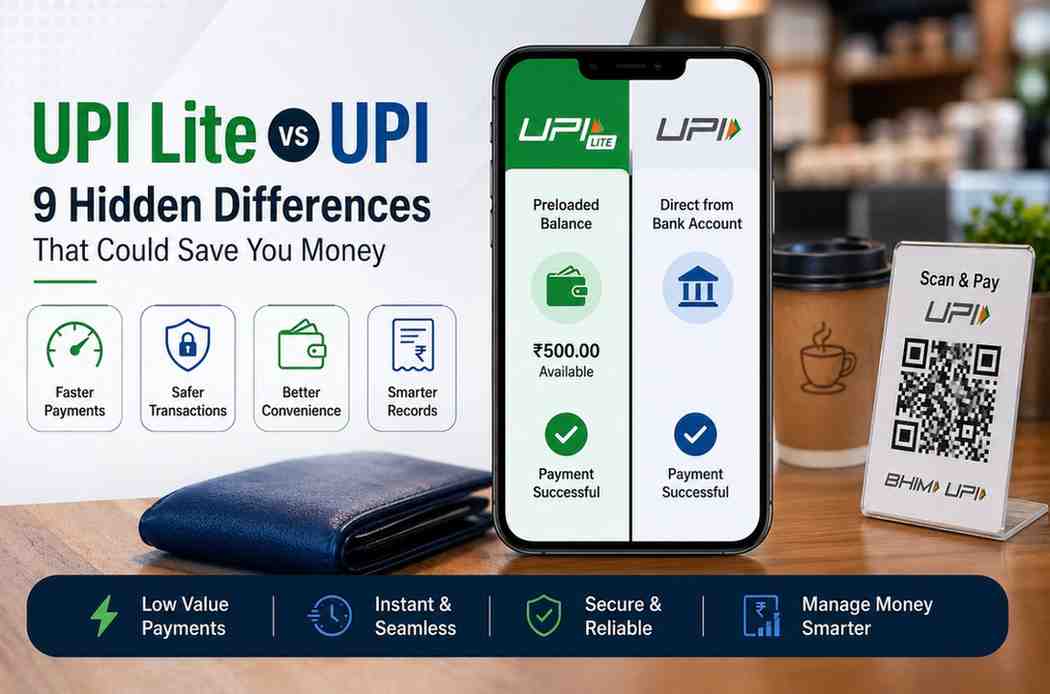
Discover 9 hidden UPI Lite vs UPI differences that could save you money, improve payment speed, reduce transaction failures, and help you choose the right digital payment method in India. UPI Lite vs UPI, UPI Lite benefits, UPI Lite explained, UPI Lite vs regular UPI, UPI Lite features, UPI payment comparison, digital payments India, UPI Lite safety, UPI Lite limits, UPI transaction speed, NPCI UPI Lite, UPI payment system, regular UPI vs UPI Lite, digital banking India, UPI Lite advantages.
Introduction
These days, digital cash moves are normal across India. Whether grabbing food, covering electricity costs, settling web orders, or dividing dinner tabs, UPI speeds up how fast money shifts hands. Enter UPI Lite – now there’s a lighter way to handle small spends with less friction. Yet confusion lingers. Some folks still mix up standard UPI with its leaner cousin, UPI Lite.
Starting off, the two might look alike since they work in the same payment world. Still, under the surface, their operations aren’t the same – they serve separate goals. Knowing what sets them apart lets people handle payments better, skip typical hiccups, and choose wisely with money.
Most people miss the small gaps between UPI Lite and standard UPI. Yet timing shapes everything – how fast it goes, whether it stalls, even how smooth each tap feels. Think twice before tapping next. Speed hides in design choices few notice. One works quiet behind the scenes, while the other steps up only when needed. Moments define which fits best.
UPI Lite vs UPI: Which One Should You Really Use?
Picking one over the other? It really comes down to what kinds of things you pay for every day. For quick buys – like snacks, bus rides, or topping up your metro card – UPI Lite moves quicker without needing constant internet checks. When it’s bigger stuff though, say rent, phone bills, or buying clothes online, standard UPI handles those better. Each has its own space; neither cancels out the other. Together they fit into different parts of how people manage money digitally across India. Starting fast, UPI Lite moves small payments ahead without delay. Meanwhile, standard UPI opens full bank features with wider reach. Some find power in using one right after the other. Balance shows up when speed meets control through both together.
What Is UPI Lite?
UPI Lite is a streamlined payment tool developed by NPCI to make small-value transactions faster and easier. Instead of directly accessing your bank account for each payment, UPI Lite allows you to load a set amount of money into a separate balance and utilize it for qualifying transactions. Consider it a lightweight payment layer that sits between your bank account and your daily purchasing habits. Once money is added to the UPI Lite balance, modest payments can be made without requiring full bank-side processing for each transaction. This decreases system burden and increases transaction speed.
UPI Lite is especially handy for consumers who frequently make little transactions like tea, snacks, groceries, parking fees, and local transportation payments. UPI Lite intends to reduce reliance on real-time banking communication, making ordinary transactions faster and more trustworthy. As digital payment volumes increase in India, UPI Lite contributes to the overall efficiency of the payment ecosystem while providing users with a more seamless experience. Users interested in the official operating framework can review the latest guidelines published by the National Payments Corporation of India (NPCI) UPI Lite framework.
What Is Regular UPI?
Most people across India rely on regular UPI for everyday money moves. Your bank connects straight into apps built for UPI, making it smooth to send cash fast – whether splitting bills, paying shops, or wiring funds to companies. Most times, when sending money through standard UPI, the system checks your bank right away – confirming balance, validating details, moving cash. Each move shows up instantly on your banking timeline. Paying through regular UPI works whether it is ten rupees or thousands. From groceries to monthly bills, even tuition or policy dues go through smoothly. Each time money moves, the bank logs it instantly. That means clear history without guesswork. Full view of where funds go shows up right away.
Most folks stick with regular UPI since it works nearly everywhere, links straight to their bank, yet fits easily into daily routines. Despite newer options popping up now and then, this system still holds steady thanks to how smoothly it runs alongside everyday banking needs. The broader digital payment ecosystem operates under regulations and consumer protection measures overseen by the Reserve Bank of India (RBI).
UPI Lite vs UPI: Quick Comparison Table
| Feature | UPI Lite | Regular UPI |
|---|---|---|
| Source of Funds | Preloaded Balance | Bank Account |
| Processing Method | Wallet-Like Balance | Direct Bank Debit |
| Payment Speed | Faster for Small Transactions | Standard |
| Bank Dependency | Lower | Higher |
| Transaction Records | Limited | Comprehensive |
| PIN Requirement | Reduced for Eligible Transactions | Usually Required |
| Best Use Case | Small Daily Payments | All Transaction Types |
| Bank Statement Entries | Fewer | Every Transaction |
| Convenience | High | Moderate |
| Large Transactions | Limited | Ideal |
UPI Lite vs UPI: 9 Hidden Differences That Could Save You Money
1. Transaction Processing Works Completely Differently
The most significant distinction between UPI Lite and conventional UPI is how transactions are executed. Every time you make a payment using regular UPI, your bank account is notified. The banking system validates available funds, authenticates the request, and finally completes the transaction. UPI Lite takes a different approach. Money is initially deposited into a dedicated Lite balance, and qualified transactions are carried out directly from that amount. Because the payment does not require comprehensive bank-side verification every time, the process is simplified and faster.
This distinction may appear technical, but it has practical ramifications. Users who make several modest payments throughout the day frequently report smoother transaction experiences with UPI Lite. The lessened reliance on financial infrastructure also contributes to lower system congestion during peak transaction periods. For someone who makes ten or twenty modest payments per day, this subtle improvement can greatly increase convenience and save time.
2. UPI Lite Can Be Faster for Everyday Purchases
When waiting in line, handing cash to someone on the street, or buying something fast – speed matters. Built for moments like these, UPI Lite strips down payments to just what’s needed. Every tap takes less time because clutter gets removed before it begins. Because funds sit ready in Lite mode, payments finish quicker. Even though standard UPI moves swiftly, each transfer waits on instant confirmation from your bank.
When lots of people send money at once – like during holidays, paydays, or big shopping events – the usual UPI system can sometimes slow down. Because it handles minor transfers off the main network, UPI Lite keeps things moving faster under pressure. Over days, those buying tea or riding buses start seeing how quick payments help. When things move fast, handling cash feels smoother, less annoying. Little delays add up. Speed changes how it all feels, without shouting about it.
3. Your Bank Statement Will Look Very Different
One moment you’re fine, next you’re hunting through pages for one payment. Regular UPI dumps each transfer separately into your bank history. A full picture shows up, yet tiny rows pile up fast down the list. Clarity hides inside clutter when too many little lines stack up. Most tiny payments vanish from your bank record when using UPI Lite. Rather than listing each micro transaction, only top-up actions show up clearly on the statement. What sticks out are deposits into the wallet, not the frequent drops in value afterward.
Clearer records help keep track of money without hassle. When people check expenses now and then, they tend to like it better if small payments aren’t piled up on reports. When tracking spending, investments, or savings closely, spotting that gap matters more. Similar to how understanding hidden bank charges in India helps improve financial awareness, managing transaction records effectively can simplify money management.
4. Payment Failure Risk Can Be Lower During Peak Hours
Failure to complete transactions is one of the most frustrating aspects of digital payments. Many consumers have reported circumstances in which money is deducted yet payment confirmation is delayed or the transaction is pending. Regular UPI is primarily reliant on real-time communication among banks, payment apps, and NPCI infrastructure. Transaction problems may occur if any segment of the chain is congested or has technical issues.
UPI Lite minimizes this reliance on qualified transactions because funds are already available in the Lite balance. Fewer systems are engaged in payment processing, which can increase dependability at peak times. This does not imply that UPI Lite totally eliminates transaction failures, but it does lessen some sorts of delays. Users who have faced situations where a UPI transaction failed but money was debited often appreciate having an alternative payment method available.
5. Authentication Experience Is More Convenient
One notable distinction between UPI Lite and conventional UPI is the payment authorization process. Regular UPI normally requires users to provide a UPI PIN for transactions, which increases security but adds an extra step to each payment. UPI Lite is intended to simplify low-value payments. Eligible purchases can typically be performed with fewer authentication requirements, resulting in a more seamless checkout experience.
For users who make frequent daily purchases, frequently entering a PIN can be inconvenient. UPI Lite lowers friction and simplifies everyday spending. The ease feature is especially useful when completing many small transactions throughout the day. While security is still vital, removing superfluous procedures can greatly improve the user experience. This mix of ease and security is one of the reasons why many users have both payment methods active.
6. Security Exposure Is Different
Some think UPI Lite is more dangerous. Others believe it’s safer. Truth? Both keep data protected. How they handle threats isn’t the same though. Standard UPI pulls funds straight from your main bank link. Each payment taps into full account value. A scam here might drain bigger sums. Security exists – but consequences shift based on structure. Most times, UPI Lite runs on money you add ahead of time. Should something go wrong, what’s at risk stays small – only what’s sitting in that account. Think of it like carrying just enough cash for lunch. Trouble can’t spread far when there isn’t much to lose. It quietly helps keep daily buys under control without drama.
Yet comfort can be misleading when using these tools. Using authorized payment platforms and services supported by the BHIM UPI platform can help reduce security risks associated with digital transactions. Fraudsters continue to develop new scams targeting digital payment users. Staying informed about the latest UPI scams in India can help protect both your UPI Lite balance and your primary bank account from cybercriminals. For daily spending, many customers prefer to store a little amount in UPI Lite while keeping bigger balances secure in their bank account.
7. UPI Lite Performs Better During Temporary Bank Downtime
Every bank occasionally performs maintenance activities, improves its systems, or endures periods of abnormally high transaction activity. In such cases, typical UPI transactions may be delayed since they require real-time connection with banking systems. UPI Lite alleviates this dependence. Because the balance is already loaded, qualifying transactions can frequently proceed without requiring full bank-side procedures for each payment. This makes UPI Lite an effective backup alternative when banking systems are momentarily unavailable.
Imagine arriving at a gas station or grocery shop and learning that your bank is experiencing technical difficulties. A funded UPI Lite balance can allow you make minor purchases without interruptions. While it should not completely replace traditional UPI, it can provide essential payment continuity. This hidden benefit is especially handy during festivals, shopping seasons, and peak transaction periods, when digital payment methods are in high demand.
8. The Best Use Cases Are Surprisingly Different
Many users activate UPI Lite without knowing when it should be utilized. As a result, they either disregard it or try to utilize it in circumstances where normal UPI is more appropriate. UPI Lite is designed for frequent, low-value transactions. Buying tea, paying parking fees, buying groceries, taking local transportation, or making minor commercial purchases are all good instances. These transactions benefit from faster processing times and increased convenience.
Regular UPI is still the favoured method for large transfers, utility bill payments, insurance premiums, rent, education expenses, and online shopping. It offers immediate bank account access and full transaction records, which many users require. Understanding the intended use case for each option enables customers to maximize convenience while maintaining financial control. Rather than competing, UPI Lite and traditional UPI complement each other.
9. Transaction Records Can Influence Your Choice
The final hidden distinction concerns financial record keeping. For some users, transaction history is incredibly valuable. Detailed transaction records are frequently used by business owners, freelancers, and people who keep meticulous records of their expenses. Every payment made via regular UPI is automatically recorded and routed through the banking system. This simplifies spending tracking, budgeting, reimbursement claims, and tax documentation.
UPI Lite uses a more concise technique. Because minor transactions are performed using the Lite balance, the level of detail displayed in bank statements may differ from standard UPI. This helps make statements clearer, but it may not be suitable for those who want detailed records for each purchase. Your favourite option is determined by your money management style. If convenience is a priority, UPI Lite provides substantial benefits. If comprehensive transaction visibility is more important, normal UPI remains the better solution.
When Should You Use UPI Lite?
UPI Lite is suited for people who conduct many low-value transactions throughout the day. If you frequently buy tea, snacks, groceries, parking tickets, or utilize public transportation, UPI Lite can make payments faster and more convenient. It is also appropriate for users who dread typing their UPI PIN multiple times for little purchases. The streamlined payment experience lowers friction and saves time on routine purchases.
People who prefer cleaner bank statements may also like the lower quantity of microtransactions in their account history. Additionally, UPI Lite can be a handy backup alternative amid short financial interruptions. If you value convenience, speed, and simplicity, UPI Lite is a valuable addition to your digital payment toolbox.
When Should You Use Regular UPI?
Regular UPI remains the recommended method for larger transactions and scenarios that necessitate detailed financial records. It is ideally suited for energy bills, rent payments, insurance premiums, school fees, internet shopping, and money transfers. Users who regularly check their costs frequently prefer conventional UPI because each payment is logged directly through the banking system. This facilitates budgeting and financial planning.
Regular UPI also eliminates the requirement to load funds into a separate balance. If you make fewer minor transactions and prefer direct access to your bank account, standard UPI may suffice in most cases. Many users prefer to integrate both systems rather than rely just on one.
Common Mistakes Users Make
- Keeping too much money in UPILite: Some customers deposit huge sums into UPI Lite and then keep the balance unused for a lengthy period. Because UPI Lite is primarily meant for tiny daily transactions, loading only the amount you intend to spend is usually a better strategy.
- Ignoring Fraud Awareness: Many people prioritize convenience but disregard security. Understanding common digital payment frauds in India can help users identify warning signs and avoid costly mistakes before they occur.
- Using Only One Payment Method: Some users rely solely on UPI Lite or standard UPI. Using both strategically typically results in a more favorable balance of ease, flexibility, and transaction management.
- Not reviewing app settings: Payment apps often change transaction limits, security features, and notification settings. Spending a few minutes going over these alternatives can improve convenience and security.
- Overlooking Platform Policies: Users must comprehend transaction restrictions, payment terms, and potential fees. Awareness of hidden charges in UPI apps can help avoid surprises and improve financial decision-making.
Advantages of Using Both Together
Using UPI Lite and traditional UPI combined frequently results in the greatest overall experience because each option serves a distinct purpose.
- Use UPI Lite to make short daily purchases including groceries, tea, snacks, transit, and parking.
- Use conventional UPI for larger payments, utility bills, online shopping, and money transfers.
- Keep your bank statements clearer by segregating microtransactions from large financial activity.
- Increase payment reliability during periods of heavy banking traffic.
- Keep only a small amount of money in your UPI Lite balance to reduce your exposure.
- Keep detailed transaction records for essential payments made via regular UPI.
- Enjoy more freedom without disrupting your current paying habits.
For most users, integrating the two systems results in a more efficient digital payment method than using each one alone.
Conclusion
Picking one over the other? That misses the point. These tools tackle separate needs across India’s digital money landscape. One moves fast, built light for routine buys you barely notice. The full version keeps tabs neatly, handles bigger sums without breaking stride. Nine quiet contrasts lie underneath. Spotting them cuts confusion at checkout. Most folks do fine when they mix both – lean on what each does well. Balance matters more than loyalty.
FAQs
Q1: Is UPI Lite better than regular UPI?
Neither alternative is universally preferable. UPI Lite is best suited for minor daily transactions, although conventional UPI remains the best option for bigger payments and complete transaction records.
Q2: Does UPI Lite require a bank account?
Yes. Before loading money into the UPI Lite balance and initiating transactions, users must first link their bank accounts.
Q3: Is UPI Lite safe?
Yes, UPI Lite is generally safe when used with authorized payment apps. However, users should be wary of fraudulent attempts and strange money demands.
Q4: Can I use UPI Lite alongside normal UPI?
Yes. Many customers benefit from using UPI Lite for small purchases and conventional UPI for larger transactions.
Q5: Why are UPI Lite payments usually faster?
Because the money is already in the Lite balance, qualified transactions require fewer verification processes, resulting in increased speed and convenience.
Q6: Will all UPI Lite payments display on my bank statement?
Not necessarily. Individual small transactions may not display in the same way as ordinary UPI transactions because they are funded from a preloaded balance.
Q7: Can UPI Lite reduce payment failures?
While no payment system can totally prevent errors, UPI Lite decreases reliance on real-time financial communication, potentially increasing dependability for qualifying transactions.
Q8: Who should use UPI Lite the most?
People that make regular low-value purchases, such as groceries, snacks, transit, and parking, stand to benefit the most with UPI Lite.
Disclaimer
This page is designed solely for educational and informational purposes. UPI Lite features, transaction limitations, and eligibility conditions may vary in accordance with NPCI standards and bank policies. Before making any financial decisions, readers should check with their bank or payment service provider to ensure they have the most recent information. PennyBlueprint does not offer legal, financial, or investing advice. Always do your own investigation before acting on any information.